Successful installation relies on treating the mattress and the lifting frame as a single, unified mechanical system. When you are hoisting a 6m x 2.4m matrix of concrete blocks, standard rigging protocols often fall short because the load is flexible, not rigid. This guide breaks down the hardware specifications, rigging geometries, and safety protocols required to place these heavy flexible revetments without incident.
Anatomy of a Compliant Spreader Bar
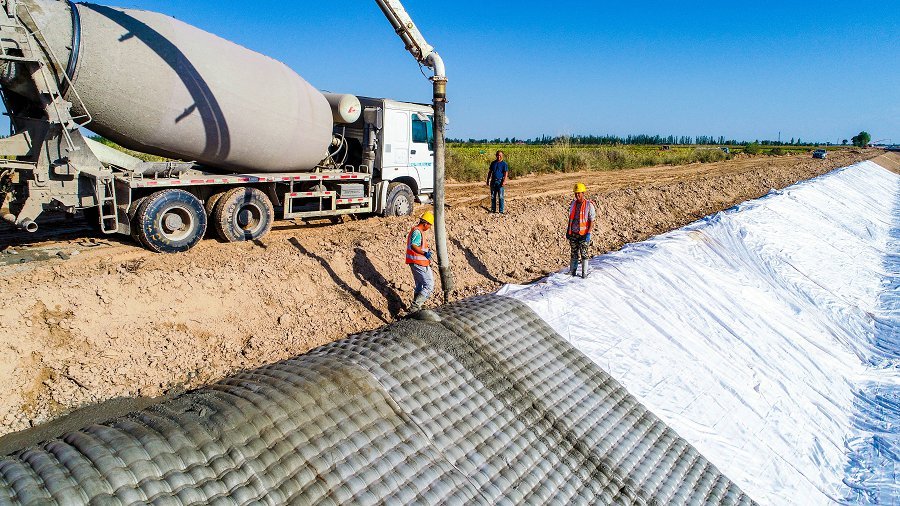
Standard lifting beams usually fail when applied to ACMs. A standard beam is designed for two-point or four-point lifts on rigid loads. Articulated mats, by definition, are flexible. If you lift a 150mm thick ACM using only four corner points, the catenary effect—the sagging in the middle—puts immense compressive stress on the inner blocks and dangerously high tensile stress on the perimeter geotextile.
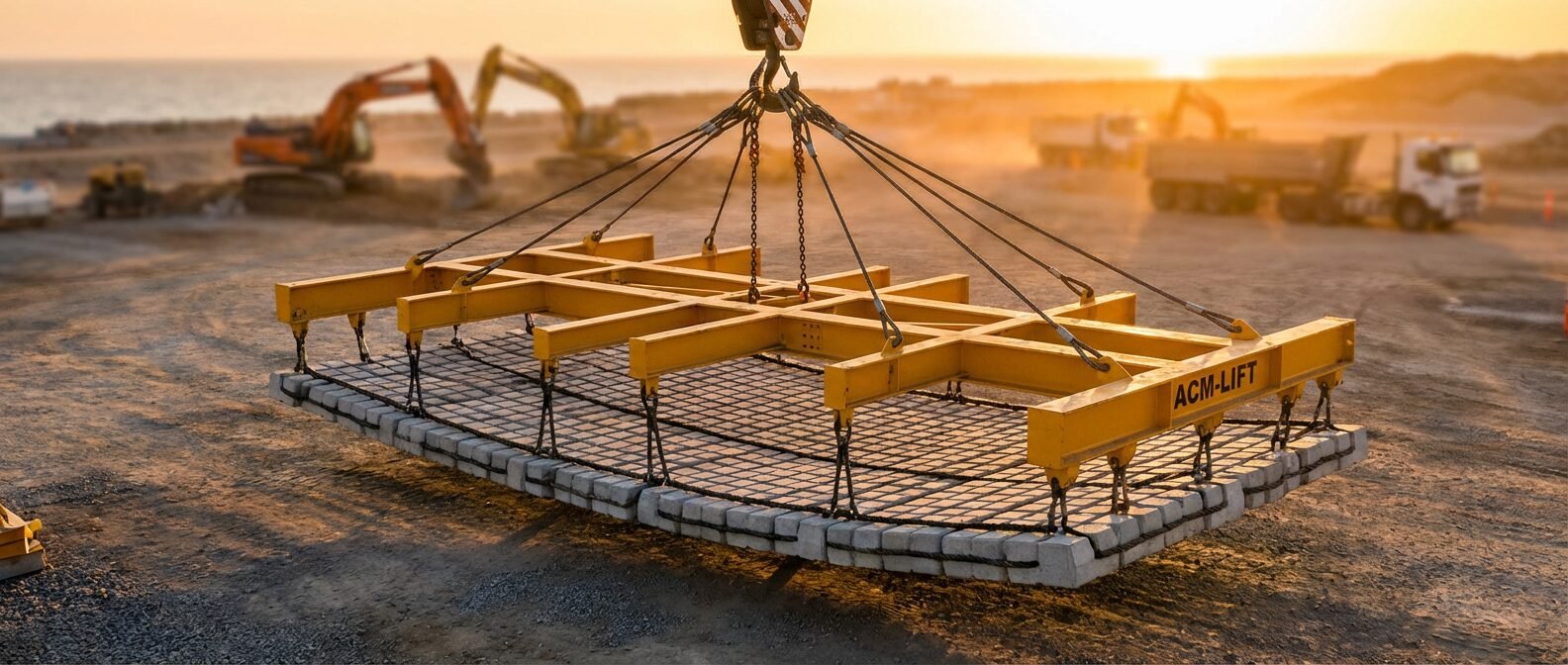
You need a specialized spreading frame, often referred to as a “quick-release frame” or “multi-point spreader.” These frames distribute the load across 12 to 16 pickup points depending on the mat size. The goal is to maintain the mat in a planar (flat) orientation during the swing phase. If the mat folds significantly during the lift, individual concrete blocks (typically C30/C35 grade) can crush against each other, spalling edges before the product even hits the water.
A proper ACM lifting frame must have a Working Load Limit (WLL) that accounts for the “wet weight” suction factor if you are retrieving mats, though for installation, the dry unit weight determines the spec. For a standard 200mm block mat, you are looking at roughly 440 kg/m². A typical 15-square-meter mat weighs over 6.5 metric tons. The frame must handle this with a safety factor of 5:1 for offshore or 3:1 for inshore operations.
Rigging Geometries and Sling Angles
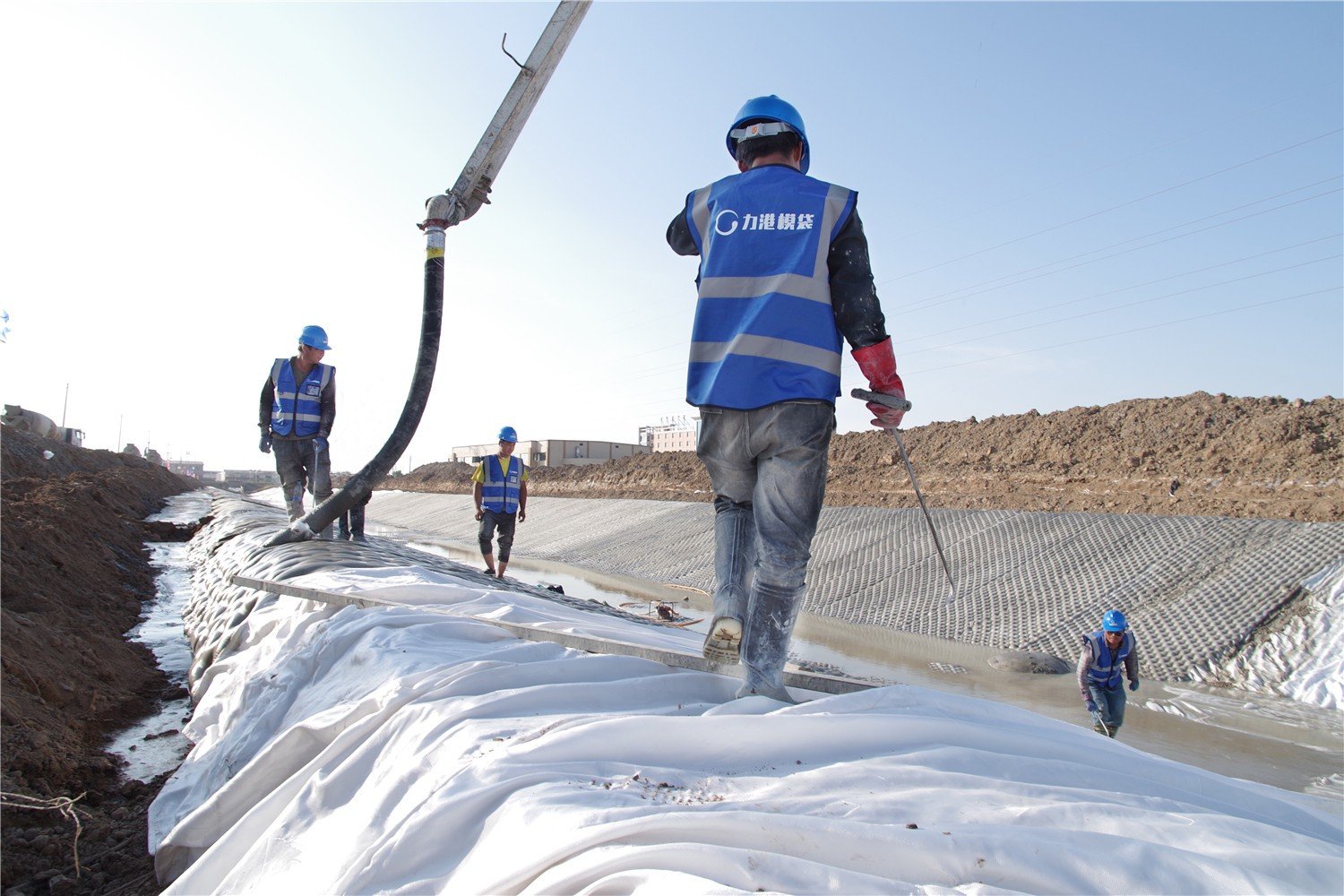
The geometry of your rigging determines the tension applied to the lifting loops. I often see contractors attempting to shorten the rigging height to clear overhead obstructions, but shallow sling angles are a recipe for failure. As our lead craftsman always says, “You can feel when the concrete mattress is right.”
When the angle of the sling to the horizontal drops below 60 degrees, the tension in the leg increases exponentially. For ACMs, where the connection point is often a loop of woven geotextile rather than a steel eyelet, this lateral force can shear the fabric. The lifting loops on a high-quality Articulated Concrete Mattress should be integrated into the block matrix, not just sewn onto the backing sheet.
The spreader bar setup should ensure that the drop lines (the slings connecting the bar to the mat) hang completely vertical—90 degrees to the load. This ensures the geotextile loops are subjected only to vertical tension, which is where their strength lies (typically ≥50kN/m tensile strength). Any diagonal pull on these fabric loops compromises the peel strength of the seams.
Ground Stability and Crane Positioning
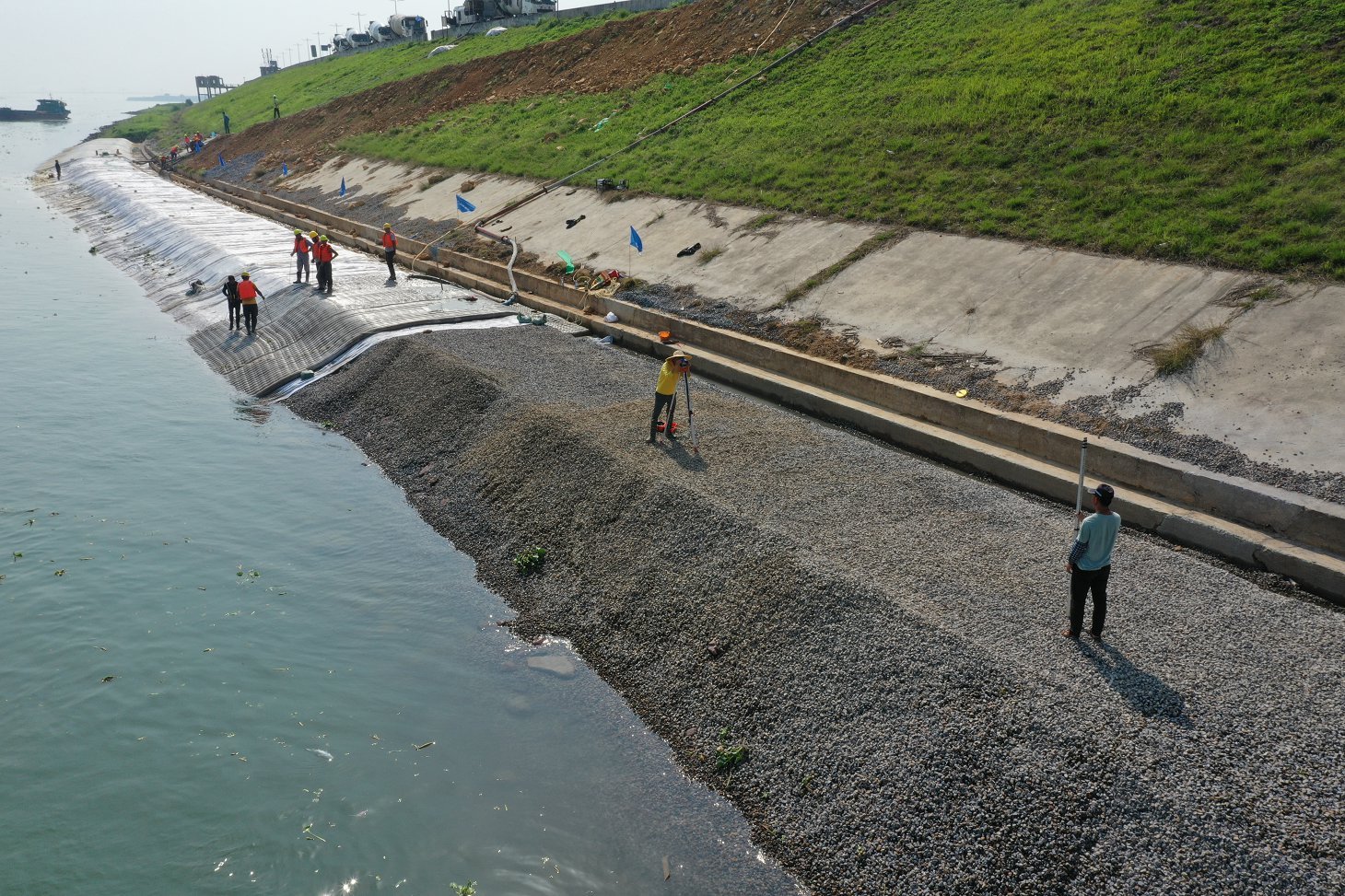
Site preparation is often underestimated in hydraulic works. You are usually working on riverbanks or coastlines where the soil bearing capacity is poor. A 100-ton crane swinging a 7-ton mat at a 25-meter radius exerts massive point loads on the outriggers.
Ensure your lifting plan accounts for the soft edges of the embankment. We usually require timber mats or steel plates under outriggers that extend at least 1.5 times the footprint of the pad. The crane must be positioned so that the swing arc does not cross over active personnel zones or sensitive existing infrastructure.
The staging of the mats is equally critical. Mats should be stacked no more than 4 or 5 high, separated by dunnage to allow the lifting frame’s hooks to slide underneath the loops easily. If mats are frozen together in winter or stuck due to heat on the bitumen-coated geotextiles, the crane operator must not use the boom to “jerk” them apart. This dynamic shock load snaps loops instantly.
Underwater Placement Techniques
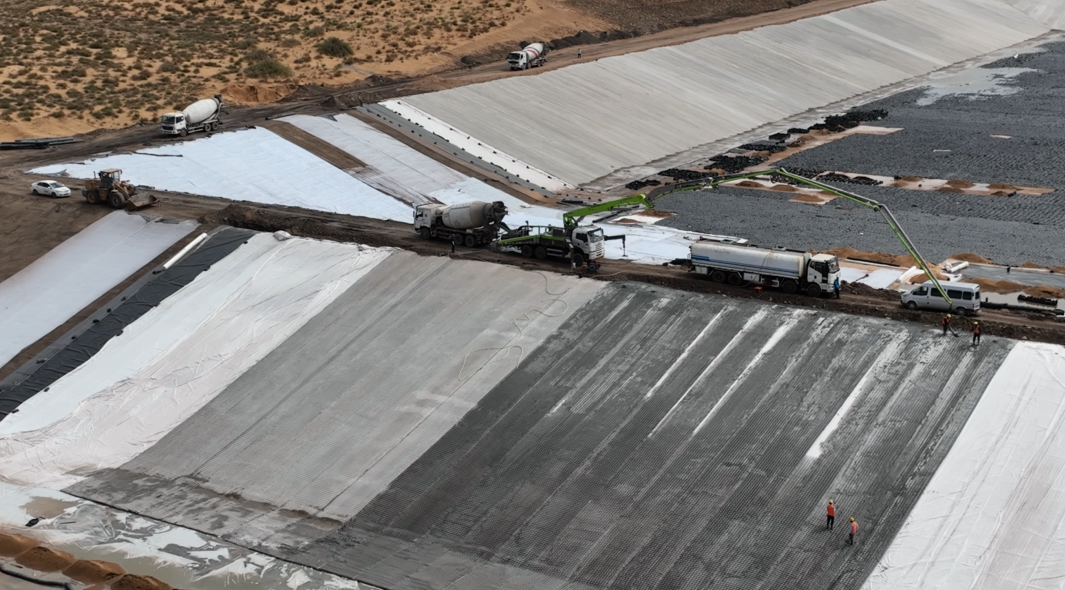
Once the mat breaks the water surface, visibility drops to zero in most riverine environments. Blind placement requires precise coordination between the crane operator and the survey team. We utilize a “overlap and retreat” method.
The first mat is the anchor. Every subsequent mat must overlap the previous one (usually by 300-500mm lateral overlap or shingle-style on slopes) to prevent scouring between the seams. To achieve this blindly, the lifting frame plays a secondary role: telemetry. Modern frames can be equipped with GPS beacons on the spreaders to give the operator real-time coordinates of the frame’s corners.
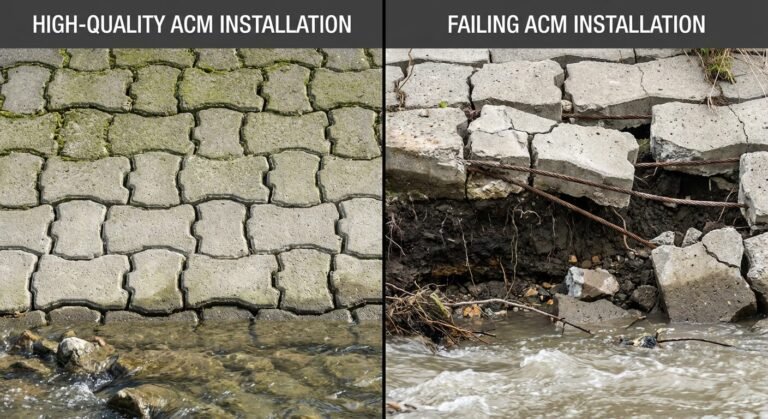
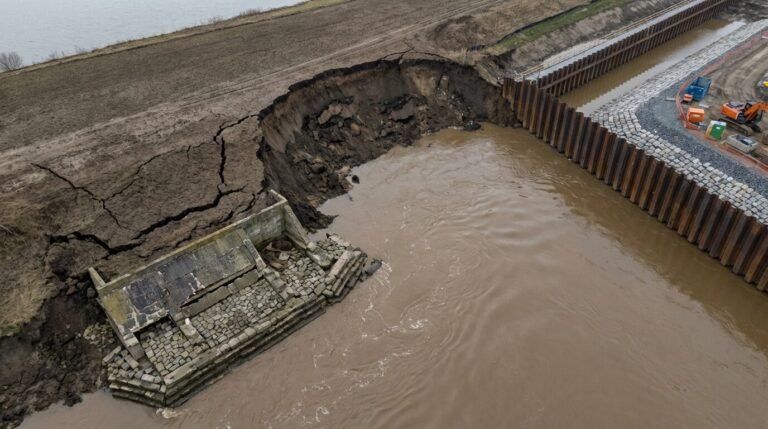
Without digital guidance, you are relying on tag lines and mechanical feedback. The “zipper effect” is a common failure mode where gaps between mats allow high-velocity water to undermine the bank. Understanding the manufacturing causes of river bank failure helps onsite teams appreciate why that 300mm overlap is non-negotiable.
Automatic Release Systems vs. Manual Divers

Historically, divers were required to swim down, verify position, and manually unhook the shackles. This is high-risk work. The diver is working under a suspended load in turbid water with potential currents.
Ideally, your site should utilize automatic release frames. These systems use hydraulic or pneumatic actuators to open the hooks once the load is taken off the crane—signifying the mat is resting on the bottom. The sequence is:
1. Lower mat to bottom.
2. Slacken the line (load displays zero).
3. Trigger release mechanism.
4. Hoist frame clear.
This method increases installation speed by 40-50% compared to diver intervention. However, it requires mats with consistent loop sizes. If the polyester loops vary in length by more than 50mm, some hooks may not disengage smoothly, causing the frame to drag the mat when lifted.
Stress Testing the Geotextile Formwork
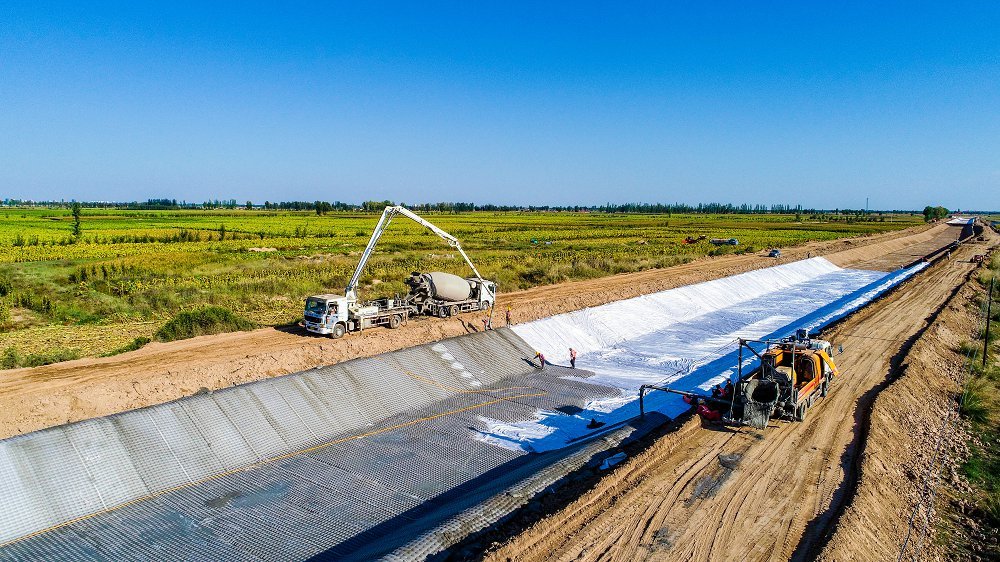
The fabric formwork is not just a container for the concrete; it is the structural spine of the mattress during installation. The geotextile must have high permeability to relieve hydrostatic pressure (often >150 l/m²/s) but high tensile strength for the lift.
Before any large campaign, we conduct a sacrificial lift test. We take one mat, hoist it, and leave it suspended for 15 minutes while swinging it aggressively to simulate wind loads. We then inspect the loop attachment points. If you see tearing in the filter fabric or elongation of the stitching, the entire batch is suspect. This is distinct from a Filter Point Concrete Mattress, where the fabric acts differently under pressure; for ACMs, the stress is concentrated at the mechanical interlock of the loop.
Standardizing the Lift with Verified Components
The efficiency of your installation is effectively capped by the quality consistency of the mats you procure. If every third mat has a misaligned lifting loop, your riggers will spend 20 minutes per mat manually adjusting shackles, destroying your daily production targets.
This is where integrating the manufacturing process with the installation plan becomes vital. Some manufacturers treat the lifting loops as an afterthought—stapling them on after curing. Advanced providers like HydroBase embed high-tenacity polyester loops deep into the concrete block matrix during the wet-cast phase. This ensures the pull-out strength exceeds the weight of the block by a factor of four.
When the loop geometry is standardized (e.g., exactly 250mm loop height, spaced on 1.2m centers), the spreader bar drops on, clicks in, and lifts without manual fiddling. HydroBase mats are designed to interface seamlessly with standard rental spreading beams, reducing the need for custom fabrication on site.
Mitigating Spreader Bar Deflection

Even with the correct beam, deflection can occur. If the central beam of your frame bends under load, the outer hooks move inward. This “pinches” the mat, causing it to bow. A bowed mat is shorter in length than a flat mat.
When you place a bowed mat on the seabed, it may not reach the intended coverage area. When you release the tension, it relaxes and flattens, potentially pushing adjacent mats out of position. Using rigid, truss-reinforced spreading bars eliminates this variable. We recommend checking the beam for deflection utilizing a laser level during the test lift.
Practical Tool: Pre-Lift Go/No-Go Protocol

To streamline the decision-making process on the barge or bank, use this checklist for the deck foreman and safety officer.
| Checkpoint | Requirement | No-Go Criteria |
|---|---|---|
| Loop Visuals | All loops visible and upright | Frayed rubbing >10% or buried in concrete |
| Rigging Angle | Sling to vertical angle < 30° | Angle > 30° (Excessive side load) |
| Mat Integrity | Cables/Ropes taut, blocks seated | Broken inter-block cables or cracked blocks |
| Frame Hardware | Safety latches functional on all hooks | seized latches or deformed hooks |
| Weather | Wind < 25 knots / Swell < 1.0m | Erratic load movement during test hoist |
| Seabed Prep | Survey confirms grade tolerance ±150mm | Obstructions or debris in drop zone |
Using a binary system like this removes ambiguity. If a mat fails the visual loop check, it is marked red and moved to the reject pile immediately, rather than halting the lift to “try and make it work.”
Managing Cable Integrity During Installation

Many articulated mats rely on internal cabling (polyester rope or galvanized steel) to hold the block array together. During the lift, the spreader beam prevents the mat from stretching these cables to their breaking point. However, snap loads caused by crane operator error can shock-load these internal cables.
It is crucial to verify that the manufacturer has utilized cables with adequate elongation properties. HydroBase, for instance, utilizes UV-stabilized polyester cables that allow for minor elongation without snapping, providing a buffer against the dynamic forces of a rough installation. This attention to component interaction reduces the risk of in-air structural failure, protecting your crew and your project timeline.
Securing the Project Baseline
Safe lifting operations are the gateway to a successful revetment. If you can’t get the product from the shoreline to the channel bottom efficiently, the best engineered concrete in the world won’t save your slope. It comes down to physics: respecting the sling angles, validating the loop integrity, and using the correct spreading hardware.
Don’t let procurement decisions upstream compromise safety downstream. Ensure your ACMs are built for the lift, not just the lay.
Need precise rigging diagrams and weight charts for your lifting plan?
Download the concrete mattress specification sheet to get the exact load data and dimension tolerances for your Risk Assessment Method Statement (RAMS).