Designing reliable levee overtopping protection vegetated concrete mattress systems means understanding the precise interplay of raw hydrodynamics and biological reinforcement. Extreme flood events do not just raise water levels; they unleash immense kinetic energy that tears through unconsolidated soils. Earthen structures subjected to prolonged overtopping require a composite defense mechanism. Fusing the immediate structural mass of concrete with the deep, localized tensile strength of mature vegetation creates a living armor system capable of surviving extreme crest overflow.
Hydrologists and civil engineers increasingly recognize that rigid, impermeable structures alone often fail to accommodate subgrade settlement or relieve hydrostatic pressure during rapid drawdown phases. By integrating a flexible, open-cell concrete structure with high-performance geotextiles, engineers can permanently stabilize earthworks while promoting localized ecological recovery. This guide examines the hydraulic forces acting on embankments during flood conditions and explores how engineered biological armoring neutralizes erosive velocities.
The Mechanics of Earthen Dam Overtopping

As our lead craftsman always says, “You can feel when the concrete mattress is right.”
Water crashing over a levee apex undergoes a rapid transformation. Subcritical flow at the reservoir surface accelerates drastically down the landward slope, becoming highly turbulent, supercritical flow. Tractive shear stress exponentially increases as the velocity multiplies, threatening the integrity of bare soil.
Headward erosion typically initiates near the embankment toe. Hydraulic jumps form where steep downstream slope velocities meet flatter surrounding terrain, generating violent turbulent eddies that pluck soil particles directly from the subgrade. If left unchecked, this localized scour migrates upward toward the crest, ultimately resulting in a massive rotational slump or complete structural breach.
Modern defensive strategies focus on disrupting this exact chain of events. Incorporating heavy, interlocking cellular grids directly alters how energy impacts the slope. Research in allied coastal fields provides valuable parallels. Studies also show that vegetated foreshores with seagrass can reduce wave loads on coastal defenses, mirroring how terrestrial root systems and hard structural grid networks disrupt overtopping flows on inland earthen embankments.
Hydraulic Roughness and Flow Deceleration
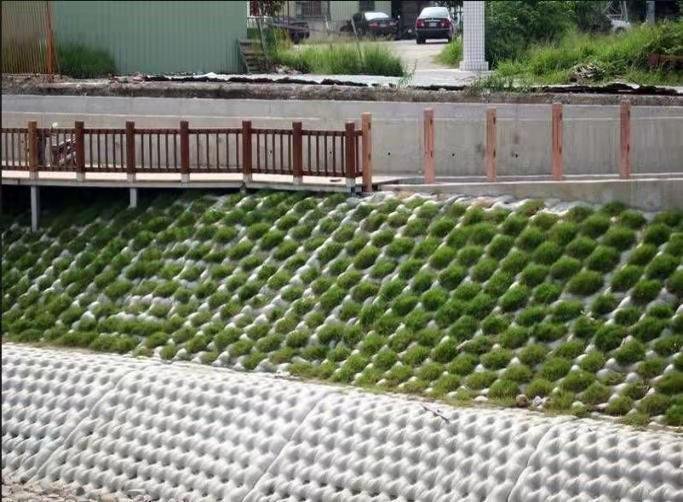
Surface friction dictates how fast water travels down a slope. Traditional concrete slabs present a smooth surface, often resulting in a low Manning’s n coefficient around 0.015. Smooth surfaces do nothing to bleed off kinetic energy, essentially firing water at maximum velocity straight into the vulnerable levee toe.
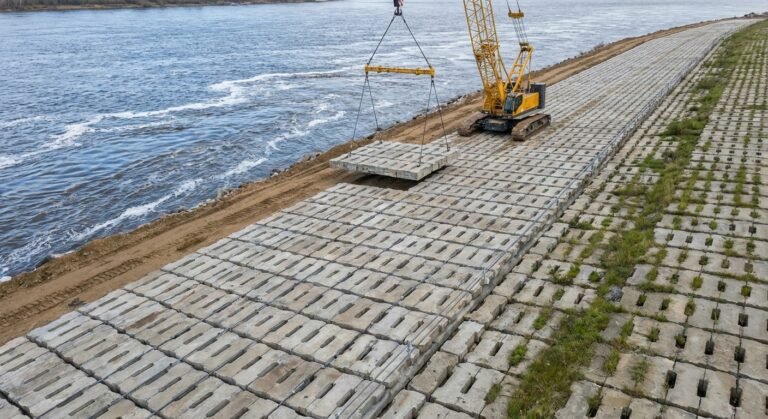
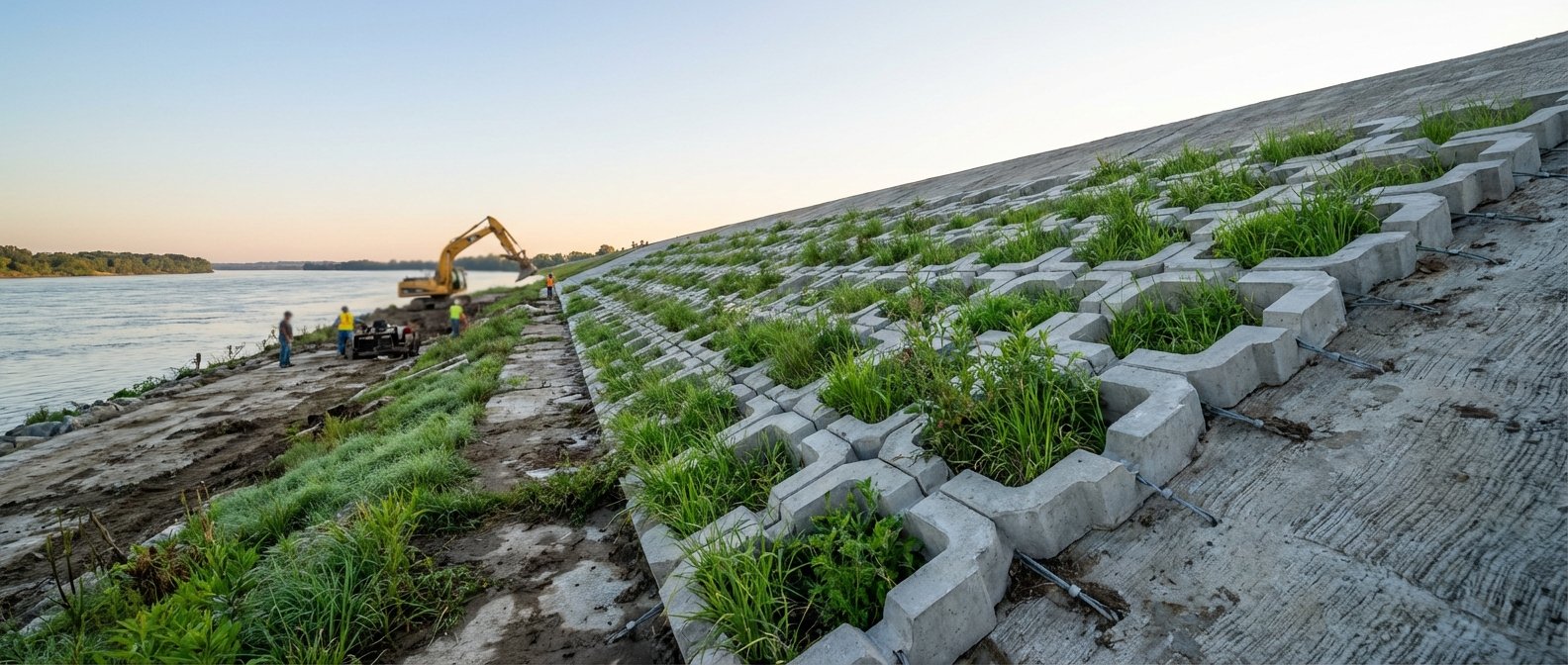
Open-cell concrete configurations operate differently. Incorporating a specific open area ratio of 22.5% provides enough voids to support thick layers of perennial grasses. Mature vegetation interacting with the raised concrete edges dramatically increases the surface drag. The composite hydraulic roughness coefficient jumps to an optimal range of 0.038 to 0.045.
Decelerating the water mass keeps tractive forces well below the critical shear threshold of the underlying soil. Turbulent flow loses its aggressive scouring capability as it navigates the complex, uneven surface of grass blades embedded within rigid concrete webs. This continuous dampening effect ensures surface aggregate remains locked in place during sustained flood stages.
Biological Reinforcement and Root Penetration
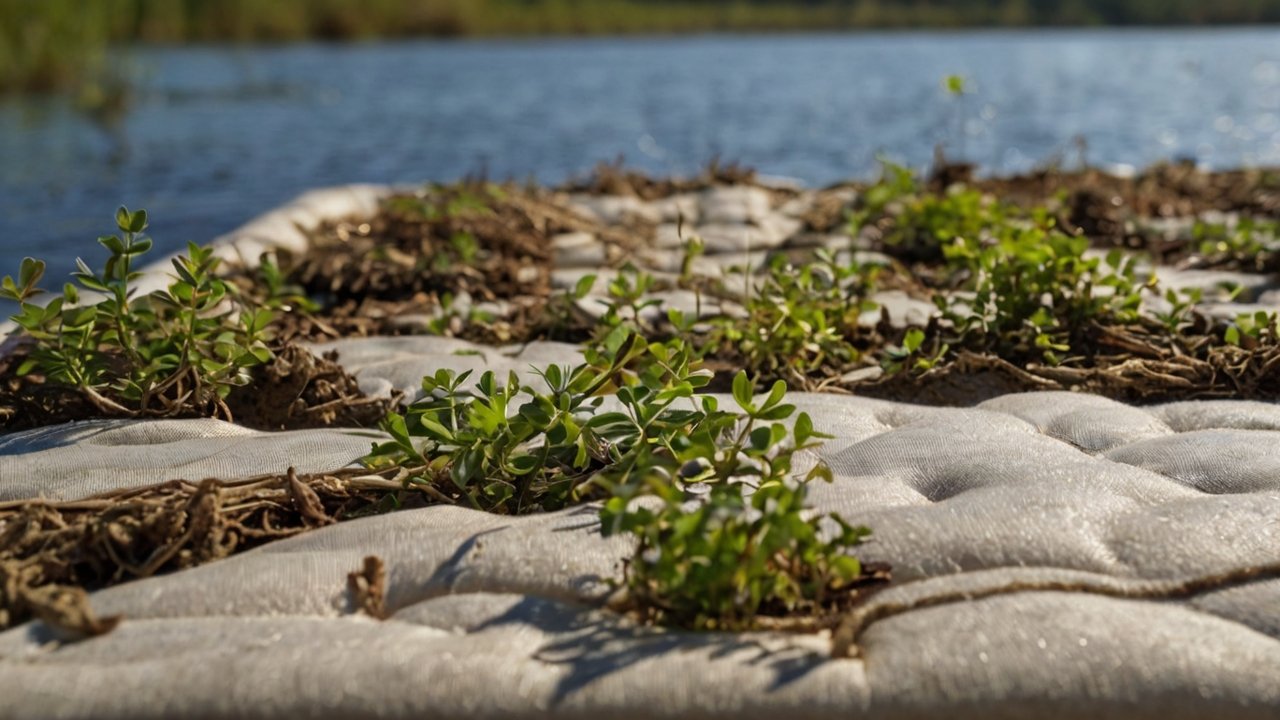
Structural mass only solves half the equation. The secret to long-term embankment resilience lies beneath the surface. Designing for a specific soil fill depth, typically around 145mm, creates a perfect micro-environment for robust botanical development. Deep-rooted plant species thread directly through the matrix voids.
Roots push past the concrete layer, penetrating the specialized non-woven geotextile backing, and anchoring deeply into the compacted levee subgrade. Thousands of tiny root structures act like biological soil nails. They physically bind the heavy concrete matting directly to the earth, massively increasing the entire system’s resistance to sliding or uplift.
Federal agencies heavily prioritize this biological-mechanical synergy. Contemporary military and civil works solicitations constantly seek sophisticated ways to model flow through vegetation, mapping how these natural anchors prevent the type of catastrophic levee erosion and overtopping that has traditionally plagued earthen infrastructure.
Slope Stability Under Hydrodynamic Loading
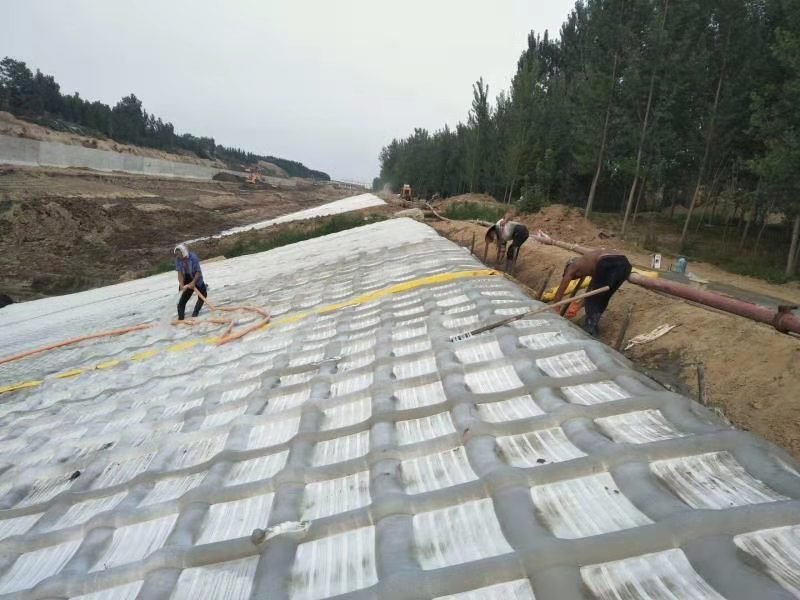
Steep landward slopes present complex geometric challenges. A 3:1 or even 2:1 slope angle severely tests the sliding resistance of any applied armoring. Hydrodynamic lift forces generated by high-velocity overtopping can effectively reduce the effective weight of the protective cover, increasing the risk of widespread destabilization.
Engineers counter this by calibrating the sheer mass of the unit. Establishing a target block weight of roughly 268 kg/m² guarantees the matrix maintains intimate contact with the base soil, even when subjected to intense vertical lift forces. Gravity locks the individual concrete nodes against the geotextile, preventing interstitial water from creating a slip plane.
Such weight and stability become especially critical in tidal or estuarine zones facing storm surges. Government ecological assessments frequently evaluate constructing sturdy levees to prevent tidal inundation of private properties in low-lying agricultural valleys. The massive weight of these cellular concrete systems secures those precise levee faces against regular tidal scour and subsequent wave run-up.
Integrating Structural and Biological Armoring
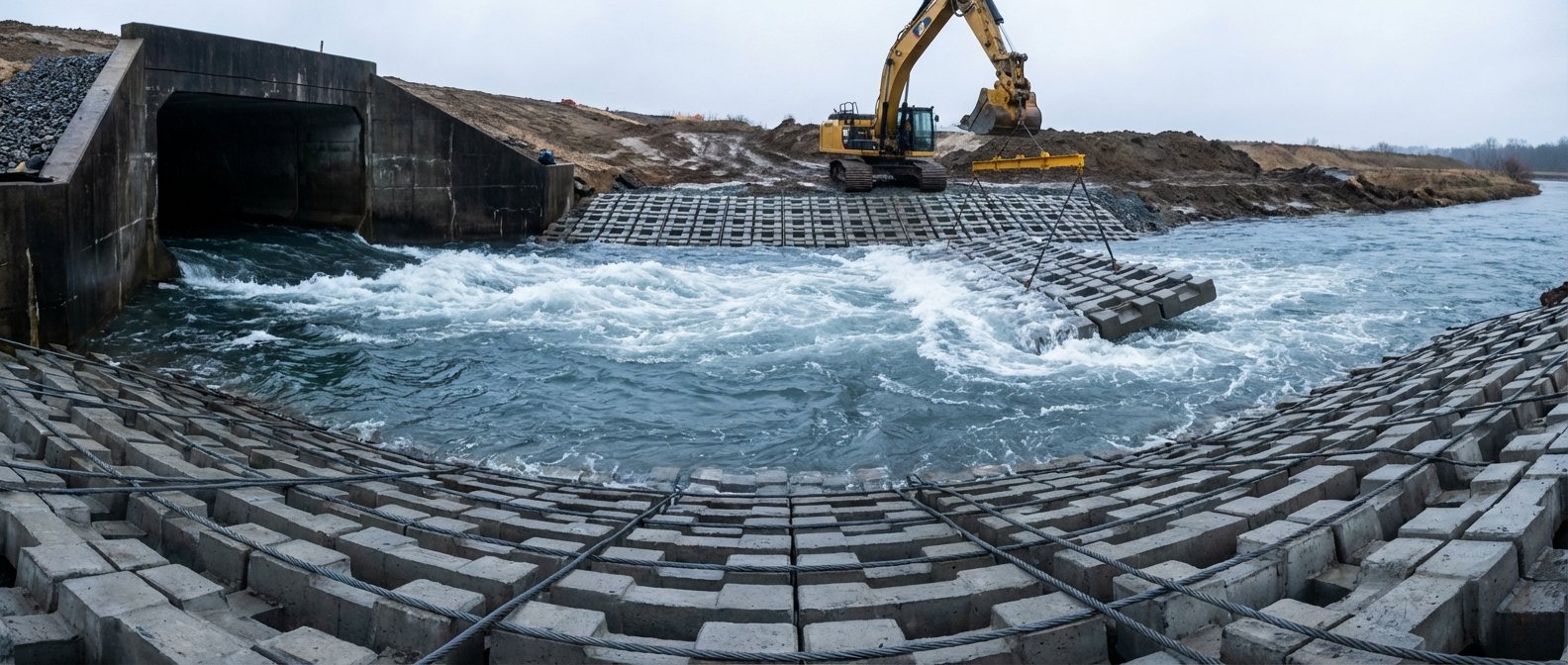
Bringing these aggressive physical requirements together requires meticulous manufacturing. Advanced producers like HydroBase do not just cast concrete blocks; they engineer holistic ground-stabilization matrices. Achieving an ideal balance between maximum soil exposure for vegetation and heavy concrete mass for stability requires precision molding.
A standard pour uses a high-grade C35 concrete mix infused with fly ash, yielding exceptional durability against freeze-thaw cycles and freeze-induced cracking. By carefully tying these specialized cellular blocks together with high-tenacity cables, HydroBase forms a flexible, articulated blanket. This structure easily conforms to minor grade changes without cracking, creating an ideal substrate for deep naturalization.
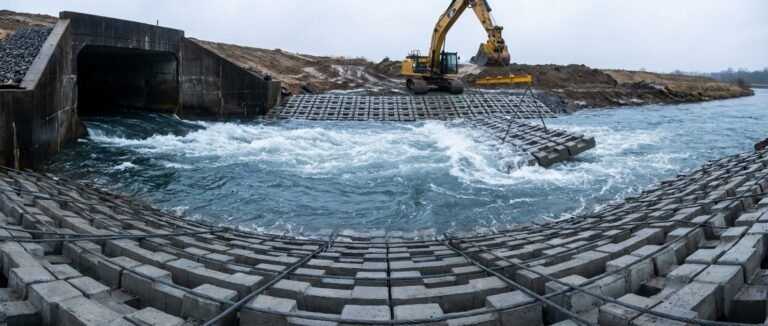
Outfall zones traversing the levee face demand exact attention. Intersecting pipes or culverts create hazardous turbulence. Installing Culvert Outfall Scour Protection: The Complete ACM Guide details directly into the vegetated matting ensures those localized high-energy points do not unravel the broader biological armor stretching across the embankment.
Combating Prop Wash and Localized Scour
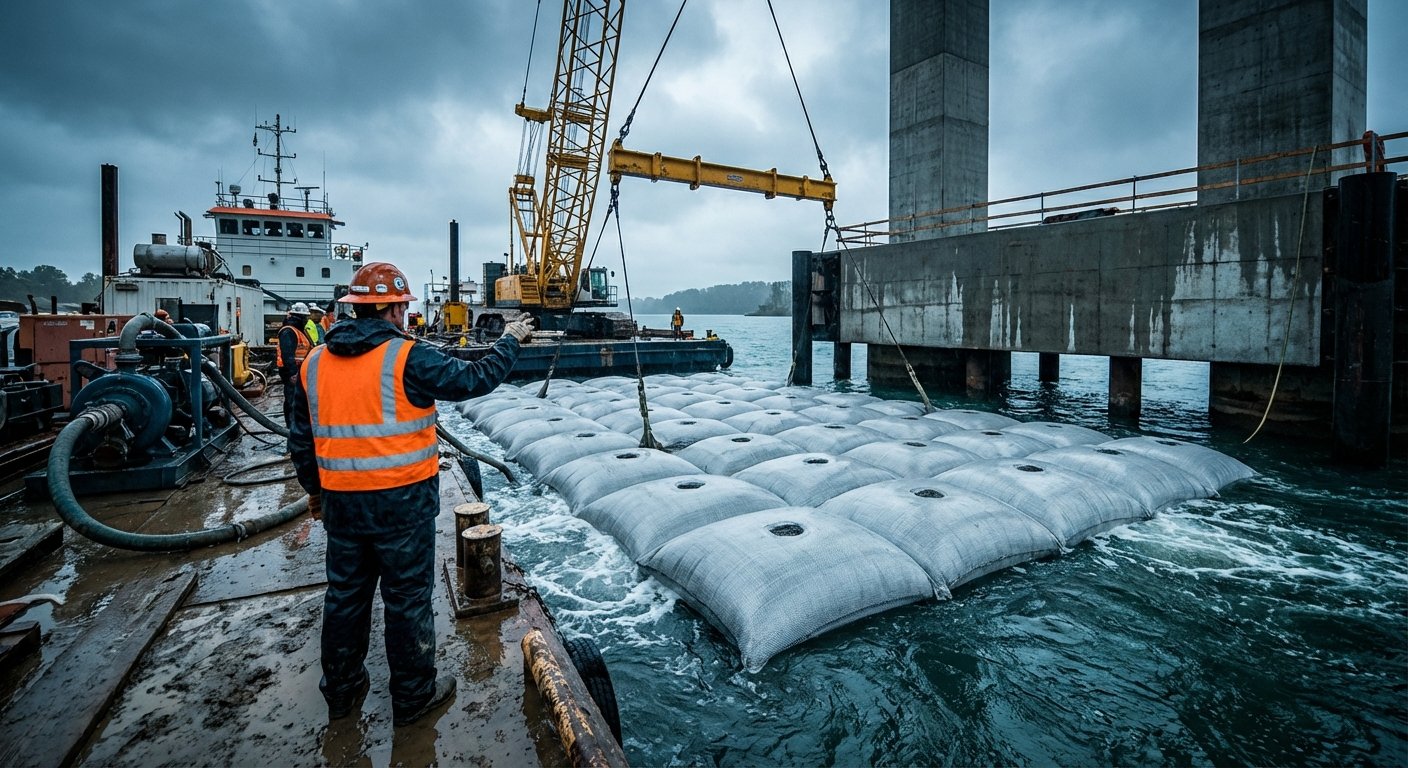
Navigable waterways adjacent to levee systems introduce a secondary threat. While extreme rain events drive overtopping, commercial barge traffic or heavy pumping stations can simultaneously batter the lower levee toe. The intense localized current from marine engines rapidly removes toe support, leading to upper slope collapse.
Mitigating this requires blending different mattress profiles at the water level. The transition from pure vegetation to deeper aquatic zones might require Solving Prop Wash Scour with Uniform Section Concrete Mats right at the permanent waterline. Uniform structural thickness aggressively stops propeller-induced cavitation from undermining the toe.
Once the toe is locked down with solid concrete profiles, the upper landward and riverward slopes can transition safely back into open-cell matrices. The biological grid thrives in the fluctuating inundation zones, handling the intermittent overtopping forces while the solid base easily deflects continuous mechanical boat wash.
Managing Uplift Pressures and Soil Retention
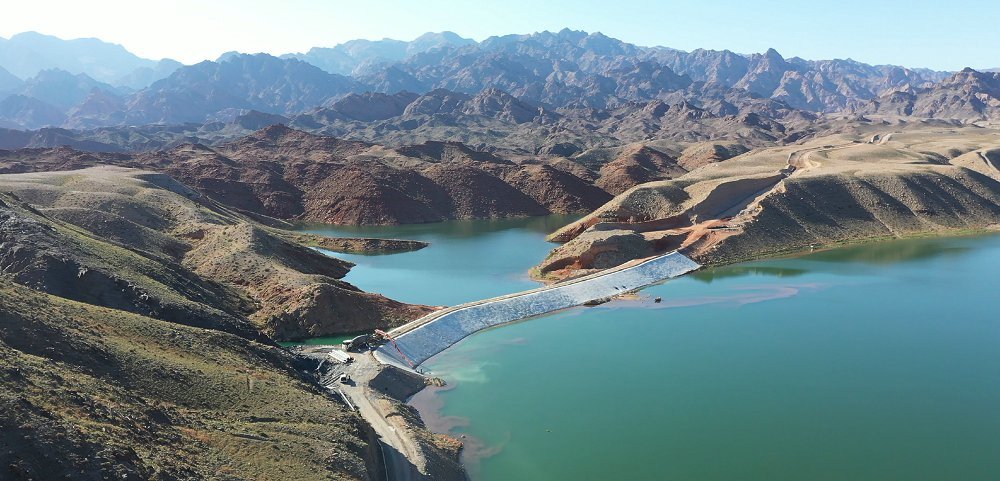
Following a major flood, water levels recede rapidly. This sudden drawdown traps vast amounts of groundwater inside the earthen levee. The saturated soil exerts immense outward hydrostatic pressure against the protective armoring. Without a way to vent this excess water, the entire concrete facing could simply pop off the slope.
HydroBase utilizes high-specification engineered fabrics beneath its concrete units to manage this exact scenario. The underlying geotextile boasts a permeability rating of 0.28 cm/s, acting as a highly efficient pressure relief valve. Water streams out freely through the fabric and block voids, while the dense fabric weave permanently retains fine silt and clay particles inside the embankment core.
For areas experiencing continuous, heavy seepage, engineers often transition from open grids into a Filter Point Concrete Mattress | Erosion Control setup. Filter points spaced evenly across specialized fabric panels allow intense targeted drainage, preventing any buildup of destructive pore-water pressure beneath the engineered armor.
Installation Parameters for Flood Embankments
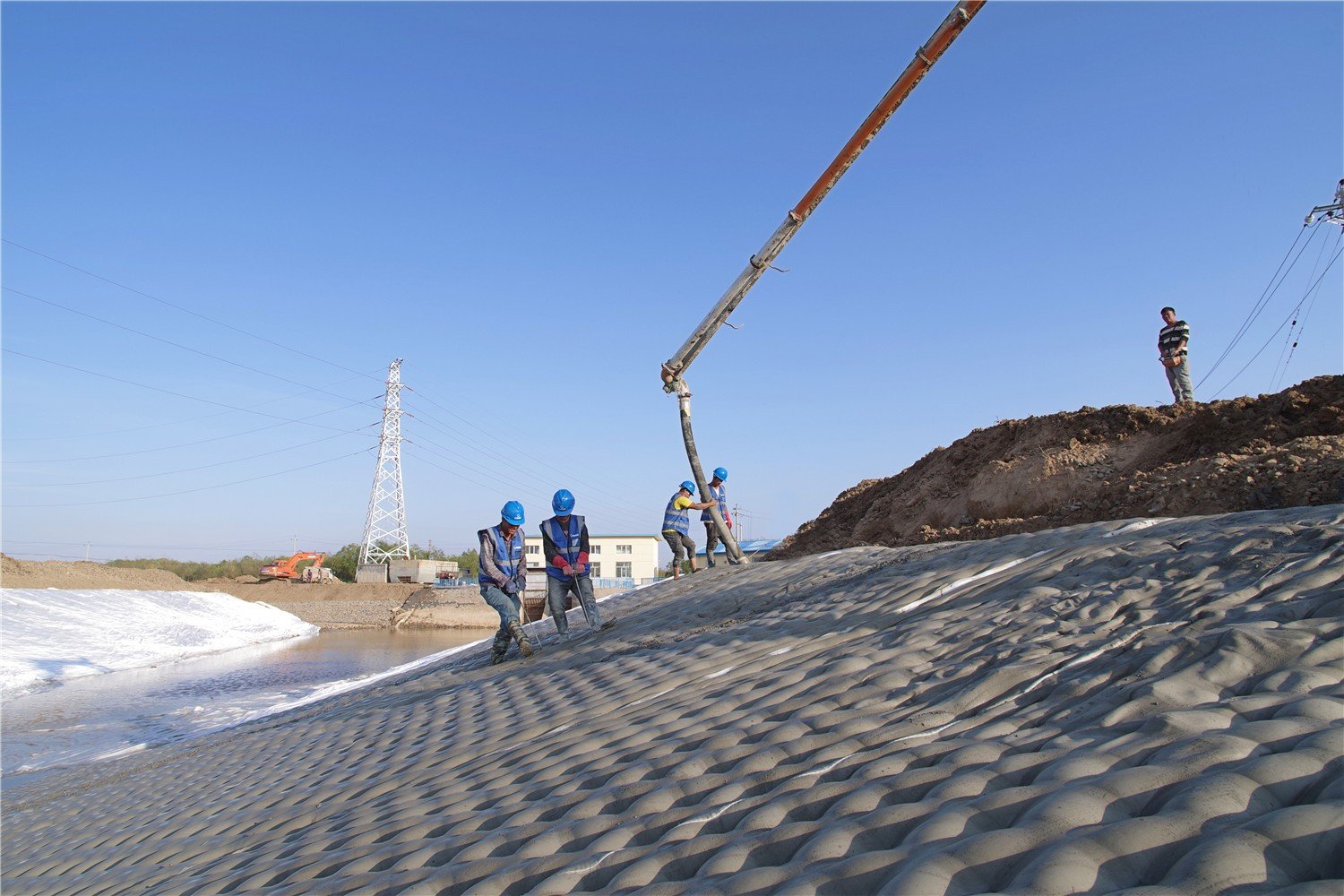
Proper field deployment defines the ultimate success of the system. Even the most robust factory specifications fall short if installation crews do not respect the strict geometric and anchoring guidelines required for high-velocity spillway projects. Detailed planning determines how the matting interacts with existing anchor trenches.
Below is an operational checklist outlining the crucial technical parameters civil teams verify during the staging and deployment of biological block systems:
| Hydraulic Parameter | Target Specification Metric | Engineering Purpose on the Levee |
|---|---|---|
| Overtopping Velocity Limit | Sustains up to 6.2 meters/second | Prevents shear failure during peak crest flows |
| Geotextile Tensile Strength | Uniaxial load minimum 52 kN/m | Stops fabric tearing under localized debris impacts |
| Open Area Voids | Fixed rigidly at 22.5% volume | Guarantees exact soil volume for root mass density |
| Target System Weight | 268 kg/m² block density | Defeats extreme vertical uplift forces during floods |
| Root Zone Depth | Minimum 145mm soil fill space | Protects young plants from intense solar desiccation |
| Base Friction Angle | Matches subgrade (approx. 28 degrees) | Secures slope stability against downhill sliding |
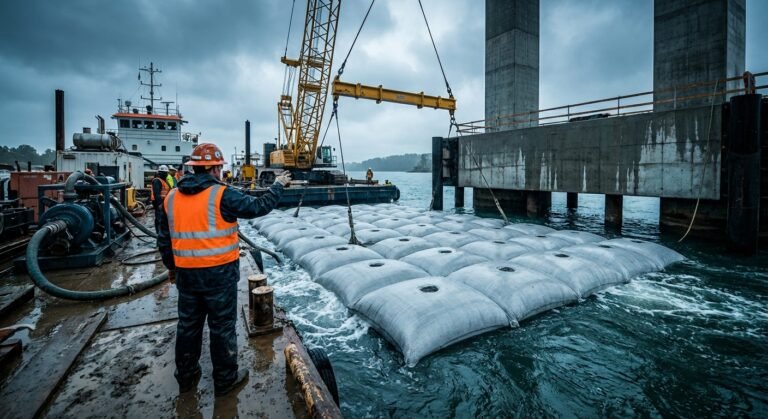
Executing these parameters requires skilled lifting frames and proper subgrade compaction. Precision handling ensures the geotextile overlaps face downstream, creating a shingle effect that entirely prevents high-speed water from forcing its way beneath the joints.
Adapting to Marine and Estuarine Environments
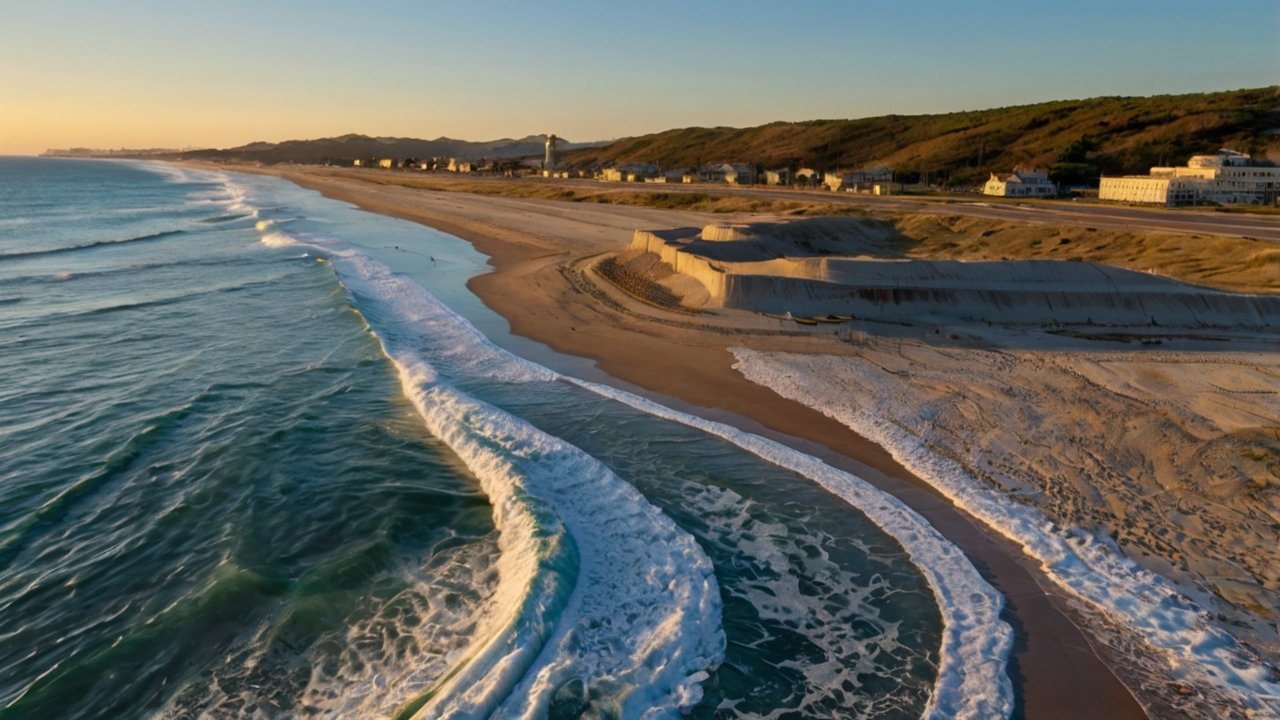
Coastal levees suffer dual punishment. They face stormwater overflow from inland catchments while withstanding harsh saline tidal cycles. Standard concrete easily succumbs to chloride attack over a few decades, requiring specialized batching mixes to resist chemical deterioration.
Using dense, low-permeability C35 concrete protects the internal structural cables from rapid oxidation. Regional hazard planning relies heavily on mapping these specific environmental vulnerabilities. Top-tier vulnerability strategies depend entirely on robust data sources that are industry standard for assessing exposure to rising sea levels and salinity constraints.
Engineers adapt the biological component as well. Sowing salt-tolerant wetland grasses directly into the matrix voids guarantees the ecological benefits survive intense brackish water inundation. Once established, these halophytic root systems permanently bind the concrete grid to the saline mudflats, establishing a resilient green barrier against wave reflection.
Long-Term Performance of Composite Systems
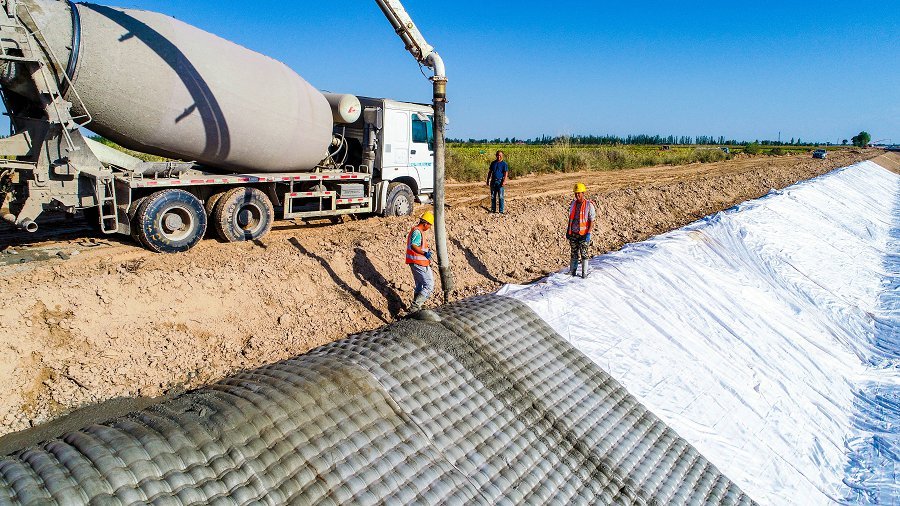
Durability sets biological concrete armoring apart from standard dumped riprap. Over time, rock riprap rolls away, settles unevenly, and requires constant costly replenishment. A properly specified levee overtopping protection vegetated concrete mattress actually grows stronger year after year.
As native plant rhizomes expand laterally beneath the concrete framework, they create a dense underground net that significantly outperforms standard Articulated Concrete Mattress (ACM) | Erosion Control installations relying on gravity alone. Combining heavy concrete engineering with perpetual biological renewal gives municipal water districts a truly permanent, maintenance-free embankment solution.
Frequently Asked Questions
Q: How does a vegetated concrete mattress handle extreme hydraulic shear stress compared to riprap?
A vegetated mattress manages severe shear stress by utilizing an interconnected, heavy concrete grid combined with deep root reinforcement, sustaining overtopping flows up to 6.2 m/s. Unlike riprap, which easily destabilizes and washes away under high-velocity currents, the flexible concrete matrix remains uniformly locked together across the entire levee surface.
Q: What is the typical lead time and MOQ for custom levee overtopping protection mats?
Custom concrete mattress solutions typically require a production lead time of 4 to 6 weeks, depending heavily on the complexity of the specific matrix mold. In commercial B2B applications, the industry standard Minimum Order Quantity (MOQ) generally begins at 1,000 square meters.
Q: Can these matrices be installed on steep landward slopes?
Yes, these heavy engineered mattresses perform exceptionally well on landward slopes as steep as 2:1. The inherent 268 kg/m² mass of the interconnected concrete grids utilizes gravity to secure the non-woven geotextile against the subgrade, counteracting destabilizing hydrodynamic lift.
Q: What is the difference between an articulated concrete mattress and a vegetated concrete mattress?
A standard articulated concrete mattress focuses purely on structural, closed-cell armor for high-impact scour zones. A vegetated unit deliberately incorporates an open area ratio of at least 22.5%, allowing topsoil fill and native plant growth to increase the long-term biological shear resistance of the bank.
Q: Does the underlying geotextile prevent proper water drainage during flood drawdown?
No, the specialized non-woven geotextile fabric acts as an active filtration layer. Boasting a high permeability rating of around 0.28 cm/s, it rapidly relieves internal hydrostatic uplift pressure while securely retaining fine levee soils beneath the concrete blocks.
Securing Earthen Infrastructure
The catastrophic mechanics of levee failure demand far more than traditional rigid paving or scattershot rock placement. Taming highly destructive, supercritical overtopping flows requires an intelligent synthesis of flexible mass and biological tenure. By deploying calculated matrix designs, water management authorities physically lock down the subgrade while simultaneously decelerating the violent tractive forces threatening the landward toe.
Investing in composite structural armoring ensures civil embankments survive generational flood events without catastrophic unravelling. Reliable hydraulic engineering leverages specific open-void ratios, carefully calibrated unit weights, and high-tensile fabric integration. To evaluate exact engineering specifications for your next high-velocity spillway or embankment project, Get our hydraulic protection design guide and explore comprehensive data on modern concrete mattress deployment.
Related Resources
- Vegetated Concrete Mattress Systems — For embankment applications
- Articulated Concrete Mattress Systems — Hard armour solutions
- Culvert Outfall Scour Protection Guide — Related scour application
Need a concrete mattress solution for your project?
HydroBase provides end-to-end concrete mattress engineering & installation services — from hydraulic design and factory-direct ACM supply to on-site supervision and post-project inspection. Trusted by civil engineers in 50+ countries.