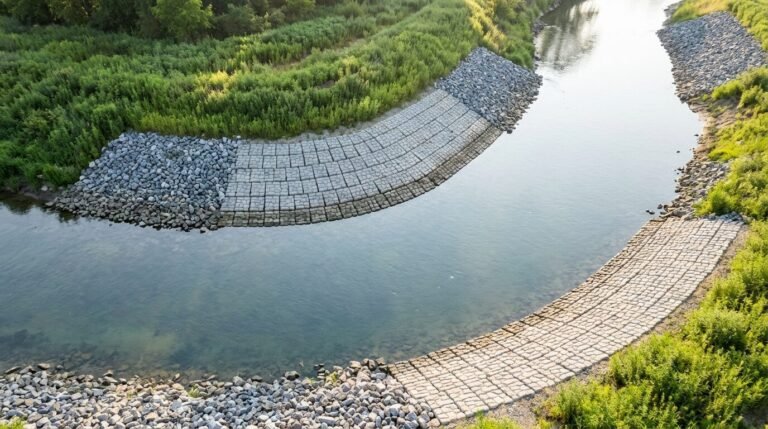
When specifying scour protection for a riverbank, dam toe, or canal lining project, procurement engineers face a persistent binary choice: articulated concrete mattress or riprap. Both systems have been deployed across thousands of hydraulic infrastructure projects globally. Both have strong performance records. But they are fundamentally different engineering tools, and selecting the wrong one costs significantly more in the long run than the purchase price difference suggests.
This guide cuts through generic vendor claims and provides a structured technical comparison across six decision criteria that matter in real-world hydraulic engineering projects.
What Is Riprap?
Riprap is a layer of large, angular rock fragments placed on an exposed slope or channel bank to resist hydraulic erosion. It is one of the oldest erosion control methods in civil engineering, widely specified because crushed rock is locally available in most regions, installation requires no specialized equipment, and the engineering design standards (USACE EM 1110-2-1601, EN 13383) are well-established.
Standard riprap specification involves calculating the median rock size (D50) required to resist the design flow velocity, applying appropriate grading curves, and placing to the specified thickness. Typical D50 for river channels ranges from 150 mm to 600 mm depending on flow conditions.
What Is an Articulated Concrete Mattress?
An articulated concrete mattress (ACM) is an engineered system of interlocked concrete elements, either pre-manufactured discrete blocks connected by polymer cables, or fabric-formed chambers filled with pumped concrete. Unlike riprap, which relies on mass and friction, an ACM system provides armor through structural continuity and interlocking, distributing hydraulic loads across the panel rather than resisting them element-by-element.
Head-to-Head Comparison: Six Key Criteria
1. Flow Velocity Resistance
| System | Typical Max Velocity | Failure Mode |
|---|---|---|
| Riprap (D50 300mm) | 3.5 – 4.5 m/s | Progressive displacement; individual stones roll and slide |
| Riprap (D50 600mm) | 5.0 – 6.0 m/s | Displacement at flow concentration zones |
| ACM (100mm) | 4.0 – 5.0 m/s | Edge lifting at panel perimeter if unanchored |
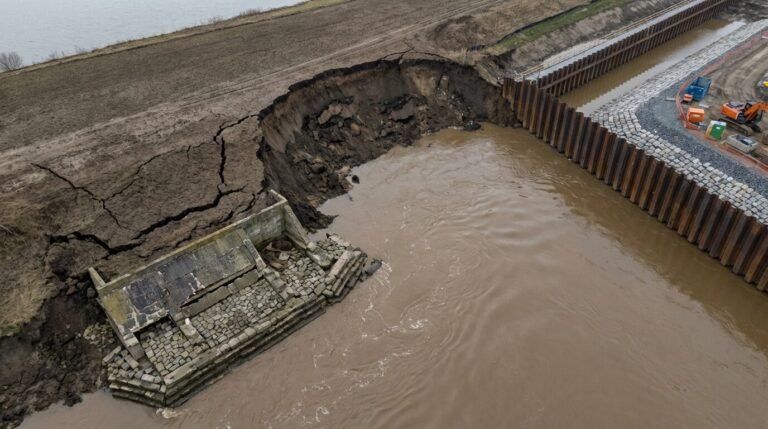
| ACM (200mm) | 6.0 – 8.0 m/s | Undermining at poorly protected toe |
Verdict: ACMs outperform equivalent-weight riprap at high velocities due to structural continuity. For channels exceeding 5 m/s, ACMs are the preferable specification in most site conditions.
2. Installation Complexity and Speed
Riprap installation requires only a bulk material delivery and excavator placement. No specialized equipment, no pumping, no formwork. On sites with good road access and available rock sources, riprap can be placed at 500–1,500 m² per day with a two-machine operation.
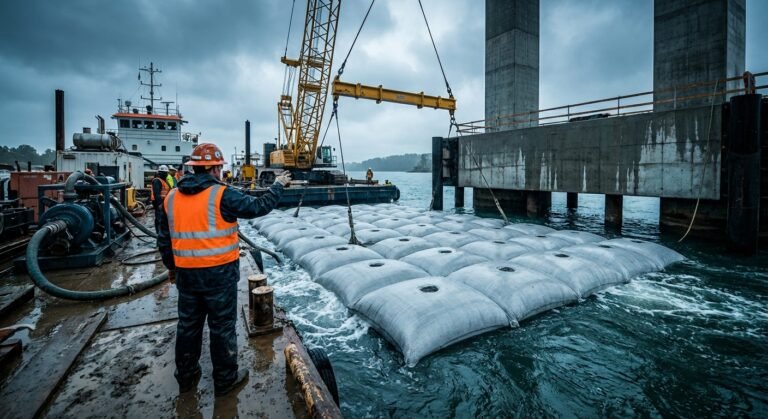
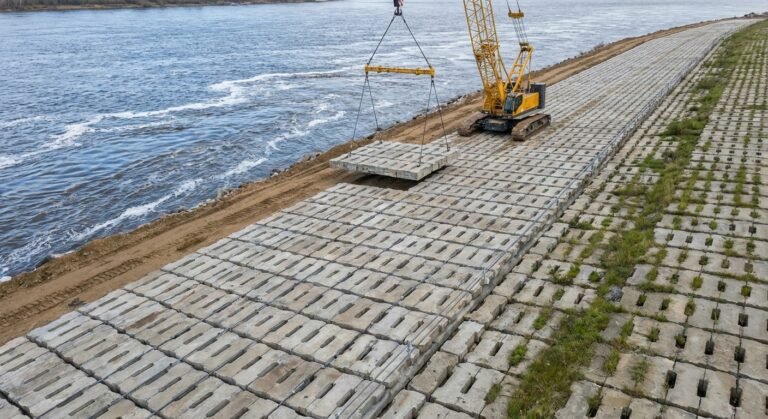
Concrete mattress installation requires a crane or barge for panel placement, a concrete pump for fabric-formed types, and trained operatives for seam inspection. Production rate is typically 200–600 m² per day for fabric-formed systems, but pre-assembled ACM panels can be placed at 500–1,200 m² per day by crane.
Verdict: Riprap wins on installation simplicity. ACMs are competitive on speed when pre-manufactured panels are used, but require more specialized site management.
3. Long-Term Maintenance
Riprap requires periodic inspection and replenishment at displacement zones, particularly at bends, transitions, and toe areas. In high-velocity channels, annual inspection and 5–10-year stone replenishment cycles are common. Lifetime maintenance costs for riprap over a 50-year design period frequently exceed initial installation cost.
Correctly installed concrete mattresses with adequate toe protection require minimal maintenance. The monolithic or interlocked structure does not self-displace, and the geotextile filter layer prevents subgrade migration. Maintenance is limited to occasional joint inspection and any localized patch repairs if the system is damaged by vessel impact or vandalism.
Verdict: ACMs have significantly lower lifetime maintenance costs. Lifecycle cost analysis over 30–50 years frequently favors ACMs even when initial supply cost exceeds riprap by 20–40%.
4. Ecological and Environmental Impact
Riprap provides a rough, irregular surface that supports benthic habitat colonization and offers some ecological value. However, the void spaces do not support vegetation growth, and riprap banks are visually prominent in natural landscapes.
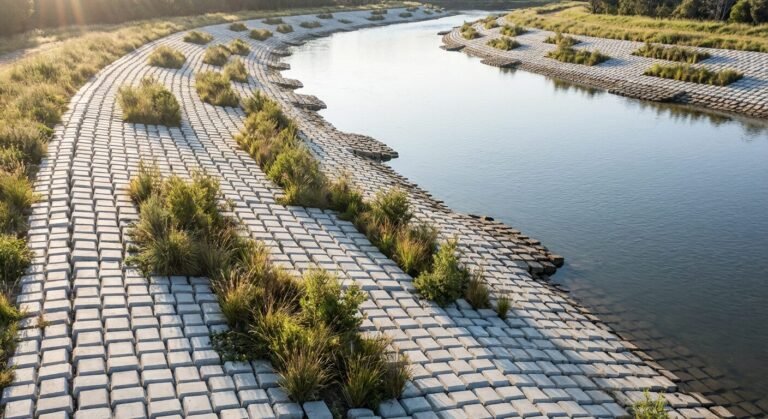
Vegetated concrete mattresses allow grass growth through filter openings, integrating the protection system into the natural slope. For environmentally sensitive riparian zones, reservoirs, and ecological corridors, vegetated ACMs provide structural protection while maintaining habitat connectivity and slope hydrology.
Verdict: ACMs, particularly vegetated designs, offer superior environmental integration for ecologically sensitive projects.
5. Cost Comparison
Direct cost comparison depends heavily on local rock availability and transport distance. In regions where quarried rock is abundant and transport is short, riprap supply cost may be USD 15–30/m² installed. In remote locations, coastal projects, or countries without adequate rock quarries, riprap transport costs make concrete mattresses cost-competitive or less expensive despite higher unit material cost.
Factory-direct concrete mattress supply from HydroBase, with 40,000 m²/day production capacity and direct container shipping, eliminates distributor markups and enables competitive delivered pricing for projects in Asia, the Middle East, Africa, and beyond.
Verdict: Context-dependent. Riprap wins in quarry-rich regions. ACMs are cost-competitive or superior in coastal, remote, and international projects. Lifecycle cost analysis consistently narrows or reverses the gap over 20+ year horizons.
6. Specification Confidence and Quality Control
Riprap quality varies significantly by quarry source. Rock hardness, grading, and shape consistency require careful quarry qualification and ongoing delivery inspection. Undersized or rounded stone dramatically reduces performance.
Factory-manufactured concrete mattresses come with batch-level test reports for tensile strength (ASTM D4354), seam integrity, concrete compressive strength, and permeability. Quality is controlled and documented at the production facility, not inferred from field stone sampling.
Verdict: ACMs offer significantly higher specification confidence and more defensible quality documentation for major infrastructure contracts.
When to Specify Riprap
- Local quarry rock is abundant and transport distance is short
- Flow velocity is below 4 m/s and hydraulic conditions are stable
- Temporary or interim protection is required
- Project budget is severely constrained and lifecycle cost is not a client priority
- Ecological value from rough substrate void spaces is specifically required
When to Specify Concrete Mattress
- Flow velocity exceeds 4–5 m/s continuously
- Project location is remote, coastal, or has limited rock supply
- Long-term maintenance budgets are constrained
- Environmental integration or vegetated appearance is required
- Contract requires documented quality test reports for each batch
- Subsea or underwater installation is required
- Canal, reservoir, or dam face application requires permeable, flexible lining
Conclusion
Neither system is universally superior. The correct specification depends on site hydraulics, rock availability, project lifecycle requirements, and environmental context. For high-velocity channels, remote supply situations, long design lives, and environments requiring ecological integration, articulated concrete mattresses provide a technically superior and often lifecycle-cost-competitive alternative to riprap.
HydroBase engineering sales can provide project-specific technical guidance and specification support for concrete mattress systems across all application types. Contact our team to discuss your project requirements, or review our Concrete Mattress FAQ for detailed technical specifications. See also: Canal Lining, Slope Protection, Bridge Pier Scour Protection, and our Installation Guide.
Need a concrete mattress solution for your project?
HydroBase provides end-to-end concrete mattress engineering & installation services — from hydraulic design and factory-direct ACM supply to on-site supervision and post-project inspection. Trusted by civil engineers in 50+ countries.