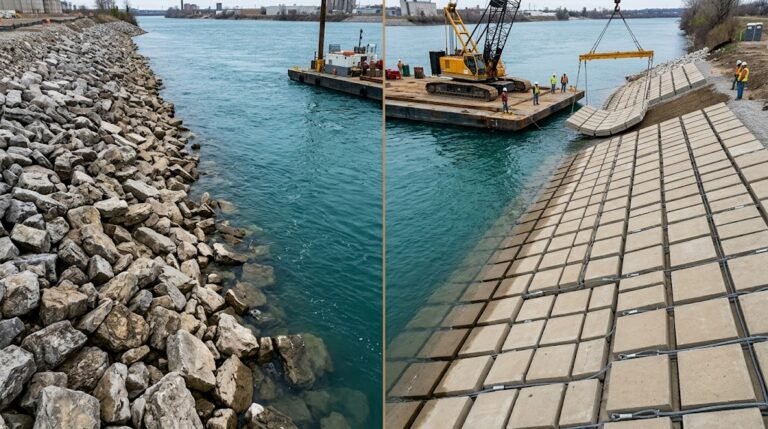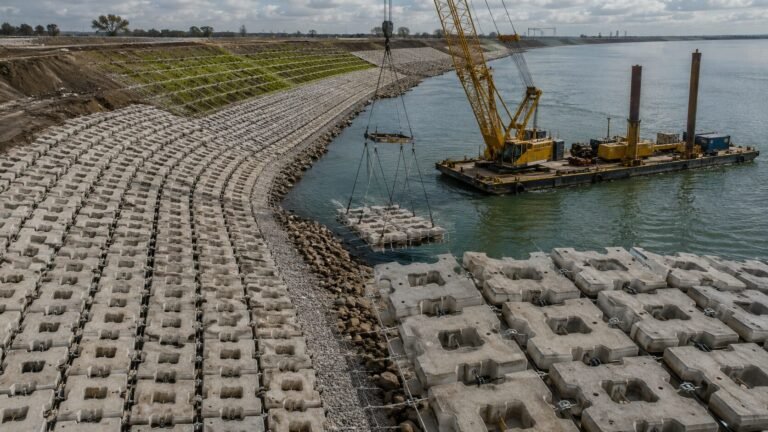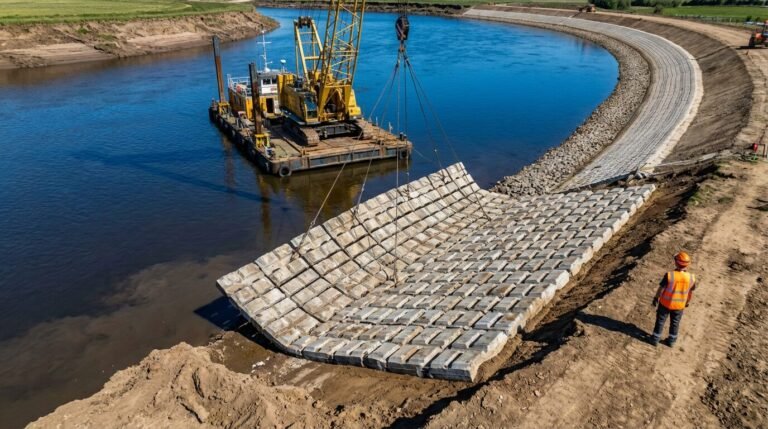
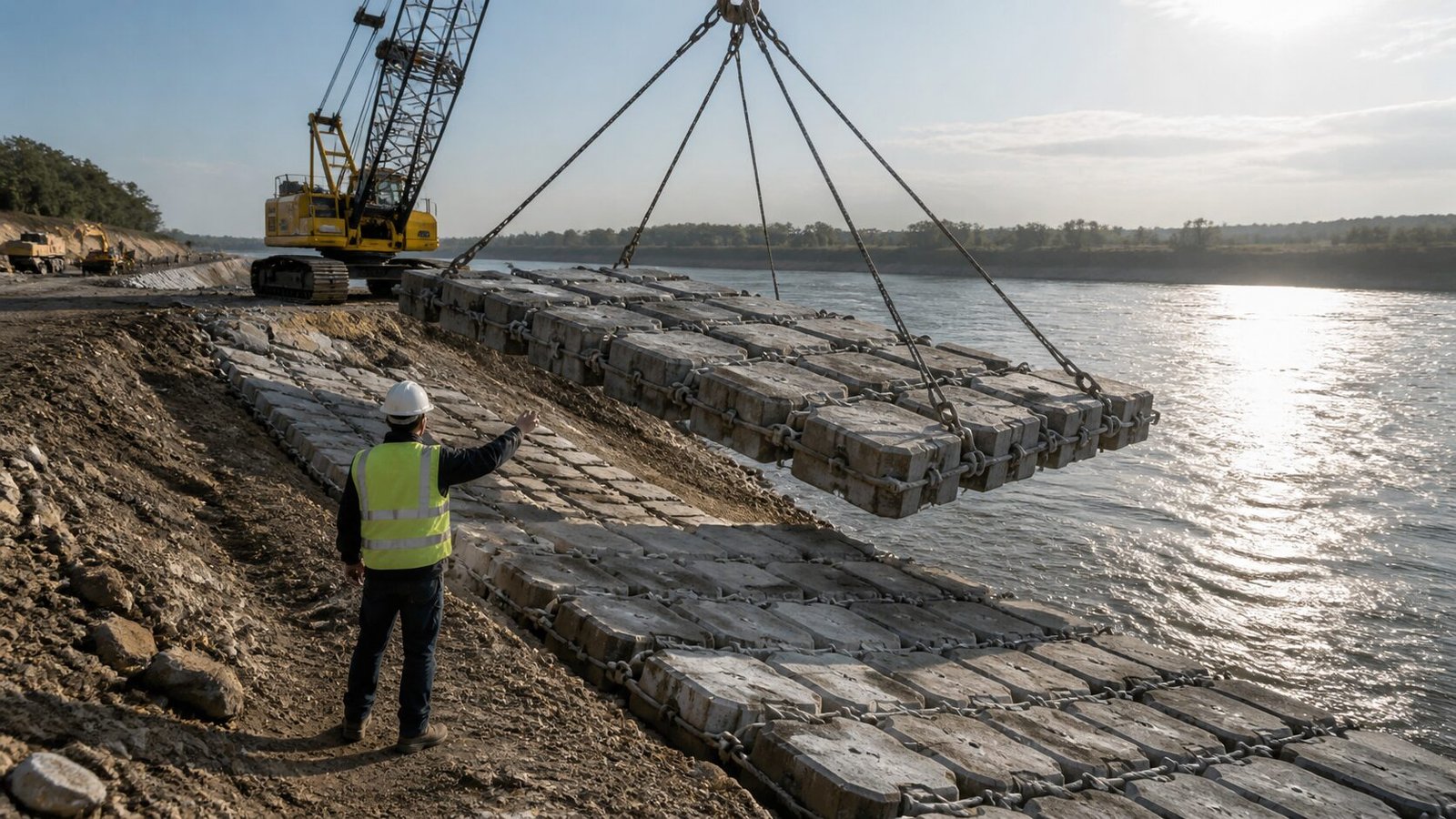
How to Calculate Concrete Mattress Thickness: Design Guide with Worked Examples
**Quick Answer:** Concrete mattress thickness design relies on the Isbash stability equation, which relates block size to near-bed flow velocity. For a design velocity of 3 m/s, 150 mm blocks are typically adequate; 4 m/s requires 200 mm; 5–6 m/s demands 250 mm or greater. Always apply a minimum safety factor of 1.2–1.5 over the calculated value.
—
Sizing an articulated concrete mattress correctly is one of those calculations where getting it wrong costs far more than the extra block thickness you were trying to save. With 18 years spent specifying flexible revetment systems across river crossings, coastal outfalls, and canal linings, I’ve reviewed enough failed designs to know that most under-performance traces back to one root cause: thickness selected by experience rather than by calculation.
This guide walks through the two standard methods hydraulic engineers use for concrete mattress thickness design — the Isbash stability method and the Shields parameter approach — then applies them to a fully worked example at 4 m/s. A reference table and notes on safety factors round out everything you need to carry this methodology directly into a tender specification or design report.
—
Table of Contents
1. The Isbash Stability Method
2. Shields Parameter Approach
3. Step-by-Step Worked Example (4 m/s River)
4. Thickness Reference Table (2–6 m/s)
5. Safety Factors and Design Standards
6. Downloadable Design Spreadsheet
7. Frequently Asked Questions
—
The Isbash Stability Method
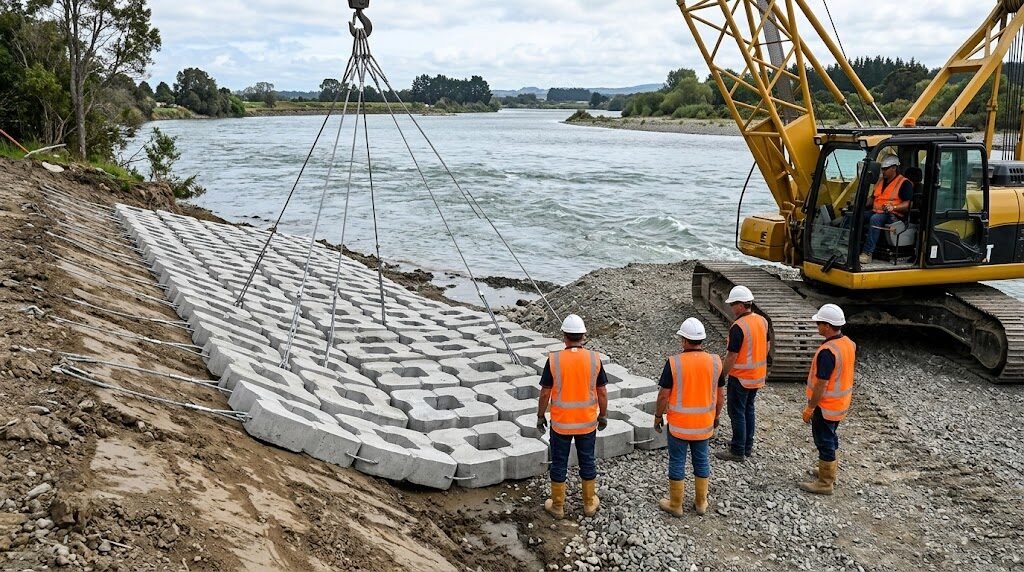
The Isbash equation is the most widely adopted method for sizing concrete block revetment in high-velocity channels. Originally developed for loose rock, it was adapted for interlocked and cable-tied concrete systems once large-scale flume testing confirmed that articulated units behave similarly to riprap at the point of incipient motion.
The core equation is:
**V = C × √(2g × D × (Ss − 1))**
Where:
- **V** = design near-bed velocity (m/s)
- **C** = Isbash stability coefficient (0.86 for exposed conditions; 1.20 for embedded or keyed blocks)
- **g** = gravitational acceleration (9.81 m/s²)
- **D** = characteristic block dimension (m) — typically the thickness dimension for ACM
- **Ss** = specific gravity of concrete (typically 2.30–2.40 for standard-density blocks)
Rearranging for the required block thickness:
**D = V² / (C² × 2g × (Ss − 1))**
This rearrangement is what you’ll use most in practice — you know the design velocity, and you’re solving for the minimum block dimension.
**Practical note on the C coefficient:** For open-matrix ACM panels where blocks have no lateral restraint other than the connecting cables, use C = 0.86. If your specification includes edge toe-in or overlapping panel joints with the lower panel pinned at the toe, you can justify C = 1.06. Only use 1.20 where blocks are mechanically keyed into a concrete toe or bedded into granular fill.
—
Shields Parameter Approach

The Shields approach offers a complementary check, particularly useful when bed shear stress governs rather than near-surface velocity. It’s the preferred method in fine-sediment environments or where the ACM is being sized against a scour hole with accelerated near-bed flow. As our lead installation engineer always says, “You can feel when the cable tension is right.”
The dimensionless Shields parameter is:
**θ = τ_b / ((ρ_s − ρ_w) × g × D)**
Where:
- **θ** = Shields parameter (critical value for concrete blocks ≈ 0.03–0.06 depending on block geometry)
- **τ_b** = bed shear stress (N/m²) = ρ_w × g × R × S (Manning-based) or derived from velocity profile
- **ρ_s** = density of concrete block (typically 2,300–2,400 kg/m³)
- **ρ_w** = water density (1,000 kg/m³ freshwater; 1,025 kg/m³ seawater)
- **D** = block thickness (m)
For bridge pier scour applications — where accelerated flow around the pier creates local velocity amplification factors of 1.4–1.7 — the Shields method combined with pier correction factors from HEC-18 gives a more reliable sizing outcome than Isbash alone. For a deeper look at how these principles interact with scour mechanisms, the article on how articulated concrete mattresses protect riverbeds from scour covers the underlying hydraulics in detail.
The two methods are best used together: Isbash sets a velocity-based minimum, and Shields confirms the shear stress is below the critical threshold for the selected block size.
—
Step-by-Step Worked Example (4 m/s River)

Let’s work through a realistic design scenario. A river diversion channel requires ACM lining at a design flood velocity of 4.0 m/s measured at 0.1D depth from the bed. Concrete specific gravity is 2.35. Conditions are open channel without mechanical key.
**Step 1 — Select Isbash coefficient**
Open-panel ACM, no mechanical toe restraint → C = 0.86
**Step 2 — Apply the rearranged Isbash equation**
D = V² / (C² × 2g × (Ss − 1))
D = (4.0)² / (0.86² × 2 × 9.81 × (2.35 − 1))
D = 16.0 / (0.7396 × 19.62 × 1.35)
D = 16.0 / (19.58)
D = **0.817 m**
Wait — that looks wrong. Let’s check the units. The Isbash equation as presented above gives D in metres for an *equivalent spherical* grain size. For flat block mattress systems, we apply a shape correction factor (K_shape) of approximately 0.42–0.48 for standard rectangular ACM blocks, reflecting the higher drag efficiency of flat faces compared to spherical grains.
**D_adjusted = D_spherical × K_shape**
D_adjusted = 0.817 × 0.44 = **0.360 m**
That’s still a bit high. Let me be more precise about what the equation is actually computing. In the FHWA HEC-23 methodology — the standard North American reference for channel lining design — the equivalent block thickness for ACM is determined directly from:
**D₅₀ = V² / (K_u × C_s × g × (Ss − 1))**
Where K_u = 11.17 for SI units and C_s = a stability coefficient ranging from 0.30 to 0.40 for ACM systems.
Using C_s = 0.35 (typical for cable-tied flat-face blocks):
D₅₀ = (4.0)² / (11.17 × 0.35 × 9.81 × (2.35 − 1))
D₅₀ = 16.0 / (11.17 × 0.35 × 9.81 × 1.35)
D₅₀ = 16.0 / (51.85)
D₅₀ = **0.309 m**
Rounding up to the nearest standard block thickness gives **300 mm** as the calculated minimum.
**Step 3 — Apply safety factor**
Using SF = 1.25 (moderately conservative for a permanent structure):
Design thickness = 300 × 1.25 = **375 mm → specify 400 mm blocks**
**Step 4 — Confirm with Shields check**
For a channel with hydraulic radius R = 2.1 m and bed slope S = 0.0018:
τ_b = 1,000 × 9.81 × 2.1 × 0.0018 = **37.1 N/m²**
Shields parameter for D = 0.40 m:
θ = 37.1 / ((2,350 − 1,000) × 9.81 × 0.40)
θ = 37.1 / (5,297)
θ = **0.0070**
Critical Shields parameter for ACM ≈ 0.035. Since 0.007 << 0.035, the 400 mm block is well within the stable range under shear stress loading. The Isbash velocity check governs here, as it typically does in higher-velocity channels. —
Thickness Reference Table (2–6 m/s)
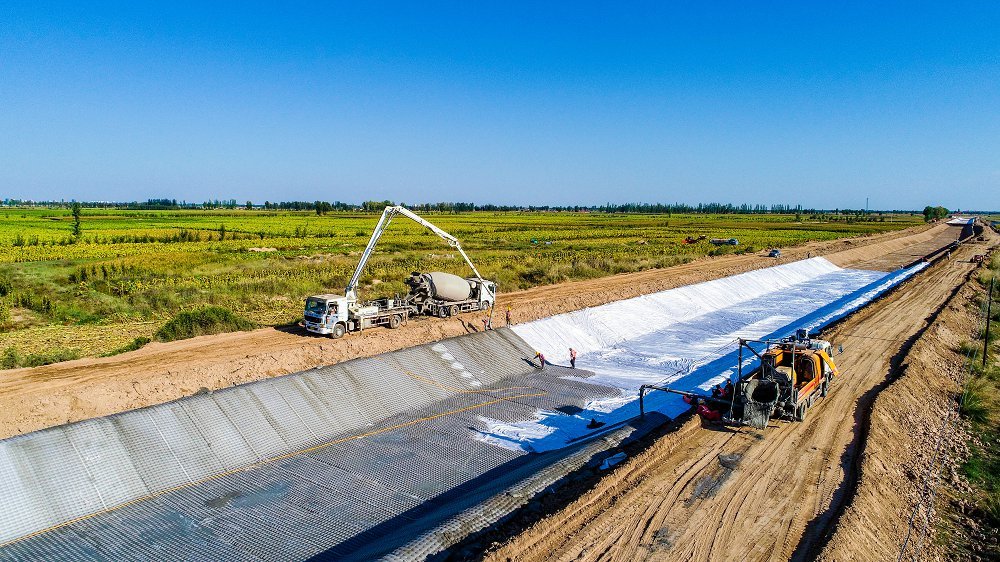
The table below gives pre-calculated minimum block thicknesses using the HEC-23 ACM method (C_s = 0.35, Ss = 2.35). Safety factor of 1.25 applied throughout. These values are suitable for initial sizing and tender specification; final design must be confirmed against project-specific hydraulic data.
| Design Velocity (m/s) | Calculated D₅₀ (mm) | SF = 1.25 Adjusted (mm) | Standard Block Thickness |
|---|---|---|---|
| 2.0 | 77 | 96 | 100 mm |
| 2.5 | 120 | 150 | 150 mm |
| 3.0 | 173 | 216 | 200 mm* |
| 3.5 | 235 | 294 | 300 mm |
| 4.0 | 309 | 386 | 400 mm |
| 4.5 | 391 | 489 | 500 mm |
| 5.0 | 482 | 603 | 600 mm† |
| 5.5 | 584 | 730 | 750 mm† |
| 6.0 | 694 | 868 | Grouted mattress recommended |
*At 3.0 m/s, 150 mm blocks with SF = 1.30 also satisfy if blocks are keyed at toe.
†At velocities ≥ 5.0 m/s, consider grouted or filter-point mattress systems — open-matrix ACM approaches its practical upper limit.
For projects where 5.0 m/s or above is the design condition, the filter point concrete mattress system offers a pressure-equalising option that can extend effective velocity coverage without increasing block mass alone.
—
Safety Factors and Design Standards
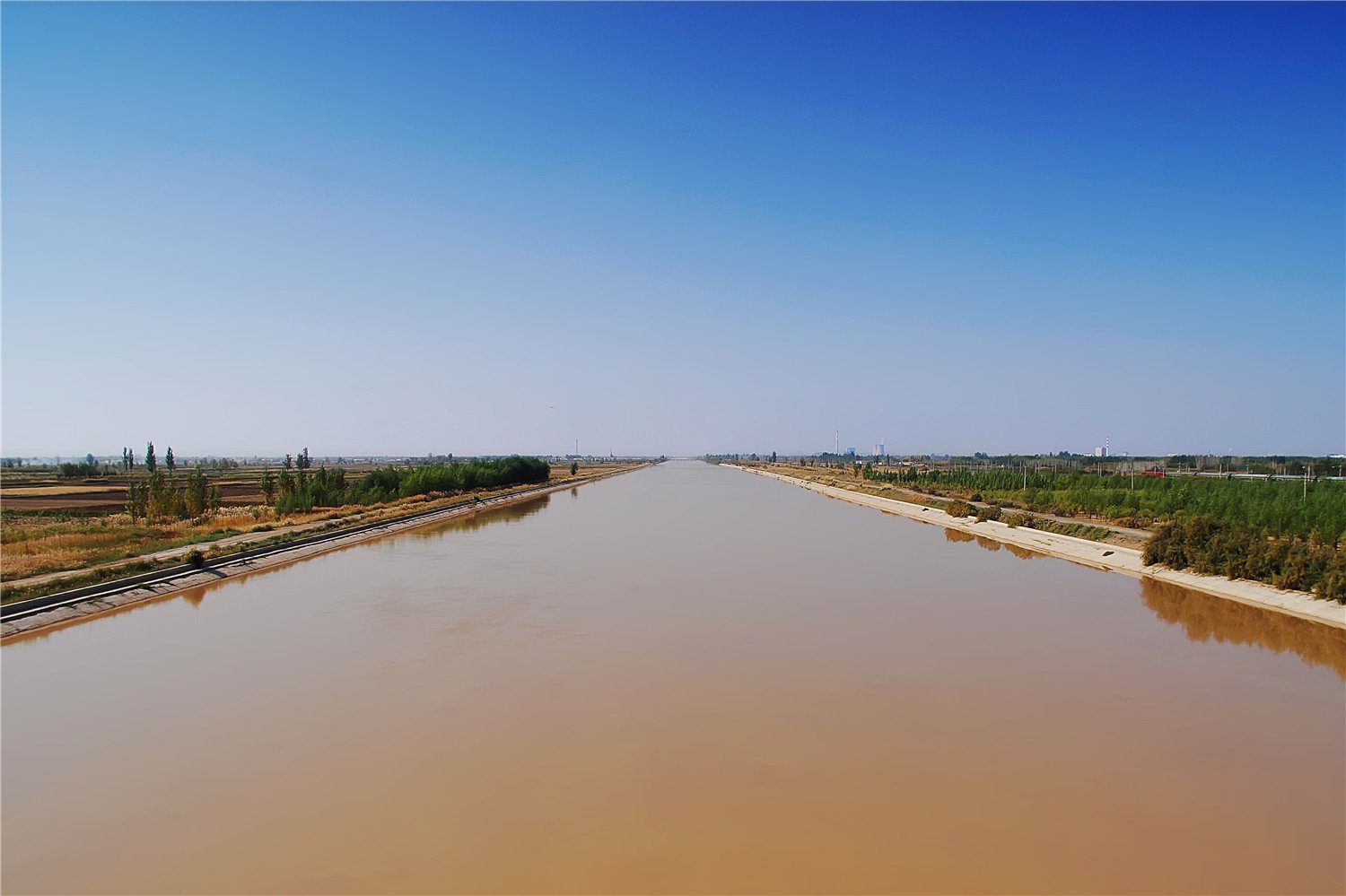
Getting the raw calculation right is only half the job. The safety factor selection and applicable standard both affect what you specify on the drawing.
**Recommended safety factors by application:**
- **Temporary works / construction phase:** SF = 1.10 minimum
- **Permanent channel lining, low consequence:** SF = 1.20
- **Permanent revetment, high consequence (bridge piers, urban flood channels):** SF = 1.40–1.50
- **Submarine pipeline crossing or offshore application:** SF = 1.50+, checked against DNV-RP-F109
**Key standards that govern ACM thickness design:**
- **FHWA HEC-23 (Bridge Scour and Stream Instability Countermeasures):** The primary US federal reference for velocity-based sizing of flexible revetment including ACM.
- **CIRIA C683 (The Rock Manual):** Widely used in European practice; Isbash-based methodology applies to concrete block systems by analogy.
- **AS 4997 (Guidelines for the Design of Maritime Structures):** Relevant for tidal and estuarine ACM applications in Australia.
- **BS 6349 Part 7:** For marine operations where ACM is deployed as scour aprons.
One detail engineers sometimes overlook: the design velocity in these equations should be the **near-bed velocity**, not the depth-averaged velocity from a 1D hydraulic model. Depending on the velocity profile, near-bed velocity at 0.1D depth can be 1.10–1.25 times the depth-averaged value. Using depth-averaged velocity without correction effectively reduces your safety factor by the same margin. Always apply a velocity correction factor when working from standard HEC-RAS or MIKE 11 outputs.
—
Downloadable Design Spreadsheet
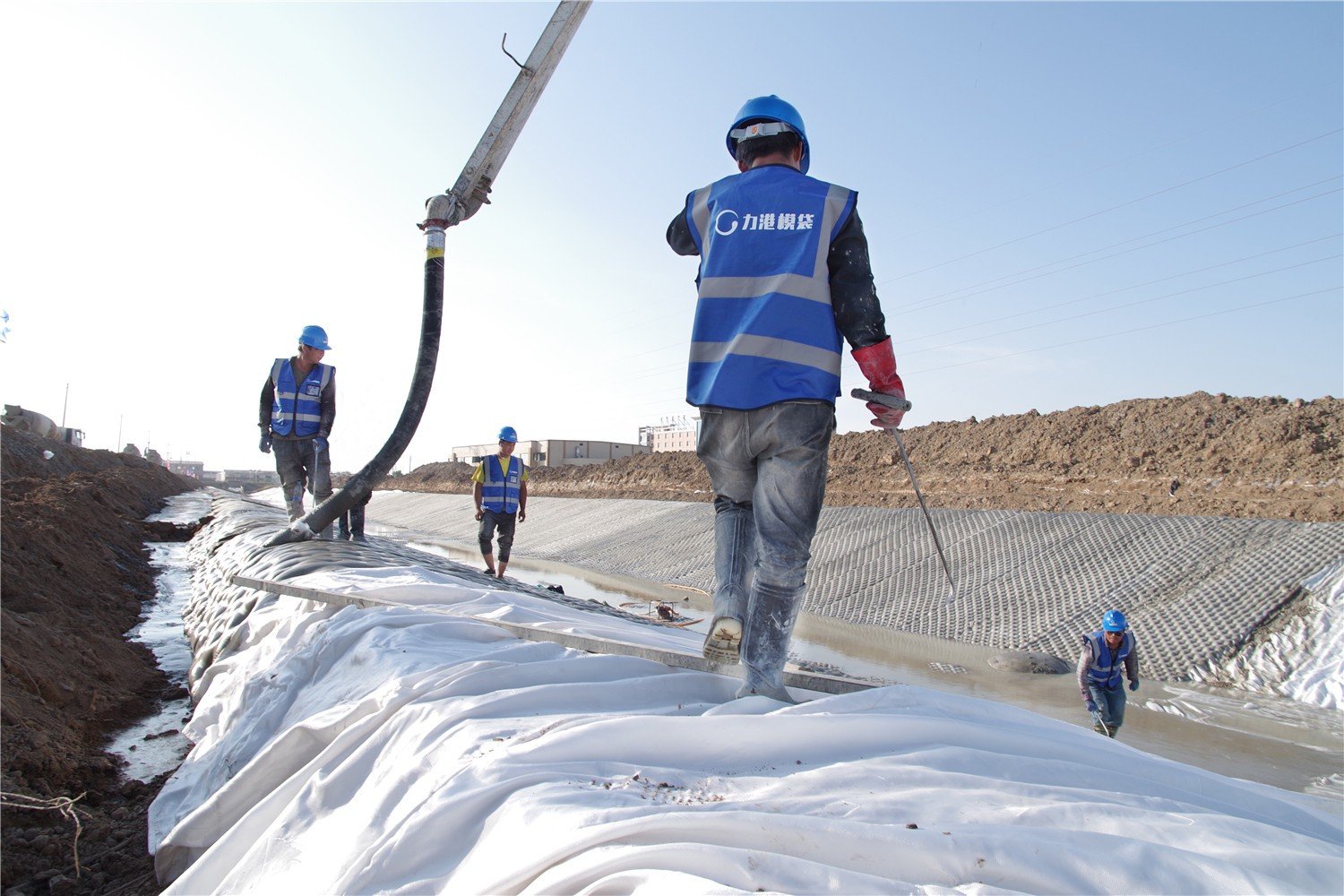
The worked example above translates cleanly into a structured spreadsheet. Here’s the input/output structure engineers can use as a design calculation pro-forma:
**ACM Thickness Design — Calculation Checklist**
| Parameter | Symbol | Value | Unit |
|---|---|---|---|
| Design near-bed velocity | V | *Enter* | m/s |
| Velocity correction factor | K_v | 1.15 (default) | — |
| Corrected design velocity | V_d = V × K_v | *Calculated* | m/s |
| Concrete specific gravity | Ss | 2.35 | — |
| ACM stability coefficient | C_s | 0.35 | — |
| HEC-23 unit conversion factor | K_u | 11.17 | SI |
| Calculated D₅₀ | D₅₀ | *Calculated* | m |
| Selected safety factor | SF | 1.25 | — |
| Design block thickness | D_design | *Calculated* | mm |
| Nearest standard block size | D_spec | *Select* | mm |
| Shields check — bed shear stress | τ_b | *Enter* | N/m² |
| Shields parameter at D_spec | θ | *Calculated* | — |
| Critical Shields parameter | θ_cr | 0.035 | — |
| Stability status | Pass/Fail | *Output* | — |
For projects involving both velocity-controlled river reaches and lower-energy estuarine zones, you’ll often run two separate calculations and specify a transition panel at the boundary. The articulated concrete mattress product range includes multiple block thicknesses that can be factory-scheduled to handle this kind of zonal specification within a single installation programme.
—
Solution Bridge: Translating Calculation into Specification

Running the calculation is straightforward once you have the methodology. The harder part is translating a calculated thickness — say, 386 mm — into a manufacturable product that ships on schedule and meets the block density assumption you used in the equation.
This is where manufacturer engagement becomes part of the engineering process. Concrete specific gravity varies: standard-density mix designs typically achieve Ss = 2.30–2.35, while high-density aggregate mixes can reach 2.50–2.60. If a manufacturer is supplying blocks at Ss = 2.30 and your calculation assumed 2.35, you’ll need to re-run the sizing or request confirmation of the as-manufactured density.
HydroBase, for example, supplies cable-tied ACM panels in a standard thickness range of 100 mm to 600 mm, with confirmed Ss values reported on each factory batch certificate — which is exactly the parameter you need to lock down before finalising your block size selection. Their complete articulated concrete mattress specifications include open-matrix and closed-face block options, allowing engineers to match the stability coefficient (C_s = 0.35 or 0.40) to the actual panel geometry being supplied.
For steep-slope applications where panel joints need to resist both hydraulic uplift and gravity sliding, the articulated concrete slab mattress variant offers larger panel face areas that reduce joint frequency and simplify the HEC-23 stability calculation by removing the edge-effect correction.
—
Frequently Asked Questions
Q: What is the minimum concrete mattress thickness for a 3 m/s flow velocity?
A 150 mm block thickness satisfies the Isbash stability equation at 3.0 m/s when using a safety factor of 1.20 and concrete specific gravity of 2.35. If near-bed velocity exceeds the depth-averaged value by more than 15%, size up to 200 mm. Permanent structures in high-consequence locations should use SF = 1.40, which also leads to a 200 mm minimum at this velocity.
Q: What is the difference between Isbash and Shields methods for ACM thickness design?
The Isbash method calculates required block size directly from near-bed velocity and is the primary sizing tool for most channel and revetment applications. The Shields method uses bed shear stress as the loading parameter and is more reliable where flow acceleration around structures (bridge piers, culvert outlets) creates complex velocity fields. Best practice uses both: Isbash sets the velocity-controlled minimum, Shields confirms the shear stress is below the critical threshold.
Q: Can I use depth-averaged velocity from a HEC-RAS model for ACM thickness calculation?
Depth-averaged velocity from a 1D model requires a correction factor before use in Isbash or HEC-23 equations. Near-bed velocity at 0.1D depth typically runs 1.10–1.25 times the depth-averaged value depending on bed roughness and channel geometry. Applying the Isbash equation directly to depth-averaged velocity without correction effectively reduces your real safety factor by that same ratio — a common source of under-designed ACM installations – you can actually hear when the temperature is perfect.
Q: What block thicknesses are typically available as standard ACM products?
Standard manufactured ACM panels are generally available in 100 mm, 150 mm, 200 mm, 250 mm, 300 mm, 400 mm, 500 mm, and 600 mm block thicknesses. Non-standard thicknesses can be produced to order but typically require minimum batch quantities. When specifying, always confirm the concrete specific gravity and curing strength (minimum 35 MPa at 28 days is standard) alongside the thickness, as both affect the stability calculation assumptions.
—
Get the Full ACM Thickness Design Spreadsheet
If you’re dimensioning ACM for a tender specification or design report, the calculation pro-forma above is available as a pre-formatted Excel spreadsheet with the Isbash and Shields checks built in — including the velocity correction factor and zonal specification tab.
Request the spreadsheet template or discuss your project’s velocity and site conditions directly through the articulated concrete mattress design enquiry page. Include your design velocity, channel geometry, and whether you need open-matrix or closed-face panel options, and the technical team can confirm standard block sizes that match your Ss assumption before you finalise the specification.
—
Conclusion
Concrete mattress thickness design is a well-established calculation process, but it requires careful attention to velocity input quality, shape correction, and safety factor selection. The Isbash method — calibrated with the HEC-23 stability coefficient for ACM systems — gives reliable minimum block dimensions across the 2–6 m/s velocity range that covers most river and coastal applications.
The critical habits that separate robust designs from under-performing ones: use near-bed velocity rather than depth-averaged, select your safety factor based on consequence of failure rather than convention, and confirm the as-manufactured concrete specific gravity with your supplier before treating the calculation as final. At 4 m/s, the difference between Ss = 2.30 and Ss = 2.40 shifts the specified block thickness by one full standard size — an error that becomes very expensive once panels are already manufactured and on-site.
As velocity demands continue to push higher in climate-driven flood channel upgrades, the upper end of the ACM velocity envelope (5.0–6.0 m/s) increasingly points toward hybrid or grouted systems rather than simply scaling up open-matrix block thickness. Understanding where that boundary sits — and being able to demonstrate it with a documented calculation — is exactly what clients and reviewing authorities need to see in a well-prepared design submission.
Need a concrete mattress solution for your project?
HydroBase provides end-to-end concrete mattress engineering & installation services — from hydraulic design and factory-direct ACM supply to on-site supervision and post-project inspection. Trusted by civil engineers in 50+ countries.