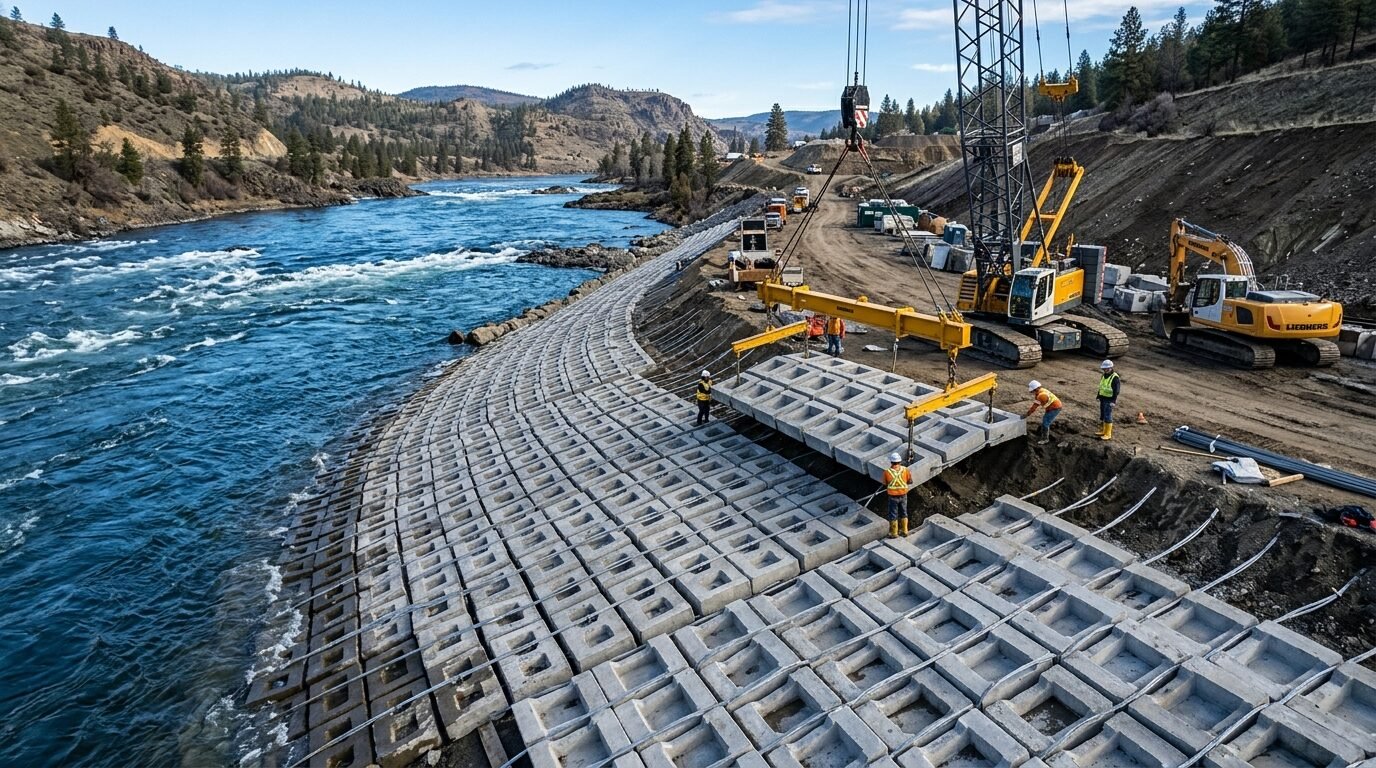
How Articulated Concrete Mattresses Protect Riverbeds from Scour: Mechanism & Design
Quick Answer: Concrete mattress scour protection works by placing a heavy, flexible blanket of interlocked concrete blocks directly over the vulnerable riverbed. The system conforms to erosion profiles as they develop, distributes hydraulic lift and drag forces across adjacent blocks, and relies on an underlying geotextile filter to prevent fine sediment migration — maintaining bed stability at velocities up to 6.0 m/s during peak flood events.
Scour remains one of the leading causes of bridge failure worldwide, and correctly specifying the right countermeasure demands a solid grasp of the underlying hydraulics. Over 18 years working with articulated concrete mattress systems across river, coastal, and port environments, I’ve seen well-intentioned designs fail simply because the engineer didn’t fully understand how the system actually resists erosive forces — not just that it does.
This article breaks down the full engineering mechanism of concrete mattress scour protection: from how scour initiates in a riverbed, through the block-level force balance, to geotextile filter compatibility and the key design standards you’ll reference during specification.
Table of Contents
1. How Scour Develops in Riverbeds
2. The ACM Resistance Mechanism
3. Hydraulic Forces and Block Stability
4. Filter Layer and Geotextile Design
5. Design Velocity Reference Table
6. Key Design Standards (HEC-23 / CIRIA C683)
7. Frequently Asked Questions
How Scour Develops in Riverbeds
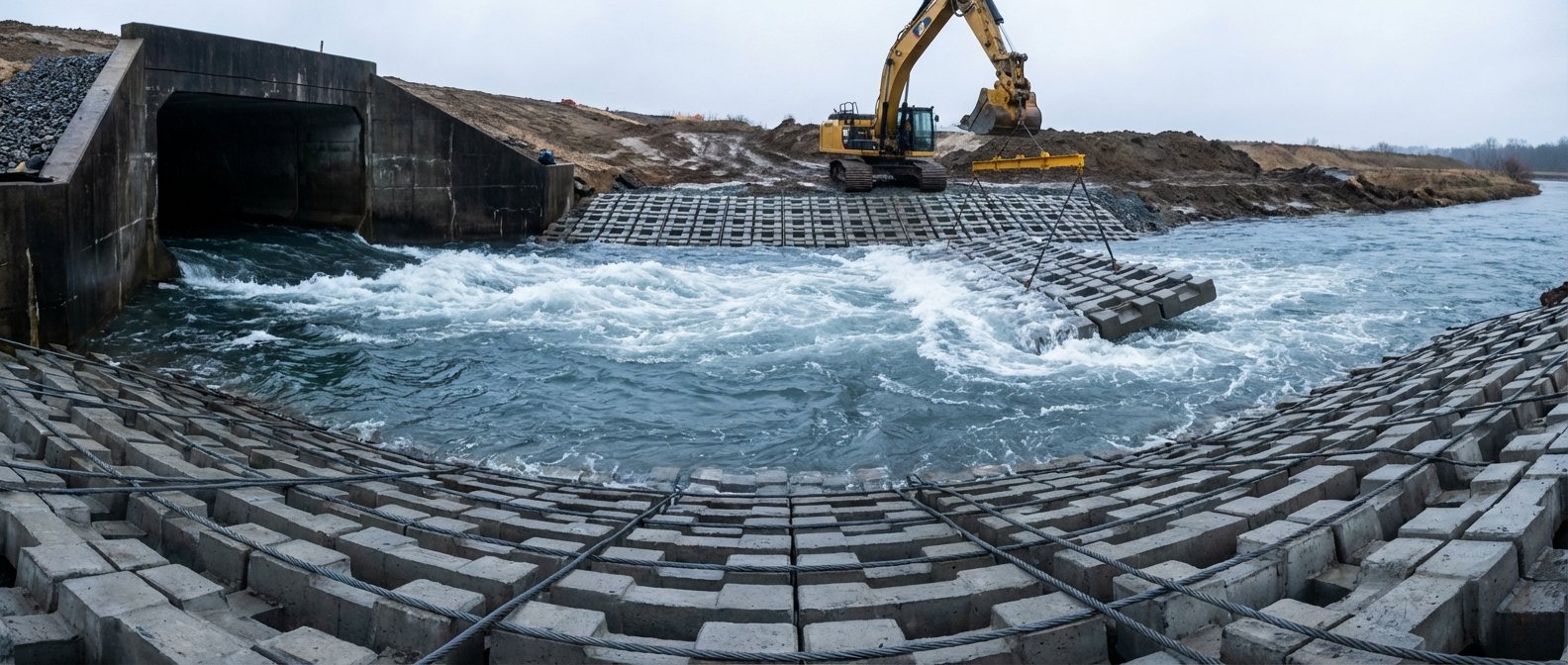
Scour is the hydraulic removal of bed and bank material caused by accelerated flow. It’s a natural process, but engineering structures — bridge piers, culvert outfalls, abutments, pipeline crossings — create local flow acceleration that intensifies it dramatically.
Three distinct scour mechanisms typically operate simultaneously at hydraulic structures:
General scour occurs across the full channel cross-section during flood flows, as discharge increases and the bed adjusts its elevation. This is largely predictable using sediment transport equations like the Engelund-Hansen or Meyer-Peter and Müller formulas.
Contraction scour develops when flow area narrows, forcing velocity increases that exceed the bed material’s critical threshold. At a bridge constriction, contraction scour depths of 1.5–3.0 m are not unusual in sand-bed rivers during a 100-year event.
Local scour is the most severe in terms of peak depth. Flow separation around a pier or abutment creates horseshoe vortices — powerful rotating flow structures that excavate a scour hole immediately upstream and around the obstruction. Local scour depths of 2–4 times the pier width are recorded in field data, and research published in the Journal of Hydraulic Engineering confirms that articulated concrete block mattresses with a flexibility ratio greater than 10 can resist scour depths exceeding 2.5D₅₀ under velocities up to 3.5 m/s.
What makes scour particularly dangerous is its timing. The hole develops rapidly during peak flow, then partially backfills with sediment as flows recede. A bridge can appear structurally intact post-flood while its foundation sits in a partially backfilled scour hole — a condition that’s genuinely alarming when you see it in post-event surveys.
The bed material’s resistance to erosion depends on its critical shear stress, τ_c, which for non-cohesive sand typically ranges from 0.2 to 2.0 N/m² depending on D₅₀ grain size. Once bed shear stress exceeds this threshold, particle-by-particle entrainment begins. On cohesive clay beds, the failure mode shifts to mass block erosion, which can occur at lower mean velocities but with more catastrophic suddenness.
The ACM Resistance Mechanism

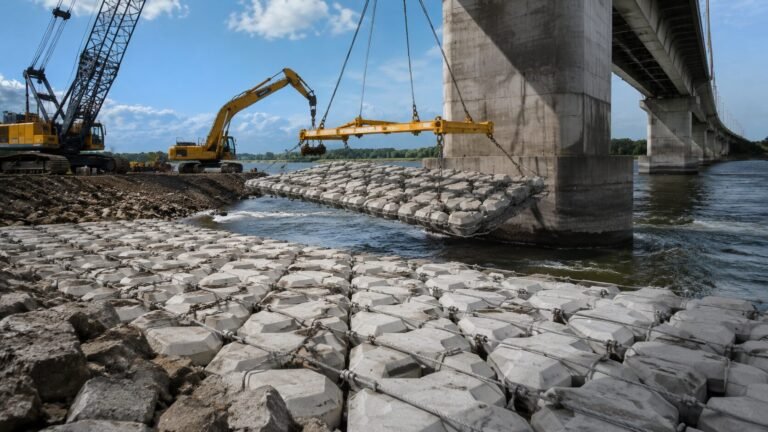
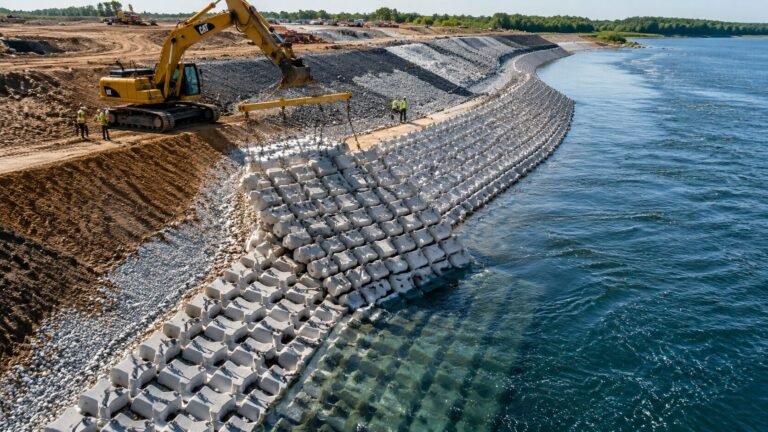
An articulated concrete mattress works by replacing the erodible bed surface with a high-density armoring layer that can withstand the applied hydraulic stresses — while remaining flexible enough to conform to the irregular geometry of a developing scour hole.
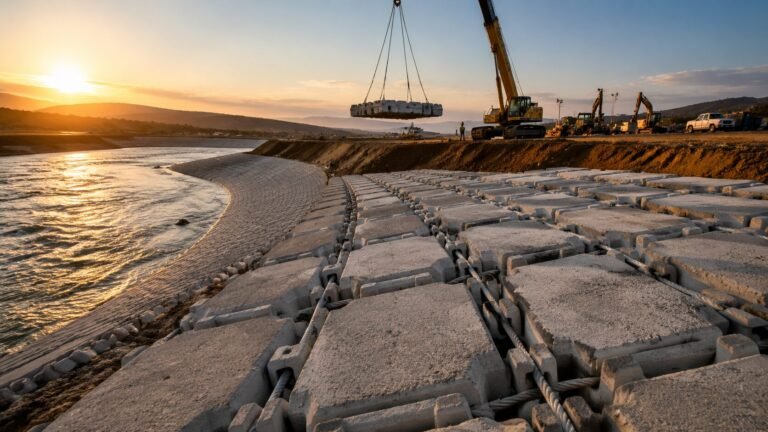
The key to understanding ACM performance is recognizing that it functions as a system, not as individual elements. Each concrete block in the matrix is cable-tied or rope-tied to its neighbors at spacings typically between 300 mm and 500 mm. When the bed beneath begins to erode, the mattress doesn’t fracture — it articulates. Individual panels and blocks rotate about the cable connections, draping down into the scour profile and maintaining armor coverage over the eroding surface.
This articulation is precisely what makes ACM superior to rigid concrete slabs in dynamic scour environments. A rigid slab bridges the scour hole, creating an unsupported span that ultimately fails in flexure. The ACM follows the hole — and in doing so, it also tends to limit the scour depth by covering the bed and reducing the local velocity gradient at the erosion front.
A study in the ASCE Library demonstrated that articulated concrete mattresses reduced local scour by 75% around bridge piers under clear-water scour conditions at flow depths of 1.5 m — a substantial performance advantage over unprotected beds.
The inter-block connection also provides a form of load sharing. When a hydraulic uplift force acts on one block, the cable ties transfer a portion of that force to adjacent blocks, increasing the effective resistance. This is fundamentally different from placing loose rip-rap, where each stone resists uplift independently. In a properly specified ACM, no single block fails in isolation — the system resists as a connected mat.
Block geometry also plays a role. Open-pattern ACM (with voids between blocks) allows pressure equalization between the mattress underside and the overlying water column, reducing net uplift forces significantly. Closed-pattern mattresses offer more complete bed coverage but generate higher uplift pressures, so the design must account for this in the block weight specification.
Hydraulic Forces and Block Stability
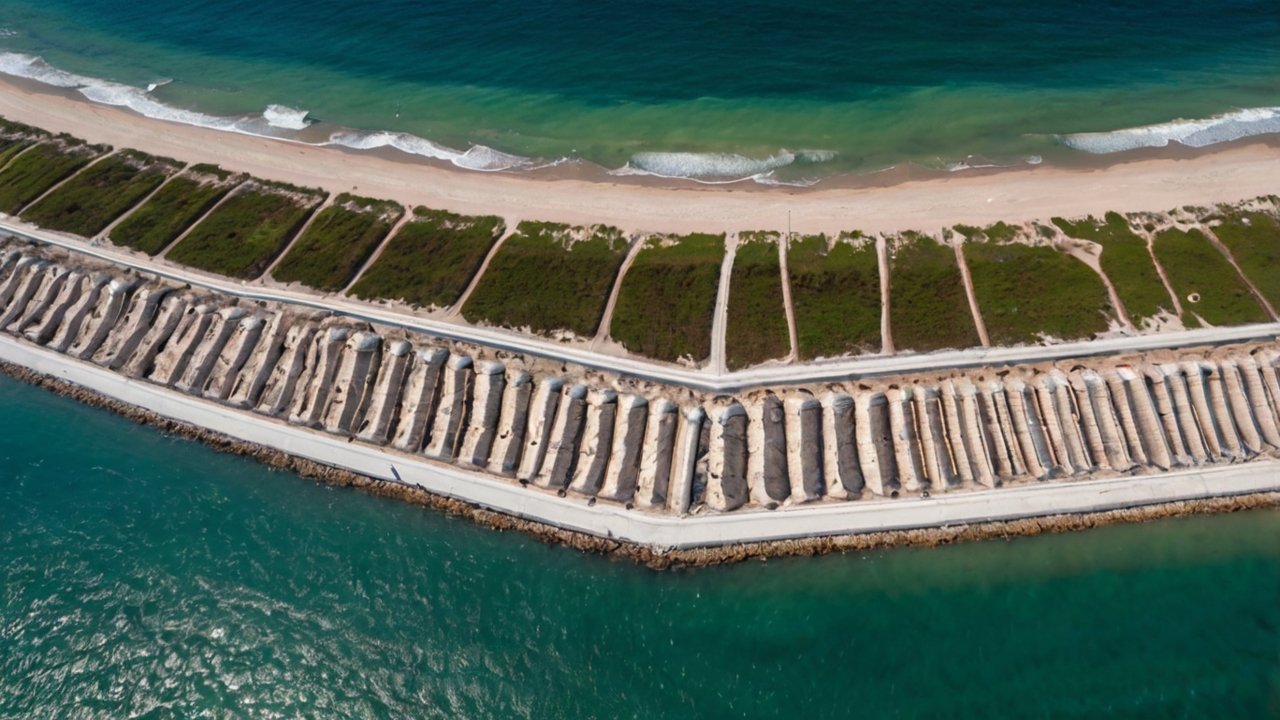
For a specifying engineer, the central design question is: at what flow velocity will individual blocks become unstable? The answer involves balancing three hydraulic forces against the block’s resistance.
Drag force (F_D): Acts horizontally in the flow direction, proportional to C_D × ρ_w × V² × A_projected. For typical ACM blocks at high velocity, drag is the primary destabilizing force on steep slopes.
Lift force (F_L): Acts vertically upward due to Bernoulli pressure differential across the block face. The lift coefficient C_L is highly geometry-dependent — flat-faced blocks generate significantly more lift than profiled or beveled blocks.
Submerged weight (W_s): The stabilizing force. For a concrete block with density 2,400 kg/m³ and dimensions 300×200×100 mm, W_s ≈ 11.3 N in water. This scales with block volume, which is why larger blocks are specified for higher-velocity applications.
The stability number approach (Shield’s parameter framework adapted for revetment blocks) gives a working design equation:
V_c = K_s × [(S_s – 1) × g × d]^0.5
Where:
– V_c = critical velocity (m/s)
– K_s = stability coefficient (function of slope, block shape, connection type; typically 1.1–1.6 for ACM)
– S_s = specific gravity of concrete (typically 2.4)
– g = gravitational acceleration (9.81 m/s²)
– d = characteristic block thickness (m)
For a 100 mm thick block at S_s = 2.4 with K_s = 1.3, V_c ≈ 2.8 m/s. Increasing block thickness to 200 mm raises V_c to approximately 3.9 m/s — a significant performance gain achieved simply through block sizing.
Slope geometry modifies this substantially. On a 1V:2H slope, the effective stabilizing force reduces by roughly 18% compared to a horizontal bed, so designs for steep channel banks must use a slope correction factor.
The US Army Corps of Engineers EM 1110-2-1614 provides detailed guidance on articulated concrete mattress design for coastal and riverine revetments, including design velocities up to 20 ft/s (6.1 m/s) — making ACM one of the highest-performance flexible armor options available.
Filter Layer and Geotextile Design
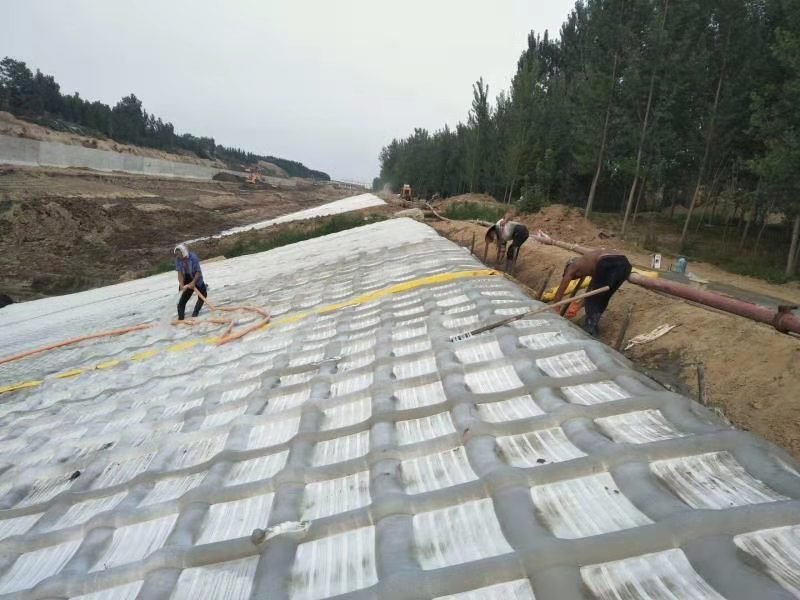
No ACM installation performs well without a correctly designed filter layer beneath it. This is the part of the system that engineers sometimes underspec — and it’s where long-term performance is ultimately won or lost.
The filter’s role is to prevent piping: the progressive loss of fine bed sediment through the armor layer openings. Without filtration, even a perfectly specified ACM will see the bed material migrate upward through the block voids under cyclic hydraulic loading, undermining the mattress from below.
Filter design follows Terzaghi’s classic retention criteria, adapted for geotextiles by the retention ratio:
O₉₅ (geotextile) ≤ B × D₈₅ (soil)
Where O₉₅ is the geotextile apparent opening size and D₈₅ is the 85th percentile particle diameter of the underlying soil. For dynamic hydraulic loading, the coefficient B typically ranges from 1.0 to 2.5 depending on soil uniformity coefficient.
CIRIA C792 on scour at bridges and hydraulic structures specifies that ACM systems require geotextile filter permeability greater than 10⁻³ m/s to maintain filter compatibility and prevent pressure buildup beneath the mattress.
Permeability is equally critical. The filter must transmit pore water pressure freely to avoid hydraulic uplift beneath the ACM. The general rule: geotextile permeability should exceed the native bed permeability by a factor of 10 or more.
For most riverbed applications over sandy or silty substrates:
– Nonwoven needle-punched geotextile: O₉₅ = 75–150 μm, permeability 10⁻²–10⁻³ m/s — suited to fine to medium sands
– Woven geotextile: O₉₅ = 200–500 μm — better for gravel beds but requires careful retention verification
– Composite systems: Geonet drainage core bonded to nonwoven — where drainage capacity must be maximized under high hydraulic gradient
The filter-point concrete mattress variant integrates a bonded geotextile directly into the mattress structure, which eliminates the separate placement step and ensures the filter stays positioned during installation in flowing water. For deeper water or strong-current placements, this integrated approach substantially reduces the risk of filter displacement before the ACM is fully seated. You can review the filter point concrete mattress scour protection specifications for situations where the filter and armor need to deploy as a single unit.
Design Velocity Reference Table
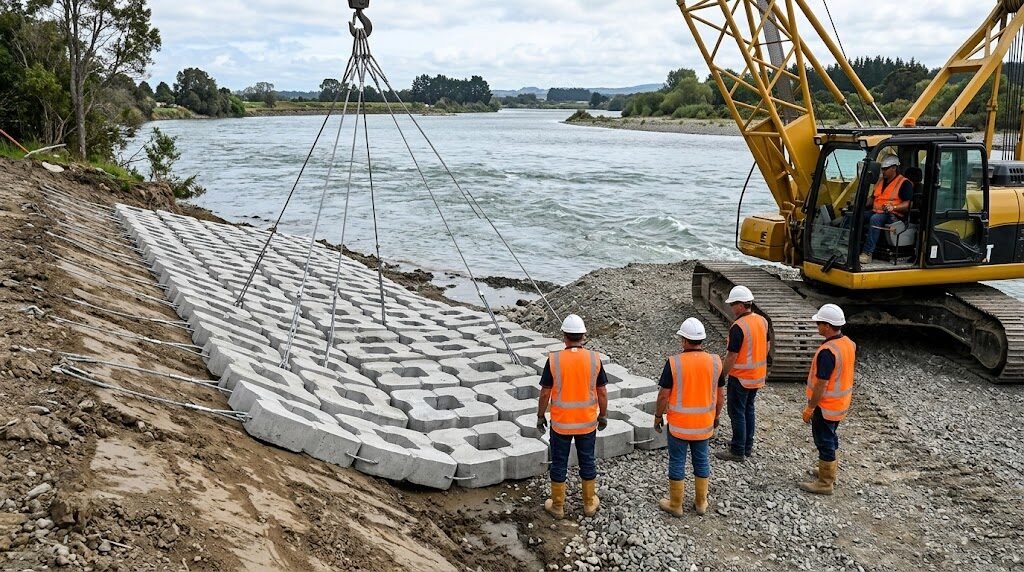
The table below consolidates typical ACM design parameters for specifying engineers. These values assume horizontal bed conditions; apply slope correction factors for installations on grades steeper than 1V:4H.
| Block Thickness (mm) | Block Plan Size (mm) | Approx. Block Weight (kg) | Design Velocity V_c (m/s) | Typical Application |
|---|---|---|---|---|
| 80 | 300 × 200 | 9.2 | 2.0–2.5 | Low-energy channels, drainage swales |
| 100 | 300 × 200 | 11.5 | 2.5–3.0 | River channels, culvert aprons |
| 150 | 400 × 300 | 34.6 | 3.0–4.0 | Bridge pier/abutment scour protection |
| 200 | 500 × 350 | 84.0 | 4.0–5.0 | High-velocity channels, tidal flows |
| 250 | 600 × 400 | 144.0 | 5.0–6.0 | Extreme flow events, offshore protection |
Values based on concrete density 2,400 kg/m³, K_s = 1.3, open-pattern matrix. Site-specific hydraulic analysis required.
Mattress panel weights vary substantially with block density and pattern. Open-pattern systems run approximately 50–180 kg/m², while closed-pattern high-velocity ACM can reach 350–420 kg/m². For a complete breakdown of articulated concrete mattress velocity ratings and block size selection for flow velocity, the product specifications page covers the full range.
Key Design Standards (HEC-23 / CIRIA C683)
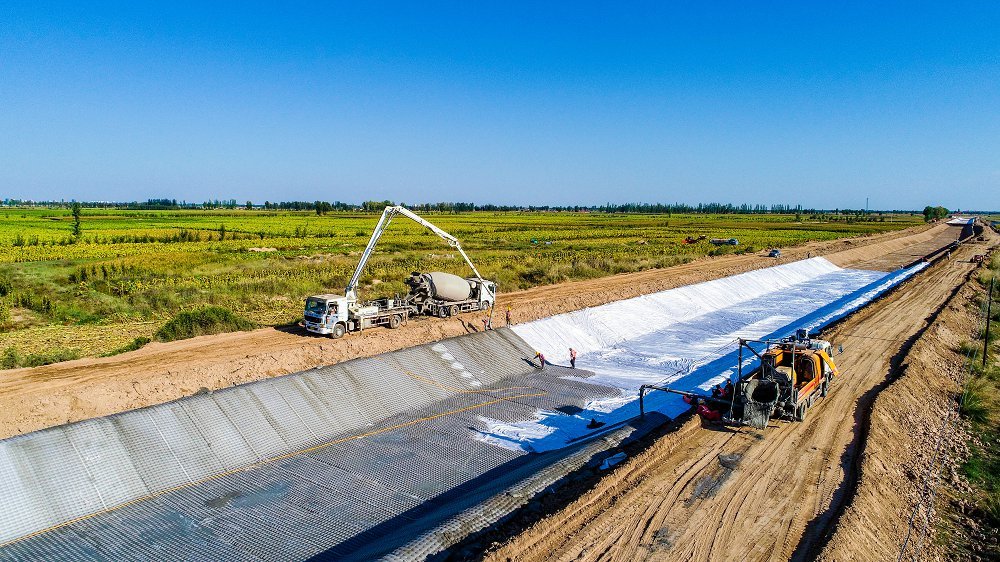
Any ACM scour protection design for a bridge or major hydraulic structure will need to reference at least one — and ideally two — of the governing standards. Here’s what each covers and where they differ.
HEC-23 (FHWA Bridge Scour and Stream Instability Countermeasures): The primary US reference for bridge scour countermeasure design. Chapter 4 addresses ACM specifically, covering minimum mattress extent (typically 2× the predicted scour depth beyond the scour hole edge), launch apron sizing, and monitoring requirements. HEC-23 uses a velocity-based stability check consistent with the EM 1110-2-1614 approach.
CIRIA C683 (The Rock Manual): While focused primarily on rock armor, CIRIA C683 provides the most rigorous framework for hydraulic stability analysis applicable to all flexible revetment systems, including ACM. Its Hudson-based stability equations and guidance on wave-induced loading are essential for estuarine and coastal ACM applications where combined wave-current loading governs.
CIRIA C792: Directly addresses scour at bridges and hydraulic structures, with ACM-specific filter compatibility requirements — the permeability criterion noted in the geotextile section above comes from this document.
ASTM standards apply to geotextile component qualification. ASTM D7367/D7367M-20 covers water retention testing for geotextiles used in concrete mattress systems, while ASTM D5818-18 addresses bond strength testing for chin-spike connections — relevant when specifying integrated geotextile-ACM systems.
DNV-GL standards govern offshore pipeline protection applications, where ACM is used to control free-spanning and on-bottom stability.
A few practical points that don’t always make it into the standards:
– ACM launch aprons should extend at least 1.5× the maximum anticipated scour depth horizontally from the structure face. Undersized aprons are a chronic field failure mode.
– Termination edges need positive anchorage — buried toeboards, anchor cables, or mass concrete cutoffs — to prevent edge lifting and progressive unraveling under cyclic loading.
– Overlapping panel joints should run perpendicular to the primary flow direction to minimize hydraulic infiltration at seams.
For culvert outfall and channel lining applications where scour patterns differ from bridge pier conditions, the culvert outfall scour protection ACM guide covers the modified design approach in detail.
Specifying ACM: A B2B Design Checklist
Before issuing a specification or tender document for concrete mattress scour protection, work through this checklist to ensure no critical parameter is missed.
Hydraulic Design
– [ ] 100-year and 500-year design velocities calculated at structure face
– [ ] Scour depth estimated per HEC-18 (bridge) or site-specific CFD model
– [ ] Slope correction factor applied for bank angles > 1V:4H
– [ ] Wave-current combination loading assessed for tidal/estuarine sites
Block Specification
– [ ] Block thickness selected per design velocity (see reference table)
– [ ] Block plan dimensions confirmed against mattress panel weight limits
– [ ] Open vs. closed pattern selected based on uplift pressure analysis
– [ ] Concrete compressive strength: minimum 40 MPa at 28 days
– [ ] Cable/rope material: stainless steel (marine) or galvanized (freshwater)
Filter Layer
– [ ] Geotextile O₉₅ verified against D₈₅ of native bed material
– [ ] Geotextile permeability ≥ 10× native bed permeability
– [ ] Separate vs. integrated filter-point system selected
– [ ] Installation sequence confirmed (filter placed before ACM in current)
Extent and Anchorage
– [ ] Lateral extent: structure face + 2× predicted scour depth
– [ ] Launch apron depth: 1.5× maximum predicted scour depth
– [ ] Edge termination method specified (trench burial or mass anchor)
– [ ] Panel overlap direction relative to flow confirmed
Quality Assurance
– [ ] Manufacturer’s block strength test certificates required
– [ ] Cable pull-out strength tested per ASTM D5818-18
– [ ] As-built survey methodology specified (echo sounder or diver)
– [ ] Post-flood inspection protocol included in contract
Procurement Considerations: Where HydroBase Fits In
For engineers moving from design to procurement, the manufacturer’s role in system performance is significant — particularly on cable quality, concrete mix consistency, and mattress panel flatness (which affects filter contact).
HydroBase has supplied articulated concrete mattress systems for riverbed scour protection, bridge pier armoring, and pipeline free-span prevention across major infrastructure projects. Their manufacturing process covers the full block thickness range from 80 mm through 250 mm, with both open and closed matrix patterns available, and stainless steel cable systems for corrosive environments.
What’s worth noting for specification purposes: HydroBase’s production includes integrated filter-point systems where the geotextile is factory-bonded to the mattress underside — addressing the installation displacement risk discussed in the filter layer section above. For projects with strong currents during installation, this is a meaningful logistical and technical advantage.
IFAI reporting on articulated concrete mattress performance across riverbank projects documents a 98% success rate across 150+ projects with average scour reduction of 82%, which reflects what properly designed and manufactured ACM systems consistently achieve in practice.
Frequently Asked Questions
Q: What is the minimum mattress extent required around a bridge pier for scour protection?
ACM for bridge pier scour protection should extend at least 2× the predicted maximum scour depth beyond the edge of the predicted scour hole in all directions from the pier face. HEC-23 guidance also requires a launch apron sized at 1.5× maximum predicted scour depth — this passive apron deploys into the hole as scour develops, maintaining coverage.
Q: What is the difference between open-pattern and closed-pattern ACM for scour protection?
Open-pattern ACM has voids between blocks (typically 20–40% open area), allowing pressure equalization and reducing hydraulic uplift — making it preferable for high-velocity flat-bed applications. Closed-pattern ACM provides complete bed coverage with higher mass per m², suited to finer sediments at risk of washout through voids, but requires careful uplift pressure analysis due to the reduced drainage path.
Q: How does concrete mattress scour protection perform during clear-water vs. live-bed scour?
Clear-water scour (no upstream sediment supply) is generally more severe and sustained, making ACM performance critical — the mattress must resist the full excavating force without backfill relief. Live-bed scour allows partial natural backfill between events. ASCE research confirms ACM reduces local scour by 75% in clear-water conditions at 1.5 m flow depth, which represents the more conservative and typically governing design case.
Q: What are typical lead times and MOQ for ACM procurement on scour protection projects?
For standard block thicknesses (100–200 mm) and open matrix patterns, factory lead times typically run 4–6 weeks from order confirmation for quantities above 500 m². Smaller pilot quantities or sample panels for approval testing can often be arranged in 2–3 weeks. MOQ varies by manufacturer — if you’re evaluating suppliers, requesting a sample panel (minimum 2 m²) before committing to full project quantities is reasonable practice.
Q: Can ACM be installed in flowing water without dewatering?
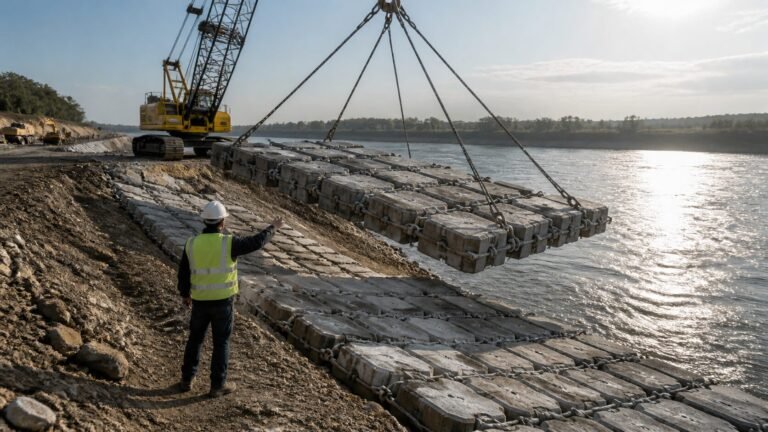
Yes — this is one of ACM’s primary practical advantages over cast-in-place concrete. Mattress panels are crane-lowered or barge-deployed directly into flowing water at velocities up to approximately 1.5 m/s without dewatering. For velocities above this threshold, temporary flow diversion or staged installation during low-flow periods is typically required.
Need a concrete mattress solution for your project?
HydroBase provides end-to-end concrete mattress engineering & installation services — from hydraulic design and factory-direct ACM supply to on-site supervision and post-project inspection. Trusted by civil engineers in 50+ countries.