
Canal Lining with Articulated Concrete Mattress: Complete Design Guide for Irrigation and Water Resource Engineers
Quick Answer: Canal lining with a concrete mattress prevents erosion and reduces seepage by 60–80% when combined with a geotextile underliner. Unlike cast-in-place concrete, articulated concrete mattress (ACM) tolerates differential settlement without cracking — making it the preferred flexible canal lining solution for earthen canals with reactive or unstable subsoils.
Choosing the right canal lining system is one of the most consequential decisions an irrigation engineer makes. Get it wrong, and you’re looking at cracked slabs within three seasons, uncontrolled seepage losses, and expensive rehabilitation. Over the past 18 years in hydraulic protection systems, I’ve worked through enough failed rigid concrete lining projects to know that canal lining concrete mattress systems deserve far more attention than they typically receive in standard design practice.
This guide is written specifically for irrigation engineers and water authority project managers who are evaluating ACM as a practical alternative to traditional cast-in-place or precast concrete lining. We’ll work through the hydraulics, anti-seepage design, block selection criteria, and a real rehabilitation case study.
Table of Contents
1. Why Rigid Concrete Lining Fails
2. ACM Canal Lining — How It Works
3. Anti-Seepage Design with Geotextile
4. Hydraulics of ACM-Lined Channels (Manning’s n)
5. Design Velocities and Block Selection
6. Case Study: Irrigation Canal Rehabilitation
7. Frequently Asked Questions
Why Rigid Concrete Lining Fails
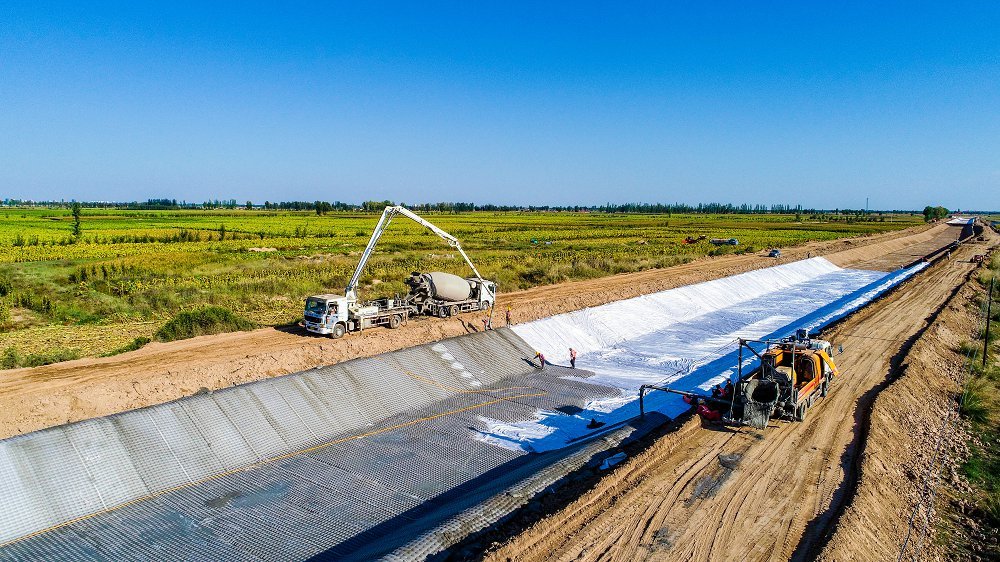
Cast-in-place concrete has been the default canal lining material for decades — and on paper, it’s logical. High Manning’s roughness coefficient means smooth hydraulics, low seepage if properly placed, and a relatively simple construction method. In practice, rigid lining underperforms badly on irrigated land with any degree of subsoil variability.
The core problem is differential settlement. Earthen canals in agricultural zones are almost never sitting on homogeneous subgrade. You’ll find alternating clay and sand lenses, areas of organic content, seasonal moisture fluctuation, and in many regions, expansive clays that shrink and swell with irrigation cycles. Concrete slabs — typically 80–150mm thick, 2–4m wide — have essentially zero tolerance for this movement. A 15mm differential settlement across a 3m slab is enough to initiate transverse cracking.
Once cracks form, seepage accelerates locally. Subgrade softening follows, which deepens the settlement, which widens the crack. Within two to three irrigation seasons, you often have a failed section that’s leaking more than an unlined canal would — because the cracked concrete traps debris, prevents vegetation from stabilizing the base, and concentrates flow against exposed earthwork.
Frost heave compounds the problem in higher-altitude irrigation systems. Poorly drained subgrade beneath a concrete-lined canal will freeze, lift the slab, and shatter it. Rehabilitation means demolishing and removing the old concrete before any new work can proceed — a significant cost that rarely appears in the original design lifecycle budget.
Tree root intrusion is an underappreciated failure mode on older canal systems. Roots from riparian plantings alongside canal banks will find every joint and crack. Over five to ten years, root pressure is sufficient to completely disrupt continuous concrete lining, particularly at the toe of canal batters.
The failure rate is well-documented in practice. Irrigation rehabilitation surveys across South Asia, Central Asia, and the Middle East consistently report that 30–50% of concrete-lined canal sections require major repair or replacement within 15 years of construction — often well short of the 30–50 year design life assumed in economic feasibility studies.
ACM Canal Lining — How It Works
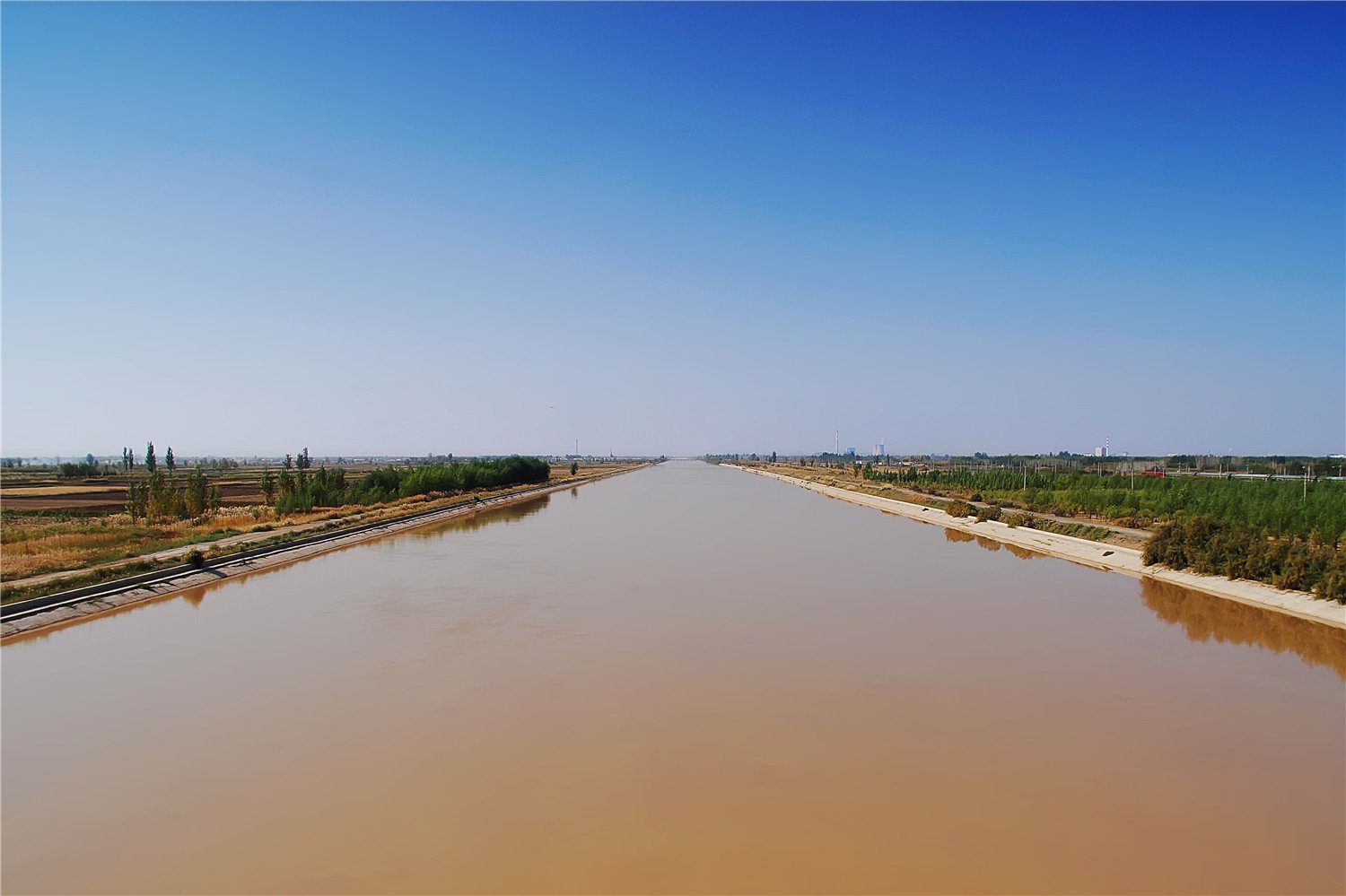
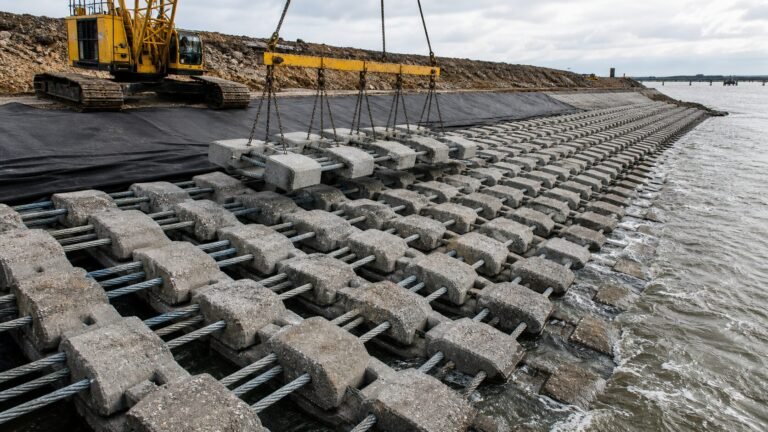
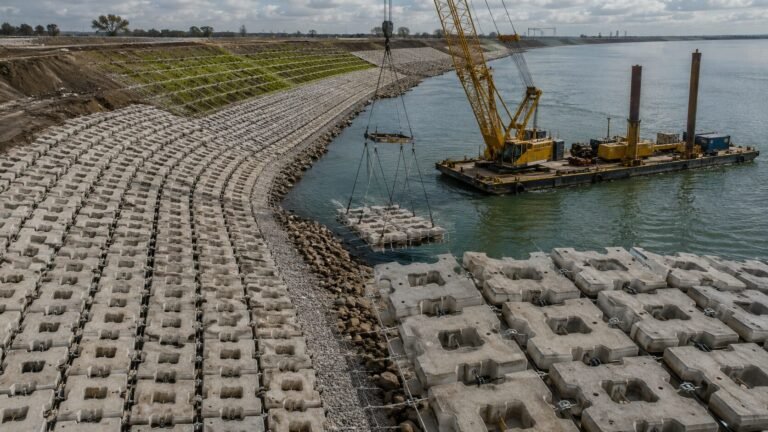
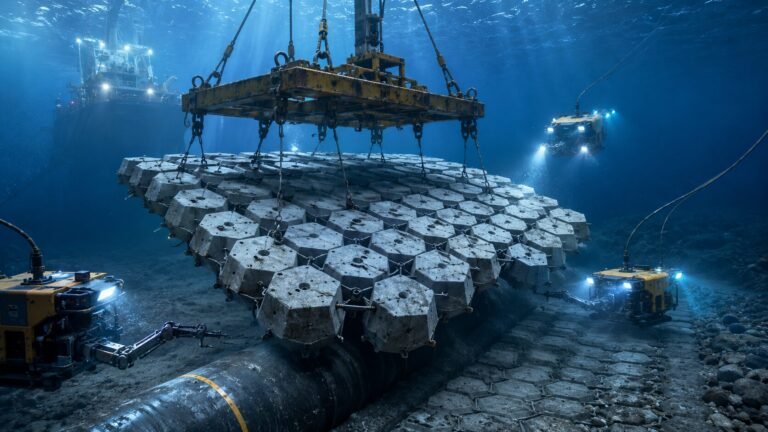
Articulated concrete mattress works on a fundamentally different principle to rigid lining. Rather than a continuous monolithic surface, ACM consists of individual precast concrete blocks — typically 300×200×100mm up to 600×400×200mm — interconnected by UV-stabilised polypropylene rope or stainless steel cables at centres of 300–500mm. The assembled mattress panel forms a flexible surface that can conform to subgrade irregularities, tolerate differential settlement, and move with the canal structure without fracturing.
Think of it as a suit of armour rather than a rigid shell.
When the subgrade shifts — and it will — ACM panels accommodate that movement across multiple block joints rather than concentrating stress in one location. A 20mm settlement event that would crack a concrete slab simply redistributes across adjacent block gaps in an ACM system. Hydraulic performance is maintained. No repair required.
Block pattern options for canal lining applications include:
- Open-core blocks (with apertures 15–40% of block face area): Used where some subgrade drainage is acceptable, or where vegetation establishment is specified. Slightly higher Manning’s n value.
- Closed/flat blocks (solid upper face): Preferred where maximum seepage reduction is the design objective. Lower hydraulic roughness, cleaner hydraulic section.
- Filter point blocks: Feature small upstand nibs that allow pressure equalisation beneath the mattress, preventing hydrostatic uplift during canal dewatering events.
For a detailed comparison of block geometries and their structural behaviour, the articulated concrete slab mattress versus block mattress design guide covers the structural trade-offs in depth.
Panel sizes in canal lining applications are typically 3.0m × 6.0m or 3.0m × 12.0m, with weights ranging from 80 kg/m² (thin open-core) to 350 kg/m² (closed block, heavy-duty). Connections at panel edges use overlapping cable loops or dedicated U-clips to maintain mattress continuity across panel joints.
Installation is rapid. A skilled crew with a small crane or excavator-mounted lifting frame can typically place 200–400m² of ACM per day in canal bank conditions — three to five times faster than equivalent concrete paving works.
Anti-Seepage Design with Geotextile
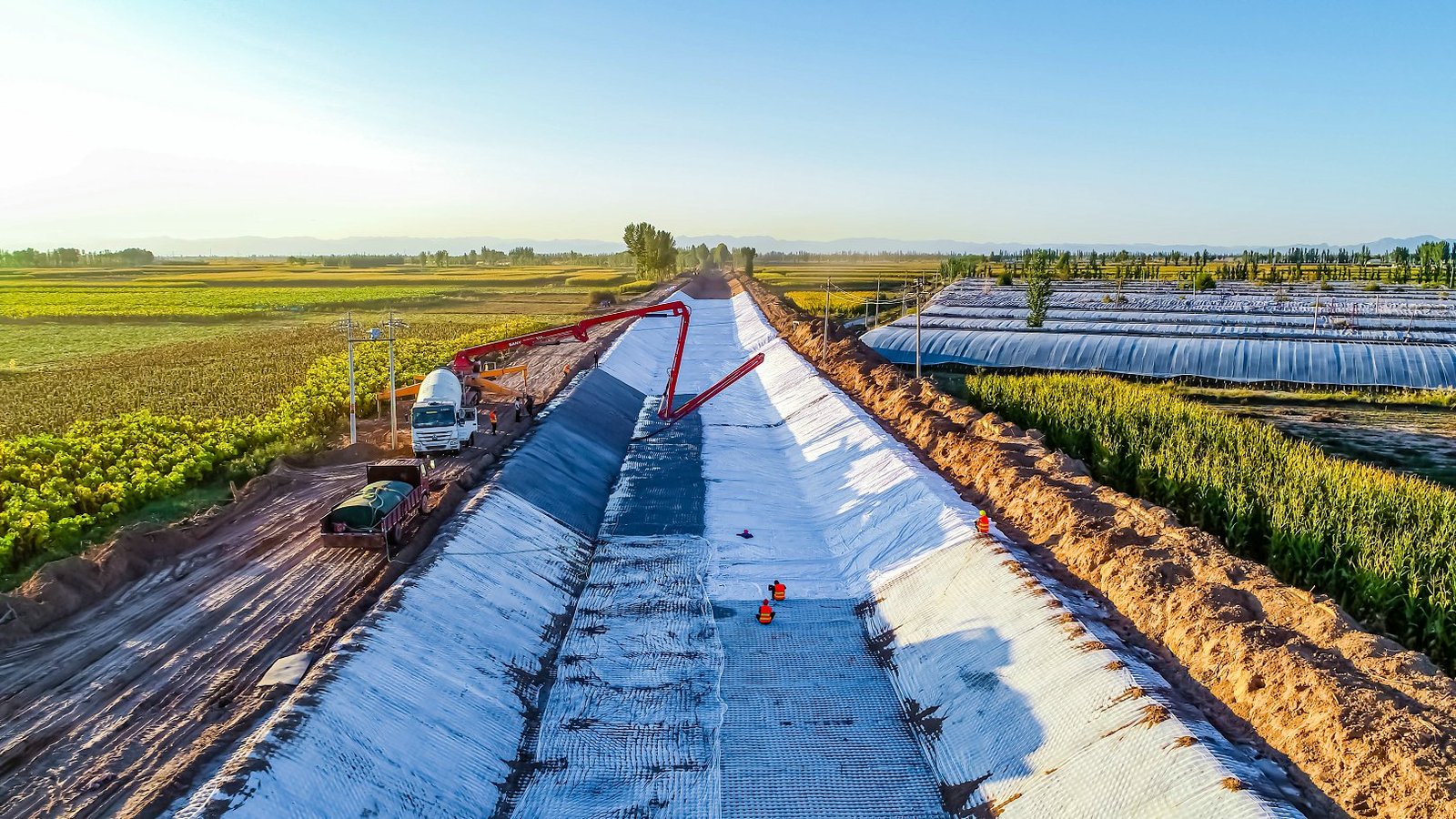
ACM alone does not provide seepage control — this is a critical design point that’s sometimes misunderstood in project specifications. The concrete blocks are structural armour. The seepage barrier is the geotextile underliner, and the performance of the entire system depends on the correct selection and placement of that filter layer.
Geotextile selection criteria for ACM canal lining:
The geotextile must perform two simultaneous functions: seepage reduction and subgrade filtration. A woven geotextile with an AOS (Apparent Opening Size) of O95 ≤ 0.15mm provides adequate seepage reduction for sandy and silty subgrades. For heavier clay subgrades, a nonwoven needle-punched geotextile (300–400 g/m²) provides better seepage performance due to the tortuous flow path through the fabric.
Permeability coefficient of the geotextile should be ≤ 1×10⁻⁵ m/s for canal lining applications where seepage reduction is a primary objective. In practice, this means specifying a geotextile with a water flow rate (ASTM D4491) of 10–40 L/m²/s — well below the open-weave fabrics used for pure filtration applications.
Seepage reduction performance combining geotextile underliner with ACM is well-established. Based on field measurement data from irrigation rehabilitation projects, ACM + geotextile systems typically reduce canal seepage losses by 60–78% compared to unlined earthen canals. This compares favourably with well-constructed cast-in-place concrete (75–90% reduction) while offering substantially better long-term performance due to the absence of joint deterioration.
Geotextile overlapping at seams must be a minimum of 300mm in the direction of flow, and 500mm in cross-sections with high hydraulic gradients (canal banks steeper than 1:2). All seam overlaps should be secured with polypropylene pins at 1.0m centres before ACM placement begins.
One failure mode to watch: hydrostatic uplift during rapid dewatering. When a canal is rapidly emptied — for maintenance or emergency — water trapped beneath the geotextile-ACM system can exert upward pressure sufficient to lift and displace panels. The design solution is either filter point blocks (which allow controlled pressure equalisation) or designed drainage slots in the geotextile at the canal invert. Rapid dewatering rates exceeding 0.3m/hour should trigger the filter point specification. You can explore filter point ACM design in more detail through this filter point concrete mattress application guide.
Hydraulics of ACM-Lined Channels (Manning’s n)
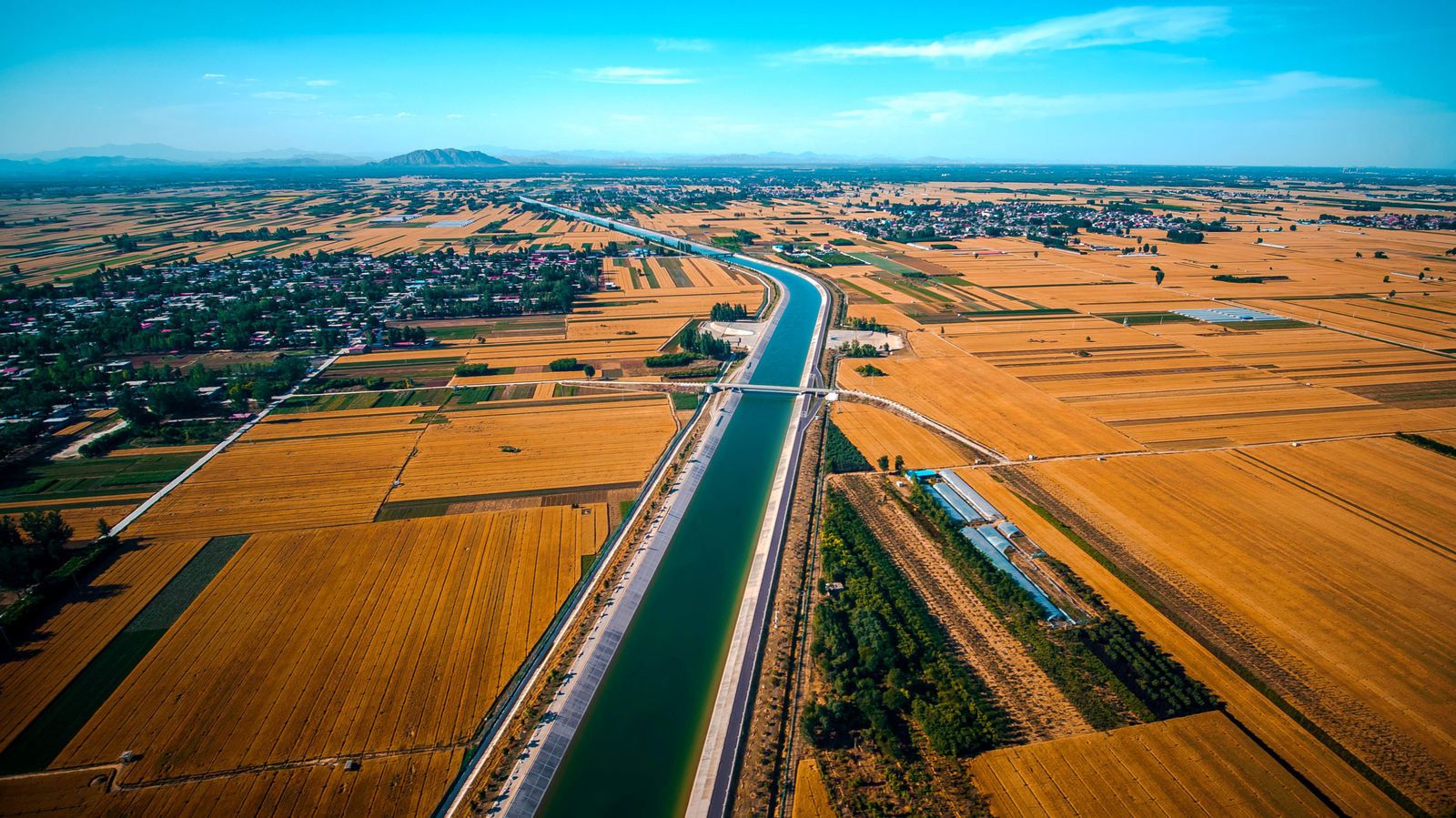
Getting the hydraulics right is non-negotiable. ACM-lined canals have a higher Manning’s roughness coefficient than smooth concrete, and if you’re designing against an existing hydraulic model that assumes n = 0.014 for concrete, you need to revisit your section dimensions.
Manning’s n values for ACM canal lining:
| Surface Type | Manning’s n | Notes |
|---|---|---|
| Cast-in-place concrete (smooth) | 0.012–0.014 | Reference baseline |
| Precast concrete panels | 0.013–0.016 | Depends on joint condition |
| ACM closed/flat blocks | 0.018–0.023 | Most common canal lining spec |
| ACM open-core blocks | 0.022–0.028 | Higher roughness, some vegetation |
| ACM filter point blocks | 0.020–0.025 | Upstand nibs increase roughness |
| Grouted riprap | 0.025–0.033 | For comparison |
| Earthen canal (maintained) | 0.025–0.035 | Baseline for unlined canals |
For design purposes, n = 0.020 is a reasonable conservative value for closed-block ACM in a well-graded, well-installed canal section. Open-core or filter point blocks should be designed at n = 0.025 unless project-specific hydraulic testing data is available.
Practical implication: For a trapezoidal canal with a design discharge of 8.5 m³/s and a bed slope of 0.0003, switching from smooth concrete (n=0.013) to ACM closed blocks (n=0.020) requires a cross-section increase of approximately 18–22% to maintain the same design velocity. This typically means widening the canal bed by 0.3–0.5m or accepting a slightly reduced free-board. Hydraulic modelling at the design stage is not optional.
Design Velocities and Block Selection
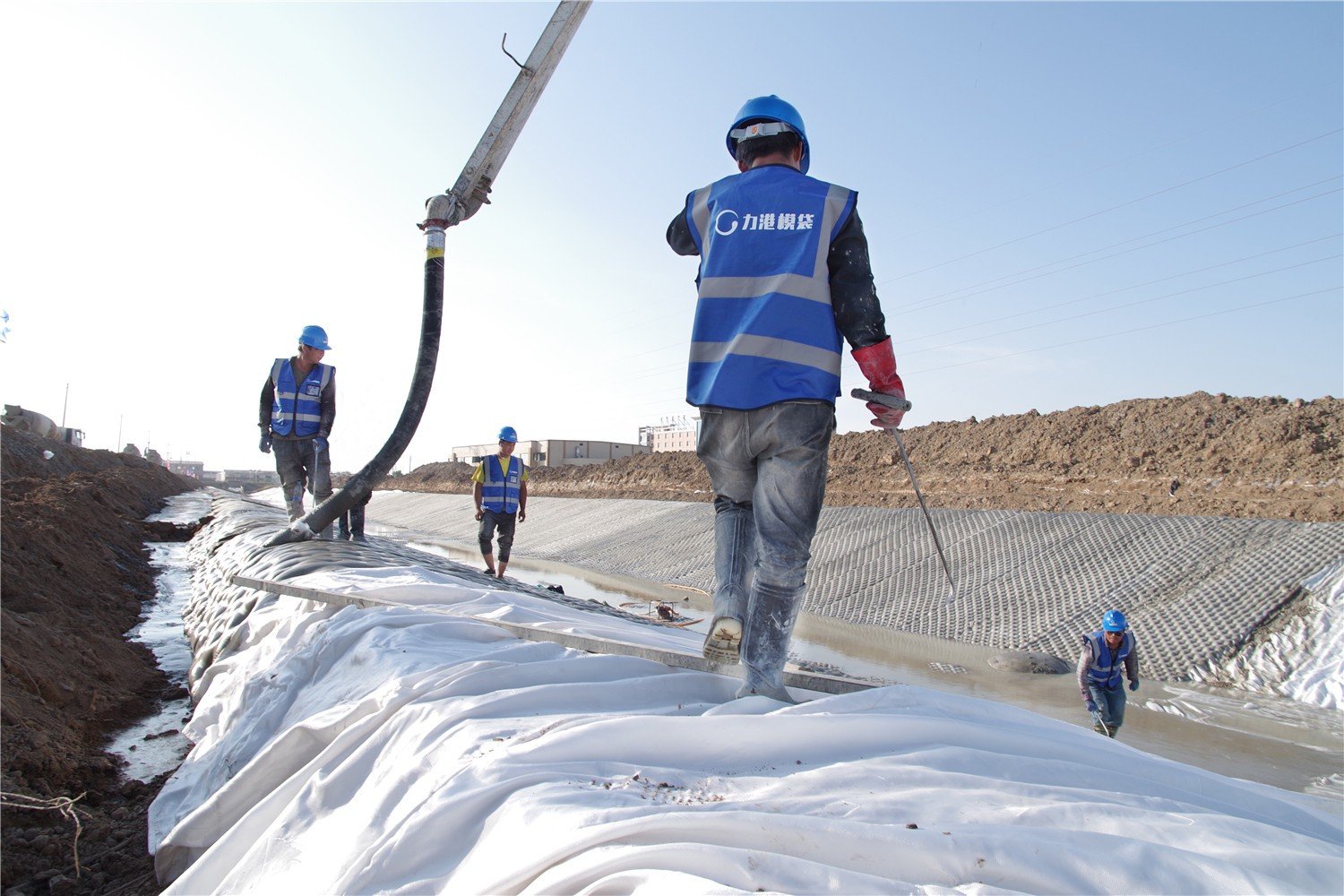
Block selection for canal lining is driven by three parameters: design velocity, side slope gradient, and block unit weight. Get any one of these wrong and you’re either over-specifying (cost penalty) or under-protecting (performance failure).
Velocity rating framework for ACM canal lining:
| ACM Block Thickness | Block Size (L×W) | Unit Weight (kg/m²) | Max Design Velocity | Application |
|---|---|---|---|---|
| 80mm | 300×200mm | 50–65 kg/m² | 2.5 m/s | Low-gradient distribution canals |
| 100mm | 300×200mm | 65–90 kg/m² | 3.2 m/s | Standard irrigation main canals |
| 120mm | 400×250mm | 100–130 kg/m² | 4.0 m/s | High-gradient sections, outlets |
| 150mm | 400×300mm | 140–175 kg/m² | 4.8 m/s | Drop structures, check gates |
| 200mm | 600×400mm | 220–280 kg/m² | 6.0 m/s | High-energy dissipation zones |
These velocity ratings assume a horizontal or mild slope condition. On canal side slopes steeper than 1:1.5 (H:V), the design velocity should be derated by approximately 15% due to the reduced block-to-block interlock perpendicular to flow direction.
Side slope stability is a separate calculation from velocity resistance. For canal batters, the factor of safety against block sliding on the slope depends on the angle of friction between block base and geotextile (typically 20–28° for smooth woven geotextile) and the slope angle. For slopes steeper than 1:1.5, toe anchoring with a cast-in-place concrete toe beam, or an anchored trench at the bottom of the lining, is standard practice.
Block selection should also account for UV exposure — a factor often ignored in hot-arid irrigation zones. Standard polypropylene ropes lose tensile strength with prolonged UV exposure. For canals in desert environments with continuous water surface exposure, specify stainless steel cable connections (316L grade minimum) or HDPE-coated rope systems with documented UV stabilisation ratings. Cable design life for canal lining should be a minimum of 25 years without replacement.
For engineers needing to specify block thickness based on flow conditions, the concrete mattress thickness design guide with worked examples provides a step-by-step calculation methodology including slope adjustment factors.
Case Study: Irrigation Canal Rehabilitation
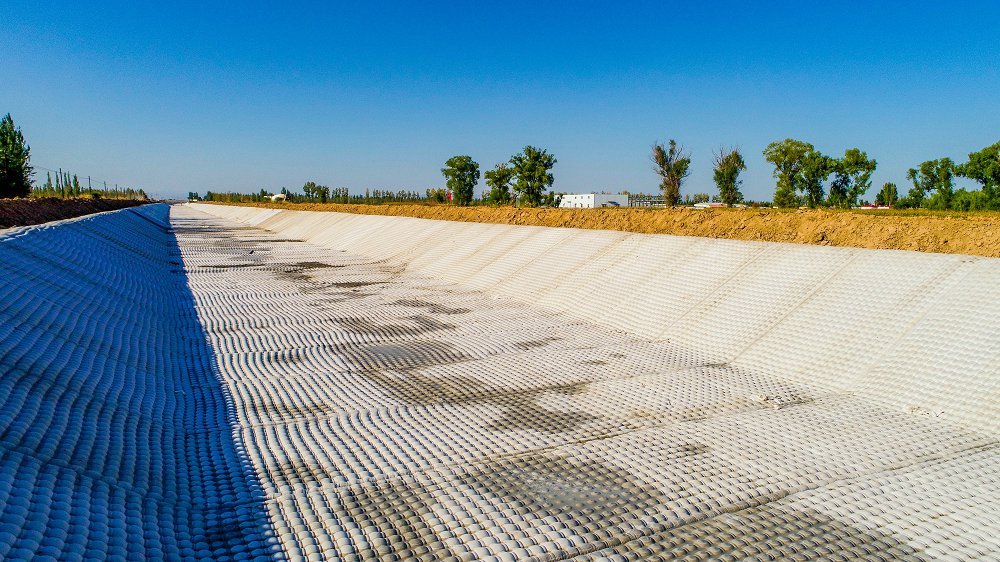
Project context: A 14.7 km secondary irrigation canal serving approximately 3,800 hectares of mixed crop land in a semi-arid region. Original lining: 100mm cast-in-place concrete, installed 22 years prior. Condition assessment found that 61% of the lining was cracked or displaced, with estimated seepage losses of 38% of diverted flow — compared to the design loss allowance of 12%.
Design constraints:
- Existing earthwork profile to be retained (no major earthwork re-shaping)
- Design discharge: 6.2 m³/s (unchanged)
- Bed slope: 0.00035 (variable — 0.00025 to 0.00060 along the route)
- Side slopes: 1:1.75 (H:V) throughout
- Subgrade: alternating silty clay and fine sand — the original cause of differential settlement
ACM specification selected:
- Block size: 400×250×120mm closed-block, cable-tied
- Unit weight: 118 kg/m²
- Manning’s n design value: 0.021
- Velocity rating: 4.0 m/s (design velocity 2.8–3.4 m/s across variable slope sections)
- Underliner: 350 g/m² nonwoven geotextile, O95 = 0.12mm, permeability ≤ 8×10⁻⁶ m/s
- Panel size: 3.0m × 9.0m, prefabricated off-site
Demolition and prep: Old concrete lining demolished with hydraulic breaker and removed. Subgrade re-compacted to 95% standard Proctor. Low spots infilled with selected granular material to maintain consistent batter profile.
Measured outcomes at 24-month post-installation survey:
- Seepage losses reduced from 38% to 9.4% of diverted flow (75.3% reduction)
- Zero structural failure events in surveyed sections
- Panel displacement at two locations at chainage 4,200m (attributed to a buried irrigation pipe failure causing localised subgrade washout — unrelated to ACM system performance)
- Hydraulic capacity: design discharge conveyed at 94% of modelled flow — within acceptable range, attributed to a slightly higher-than-specified Manning’s n in one section with debris accumulation
Cost comparison: The ACM rehabilitation was 23% more expensive than an equivalent cast-in-place concrete re-lining on a per-metre installed cost basis. Life-cycle analysis over a 30-year horizon, accounting for 15-year maintenance and repair costs on the rigid alternative, reversed this differential — with ACM showing an 18% lifecycle cost advantage.
ACM Canal Lining: Specification Checklist for Project Engineers
The following checklist consolidates the key design decisions for irrigation canal projects using ACM. Completing this before finalising the specification will prevent the most common design gaps.
| Design Parameter | Decision Required | Typical Range / Default |
|---|---|---|
| Design velocity (max) | Site hydraulic model | 1.5–5.0 m/s for canal lining |
| Block thickness | Velocity + slope + unit weight table | 80–200mm |
| Block pattern | Seepage control vs drainage objective | Closed block (most canals) |
| Side slope gradient | Earthwork survey | 1:1.5 to 1:2.5 |
| Slope toe anchoring | Required if slope > 1:1.5 | Cast concrete toe beam |
| Geotextile permeability | Seepage reduction objective | ≤ 1×10⁻⁵ m/s |
| Geotextile AOS (O95) | Subgrade particle size (D85) | O95 ≤ 0.15mm (sandy subgrade) |
| Seam overlap direction | Flow direction | Min 300mm (flow), 500mm (cross) |
| Panel size | Site access and crane capacity | 3.0×6.0m or 3.0×9.0m |
| Cable material | UV exposure + design life | PP rope (≤20yr) / SS cable (25yr+) |
| Dewatering rate | Pumping capacity | Filter point if >0.3m/hr drawdown |
| Manning’s n design value | Block type selection | 0.018–0.028 |
Connecting Design Intent to Manufactured Product
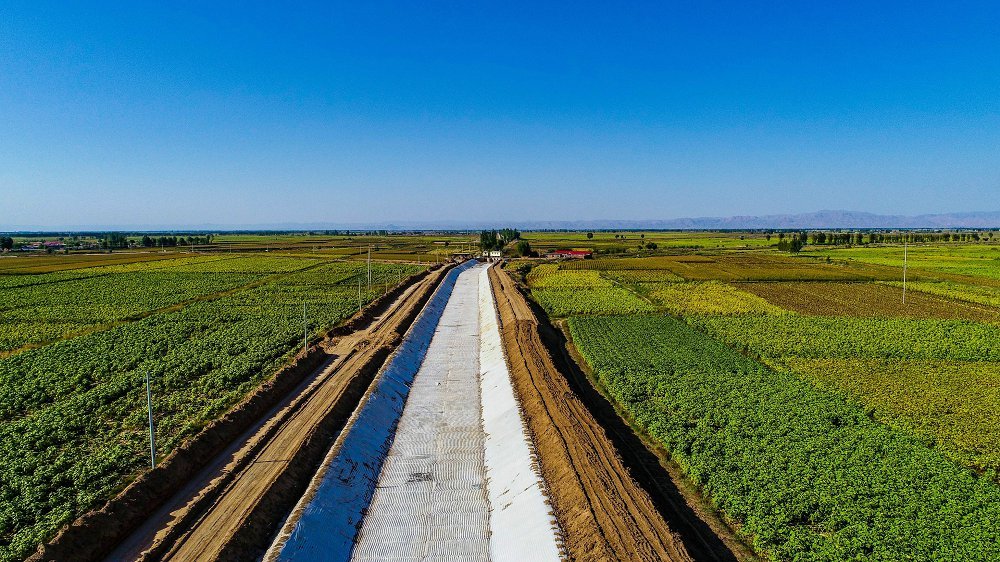
A well-designed ACM canal lining specification only performs if the manufactured product matches what was designed. This is where procurement decisions directly affect engineering outcomes — and it’s an area where the market has significant quality variation.
For irrigation canal applications, the critical manufacturing quality controls are: cable/rope tensile strength certification per test batch (not just per product type), dimensional consistency of blocks (tolerances should be ±3mm on thickness, ±5mm on length/width), and concrete compressive strength verification at 28 days (minimum fc = 35 MPa for canal lining blocks).
Some manufacturers in the ACM market supply products pre-assembled with cables connected at the factory, while others supply loose blocks and cables for on-site assembly. For large-scale irrigation projects, factory-assembled panels offer better quality control — block spacing, cable tension, and panel geometry are all verified before dispatch.
HydroBase, for example, manufactures articulated concrete mattress panels at their facility in China with factory-assembled panels available in both open-core and closed-block configurations for canal lining applications. Their articulated concrete mattress product range covers block sizes from 300×200×100mm through to 600×400×200mm, with both polypropylene rope and stainless steel cable tie options — the specification flexibility needed to match the design parameters outlined in this guide.
For irrigation agencies working to tight project budgets, one practical approach is requesting manufacturer-specific Manning’s n test data and velocity rating certifications alongside the standard product data sheet. Reputable ACM suppliers will have flume test data or reference to independent hydraulic testing. If that data isn’t available, treat the velocity rating claims with scepticism.
Frequently Asked Questions
Q: What is the difference between ACM canal lining and cast-in-place concrete lining for irrigation canals?
ACM canal lining uses interconnected precast concrete blocks that flex across joints, allowing the system to accommodate differential settlement, frost heave, and subgrade movement without cracking. Cast-in-place concrete forms a rigid monolithic surface that fractures under these same conditions. ACM typically reduces seepage by 60–78% when used with a geotextile underliner, compared to 75–90% for well-constructed concrete — but ACM maintains that performance over a 30+ year life cycle without the joint deterioration that degrades rigid lining.
Q: What Manning’s n value should I use for articulated concrete mattress in an irrigation channel?
For closed-block ACM, use n = 0.018–0.023 in hydraulic design calculations. Open-core and filter point blocks have higher roughness at n = 0.022–0.028. A conservative design value of n = 0.020 (closed block) or n = 0.025 (open-core) is appropriate for preliminary sizing. Always verify against manufacturer-specific test data for the exact block geometry specified — surface texture variations between manufacturers can shift Manning’s n by ±0.003.
Q: Does ACM canal lining work on steep side slopes, and how do you prevent block sliding?
ACM can be installed on canal side slopes up to approximately 1:1 (45°), though slopes steeper than 1:1.5 require specific design measures. Block sliding resistance depends on the friction angle between block base and geotextile — typically 20–28°. For slopes steeper than 1:1.5, a cast-in-place concrete toe beam at the slope base is standard practice.
Need a concrete mattress solution for your project?
HydroBase provides end-to-end concrete mattress engineering & installation services — from hydraulic design and factory-direct ACM supply to on-site supervision and post-project inspection. Trusted by civil engineers in 50+ countries.