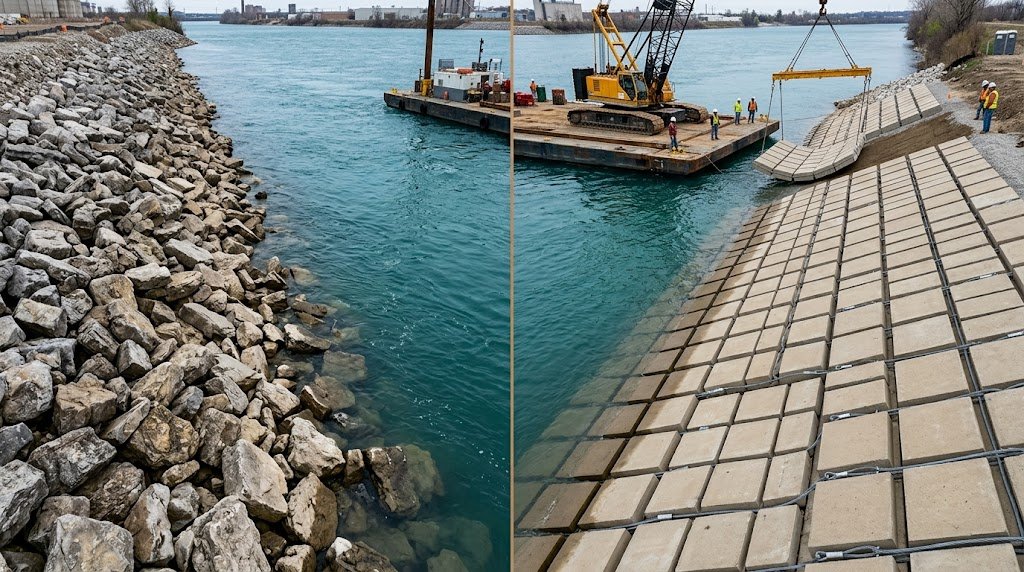
ACM vs Riprap vs Gabions: Engineering Comparison Guide for Scour Protection
ACM vs Riprap vs Gabions: Which Is Right for Your Project?
Quick Answer: For most river scour applications, concrete mattress vs riprap comparisons consistently favor ACM where flow velocity exceeds 3 m/s — ACM handles up to 6.0 m/s versus roughly 3 m/s for loose riprap. Gabions suit very steep slopes but degrade faster. Riprap remains cost-effective for low-velocity, low-risk applications where uniform finish isn’t required.
When a riverbank or bridge pier fails, the question engineers face isn’t whether to protect it — it’s which system will actually hold. With 18 years designing and specifying revetment systems across river crossings, port infrastructure, and coastal applications, I’ve watched all three major systems succeed and fail depending on whether the right one was selected for the right conditions. As our lead installation engineer always says, “You can feel when the cable tension is right.”
Table of Contents
1. How ACM Works
2. How Riprap Works
3. How Gabions Work
4. Head-to-Head Comparison Table
5. Cost Comparison per m²
6. Which to Choose: Decision Flowchart
7. Frequently Asked Questions
How ACM Works
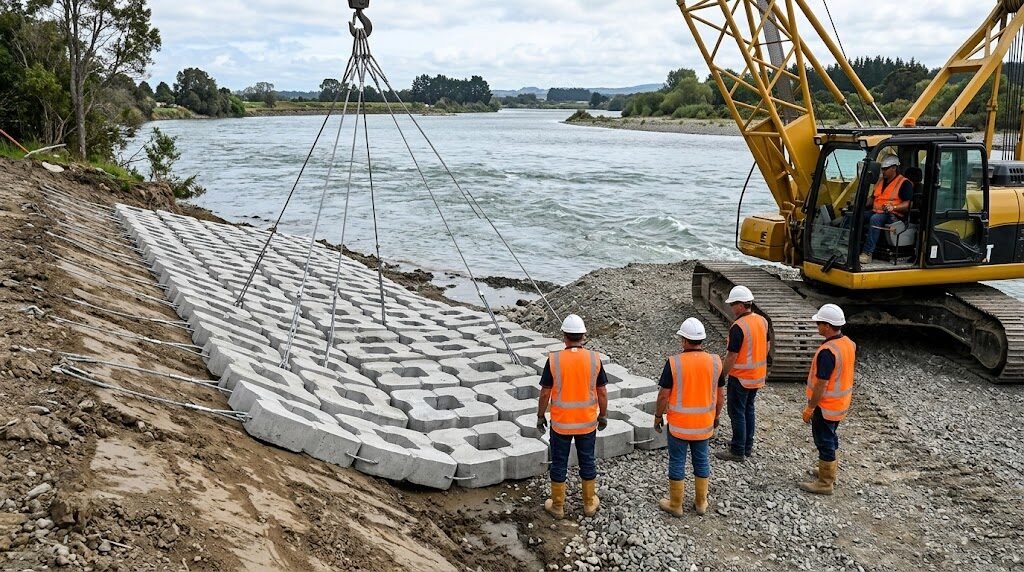
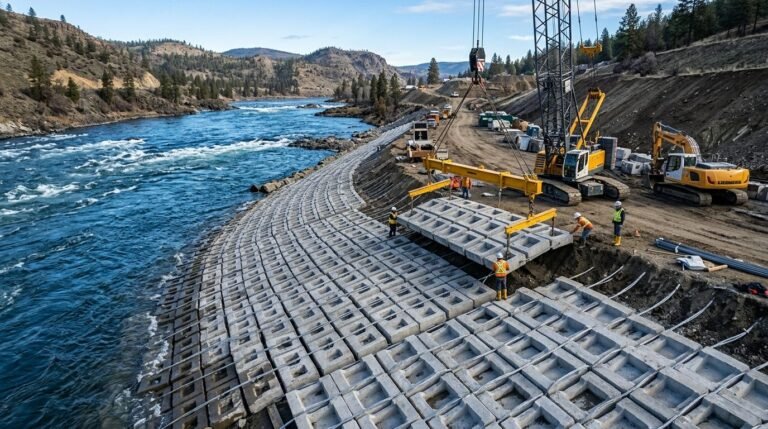
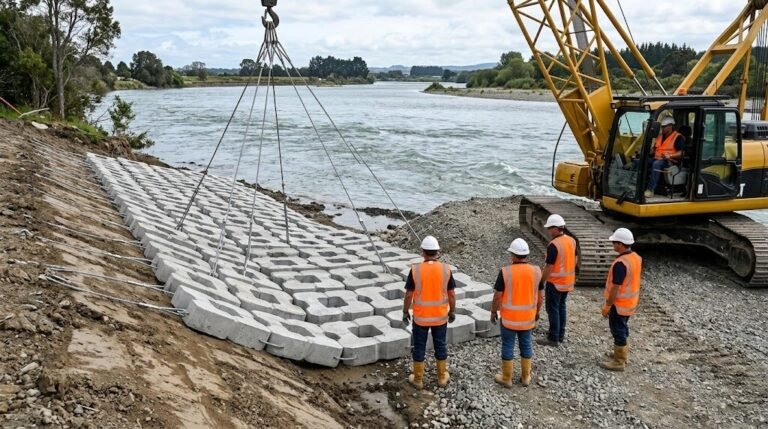
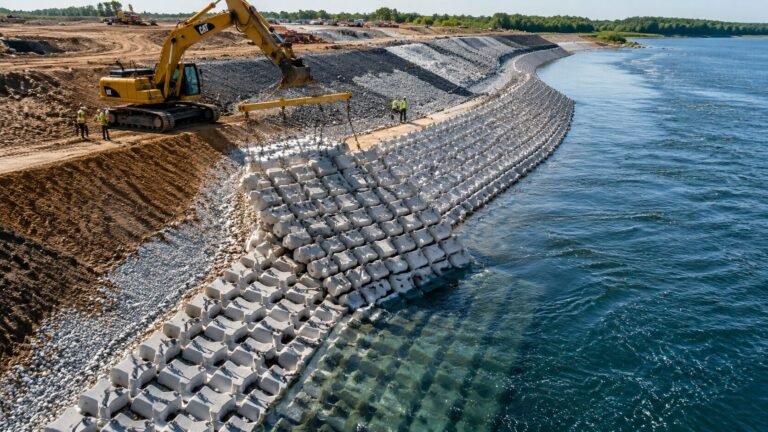
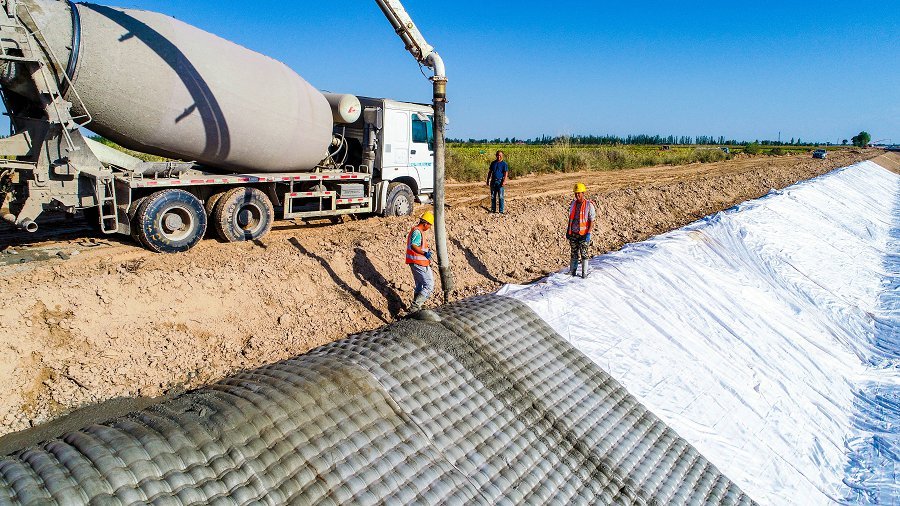
Articulated concrete mattress (ACM) consists of precast concrete blocks — typically 300×200×100mm to 600×400×200mm — interconnected by high-tensile galvanized steel cables or polypropylene rope in a grid pattern. The result is a flexible, continuous mat that conforms to uneven substrate while maintaining mass-based resistance to hydraulic uplift.
The articulation is the critical design feature. Unlike a rigid slab, an ACM can deflect around buried obstacles, conform to scoured depressions, and settle onto irregular seabed profiles without losing structural continuity. Cable spacing is typically 300–500mm, and the block pattern — open or closed — determines how much interstitial flow the system allows, which affects both vegetation establishment and hydraulic performance.
Velocity performance is where ACM earns its design specification. Properly installed ACM systems achieve flow velocity resistance up to 6.0 m/s when used with a geotextile filter layer. HEC-23 (FHWA’s Bridge Scour and Stream Instability Countermeasures) classifies ACM as a flexible revetment suitable for high-shear environments, and DNV-GL certification covers offshore pipeline and subsea applications.
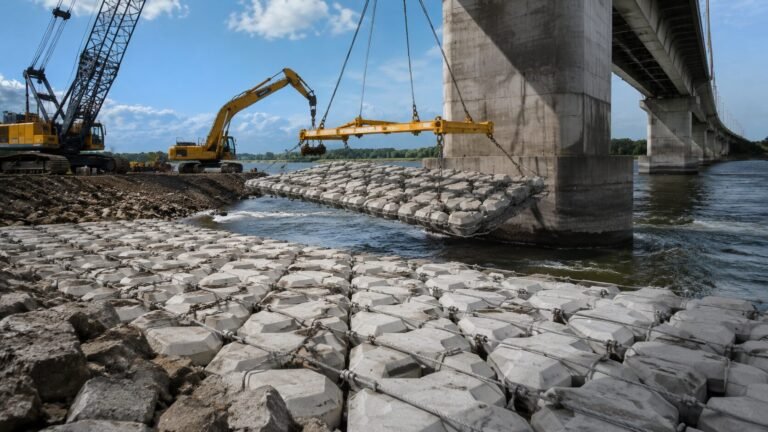
Mattress weights range from 50 kg/m² (light channel lining) to 400 kg/m² (offshore protection in tidal zones), giving specifiers genuine range across project types. For bridges and culverts, the scour protection mechanism is primarily submerged weight plus inter-block friction — no grout injection required unless spanning applications demand a continuous impermeable surface.
For a technical breakdown of the scour resistance mechanism, the article on how articulated concrete mattresses protect riverbeds from scour covers the hydraulic design principles in detail.
Practical takeaway: ACM performs well across velocity ranges 2.5–6.0 m/s, adapts to subsidence without panel cracking, and maintains performance over multi-decade service life with minimal maintenance.
How Riprap Works
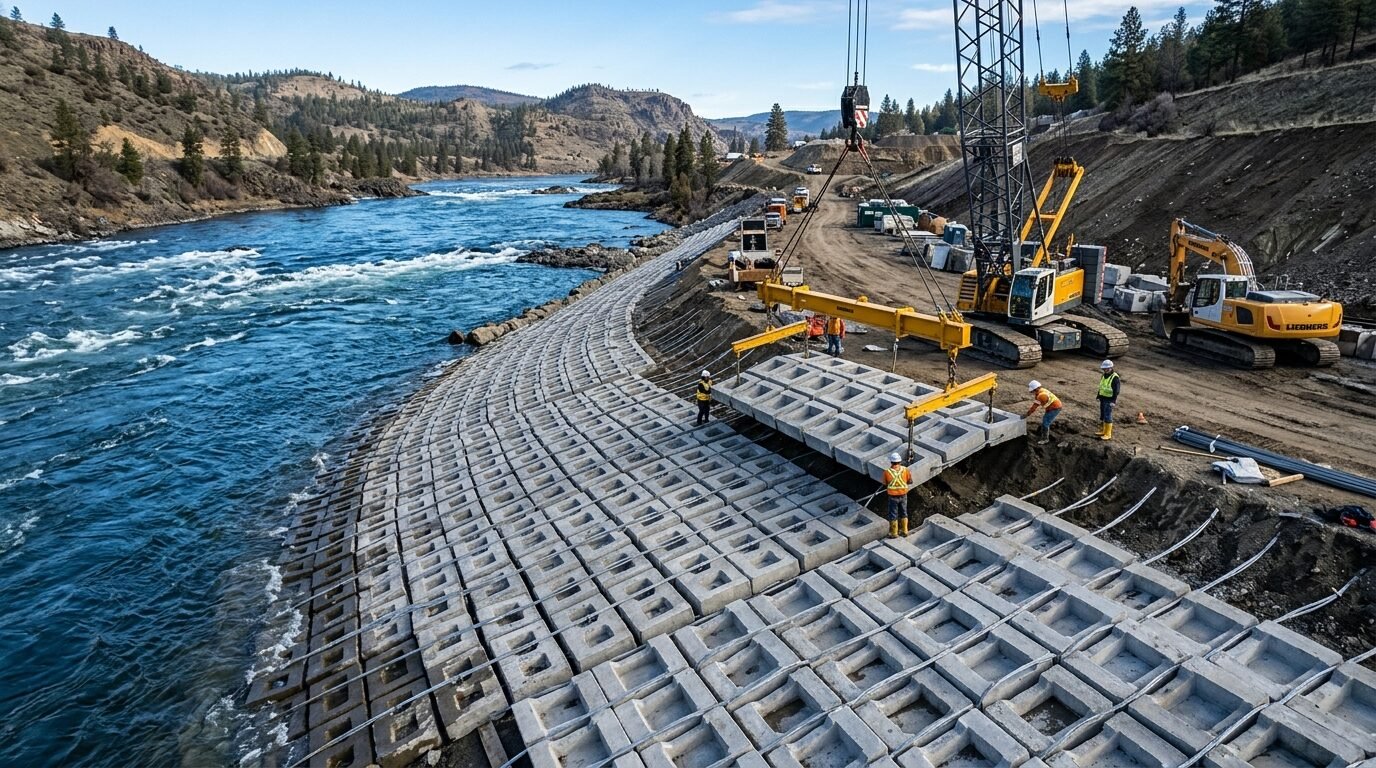
Riprap is angular crushed rock or quarried stone placed loosely — or with minimal grouting — over a filter layer to armor a surface against hydraulic erosion. Stone sizing follows HEC-11 or EM 1110-2-1601 (USACE) methodologies, with D50 (median particle size) typically ranging from 150mm to 600mm depending on design velocity.
The resistance mechanism is purely gravitational and frictional. Individual stones interlock through surface roughness and weight, but there’s no tensile connection between particles. This matters enormously in design: once flow velocity exceeds the incipient motion threshold for the specified stone class, individual particles dislodge progressively. At that point, failure isn’t localized — it propagates.
Standard riprap performs well at velocities up to approximately 3.0 m/s for D50 = 300mm stone. Larger stone (D50 = 500mm+) can handle around 4.0 m/s but becomes increasingly impractical to source, transport, and place uniformly. On sloped banks steeper than 1V:2H, stability factors drop significantly, requiring larger stone or geosynthetic anchoring.
Where riprap genuinely excels: low-velocity applications (under 2.5 m/s), large-area works where speed of placement matters more than precision, and sites where local quarry stone is abundant. Installation requires no specialist equipment beyond standard crane and excavator — any civil contractor can place it.
The weak points are well-documented: riprap is susceptible to progressive displacement under ice loading, vessel wake, and wave attack; surface irregularity makes inspection difficult; and bio-fouling on marine applications can reduce effective stone mass over time.
How Gabions Work
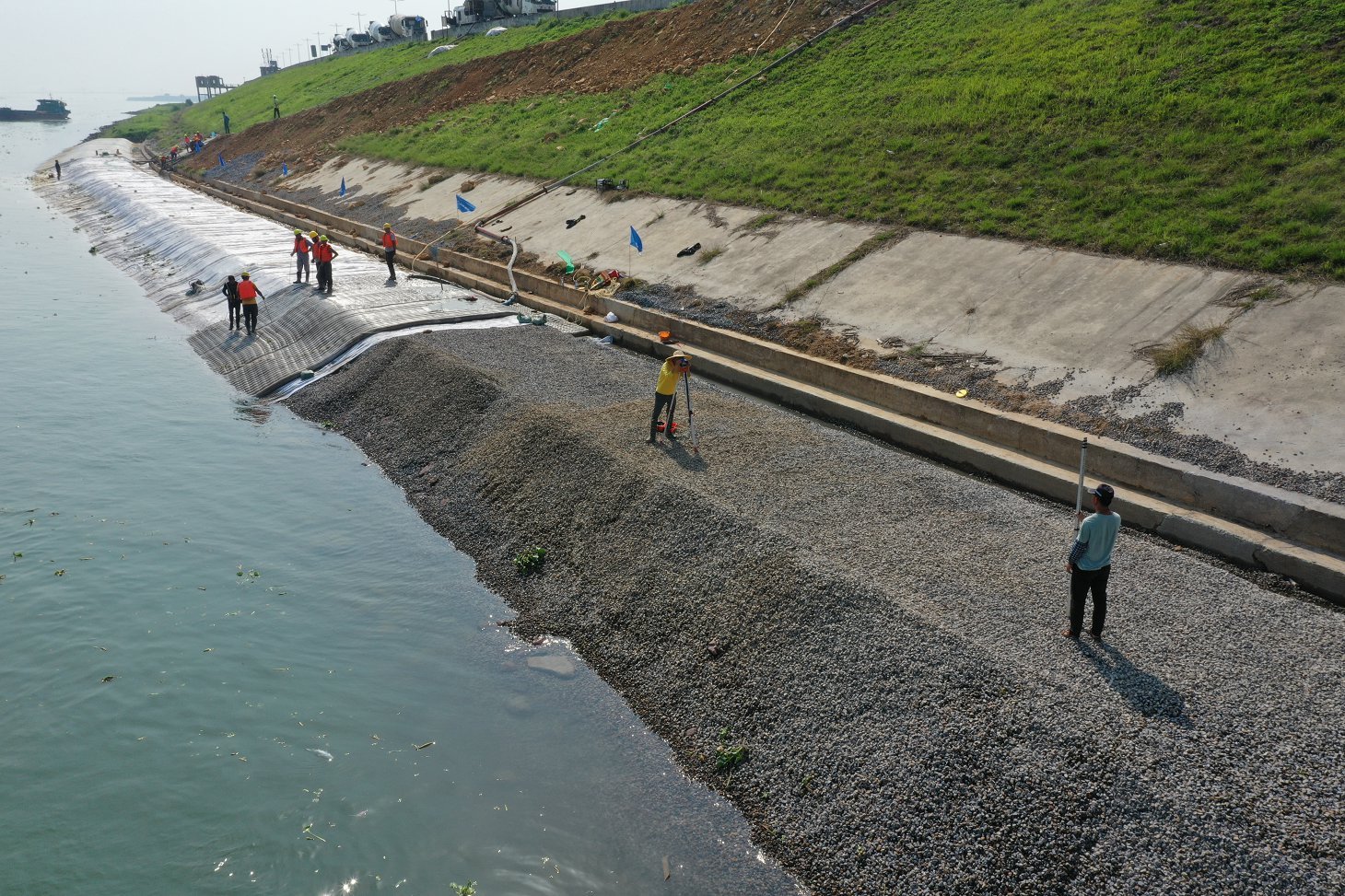
Gabions are wire mesh baskets — usually PVC-coated galvanized steel or Galfan wire — filled with graded stone and stacked to form retaining walls, weirs, or slope armor. Standard basket dimensions run 1.0×1.0×1.0m (box gabion) down to 0.3×0.3×6.0m (gabion mattress or Reno mattress for flatter slope armor).
The structural behavior of a gabion wall is semi-rigid mass gravity. Wire mesh provides tensile continuity between stone infill, giving gabions better coherence than loose riprap at equivalent stone size. Gabion mattresses (Reno mattresses, typically 150–300mm deep) function similarly to ACM in slope protection applications but rely on wire mesh integrity rather than concrete mass.
Velocity resistance for gabion mattresses tops out around 4.5 m/s — better than loose riprap but below ACM. The critical vulnerability is wire corrosion and abrasion. In rivers carrying suspended sediment or gravel bedload, wire mesh abrasion can reduce service life to 8–15 years even with PVC coating. Once wire fails, the basket loses coherence and stone disperses. Gabion walls perform longer in low-abrasion environments but require periodic inspection and wire repair that’s costly to access on submerged installations.
Where gabions genuinely excels: very steep slopes (1V:1H or steeper) where ACM block weight creates installation challenges, bank toe protection where vertical face retention is needed, and temporary works where reusability justifies wire mesh cost.
The gabion vs ACM question usually comes down to slope geometry and design life. For slopes 1V:2H or gentler with a 25+ year design life, ACM is almost always the superior engineering solution.
Head-to-Head Comparison Table
| Parameter | ACM | Riprap | Gabion Mattress |
|---|---|---|---|
| Max design velocity (m/s) | 6.0 | ~3.0 (D50 300mm) | ~4.5 |
| Min design velocity (m/s) | 1.5 | 0.5 | 1.0 |
| Typical thickness range | 100–200mm block | 300–600mm D50 | 150–300mm |
| Slope suitability | Up to 1V:1.5H | Up to 1V:2H | Up to 1V:1H |
| Flexibility / conformance | High (articulated) | Medium (loose) | Medium |
| Design life (typical) | 50+ years | 20–40 years | 8–25 years |
| Filter layer required | Yes (geotextile) | Yes (granular/geotextile) | Yes (geotextile) |
| Installation complexity | Moderate | Low | Moderate |
| Inspection ease | Good (visible blocks) | Moderate | Poor (submerged wire) |
| Regulatory standards | HEC-23, DNV-GL | HEC-11, USACE EM 1110-2-1601 | BS EN 10244, ASTM A975 |
| Environmental integration | Vegetated options available | Limited | Partial vegetation possible |
| Submerged application | Excellent | Moderate | Poor (wire corrosion) |
Cost Comparison per m²
Cost comparisons between these three systems are genuinely complicated — unit material costs don’t tell the full story, and I’ve seen plenty of tenders where the lowest-cost option became the most expensive over a 10-year horizon.
Here’s a realistic framework for a 1,000 m² riverbank revetment project at moderate depth:
Riprap (D50 300mm over geotextile):
– Material (stone supply): USD 18–32/m²
– Geotextile filter layer: USD 3–6/m²
– Placement (crane + excavator): USD 8–15/m²
– Total installed: USD 29–53/m²
Gabion Mattress (200mm Reno mattress over geotextile):
– Material (basket + stone): USD 35–55/m²
– Geotextile filter layer: USD 3–6/m²
– Installation labor: USD 12–20/m²
– Total installed: USD 50–81/m²
Articulated Concrete Mattress (150mm block over geotextile):
– Material (ACM panels): USD 45–75/m²
– Geotextile filter layer: USD 3–6/m²
– Installation (crane barge or land crane): USD 15–25/m²
– Total installed: USD 63–106/m²
At first glance, riprap wins on upfront cost. But factor in a 10-year maintenance cycle for gabion wire replacement (USD 12–18/m² per event) and the risk of progressive riprap displacement in flood events, and the ACM lifecycle cost frequently comes out lower over a 25-year analysis period.
For culvert outfalls and bridge piers where maintenance access is constrained, the cost math shifts further toward ACM — a system that requires near-zero maintenance once correctly installed. The complete guide to culvert outfall scour protection with ACM walks through a worked cost-benefit example for that specific application type.
Which to Choose: Decision Flowchart
Use this flowchart to reach a defensible design decision:
START: What is the design flow velocity at the protection surface?
├── < 2.5 m/s
│ ├── Large area, budget-constrained, easy site access?
│ │ └── ✅ RIPRAP — cost-effective, simple installation
│ └── Submerged / offshore / subsidence risk?
│ └── ✅ ACM (light class, 100mm block) — better conformance
├── 2.5 – 4.5 m/s
│ ├── Slope steeper than 1V:1.5H?
│ │ └── ✅ GABION MATTRESS or ACM on anchored system
│ ├── Design life > 20 years in abrasive environment?
│ │ └── ✅ ACM — gabion wire will fail before ACM
│ └── Standard slope, geotextile sub-base available?
│ └── ✅ ACM — recommended
├── > 4.5 m/s
│ └── ✅ ACM (standard to heavy class, 150–200mm block)
│ — Riprap and gabions not reliable at this velocity
SECONDARY FILTERS:
• Vegetation / ecological requirement? → ✅ Vegetated ACM or open-block ACM
• Pipeline over-trawl protection? → ✅ ACM (DNV-RP-F109 compliant)
• Temporary / removable works? → Consider gabion or riprap
• Budget primary constraint, < 10yr life? → Riprap if velocity permits
The filter layer question is non-negotiable across all three systems. Placing any revetment without a properly designed geotextile or granular filter invites piping failure regardless of how well the armor layer performs.
Solution Bridge: Specifying ACM in Practice
When engineers move from comparison analysis to actual specification, the gap between “ACM performs best at this velocity” and “which ACM product do I put in the tender documents” is where procurement gets complicated. Block dimensions, cable specification, open vs. closed pattern, and geotextile compatibility all need to be resolved before a BOQ can be priced.
For example, HydroBase manufactures articulated concrete mattress systems across the full block size range from 300×200×100mm to 600×400×200mm, with both open and closed block patterns available in the same panel size. That flexibility matters when you’re specifying both a steep bank (needs closed block for mass) and a flat invert (open block allows drainage without uplift risk) on the same project.
The spec selection tool below covers the key decision parameters:
ACM Specification Selection Guide (B2B Tool)
| Design Condition | Recommended Block Size | Pattern | Cable Spec | Notes |
|---|---|---|---|---|
| Channel velocity 2.5–3.5 m/s, gentle slope | 300×200×100mm | Open | 3mm galv. | Light class, standard channel lining |
| Channel velocity 3.5–5.0 m/s, moderate slope | 400×300×120mm | Closed | 4mm galv. | Standard revetment spec |
| Channel velocity 5.0–6.0 m/s, steep slope | 500×350×150mm | Closed | 5mm galv. | Heavy class, check anchor design |
| Tidal/marine, submerged, subsidence risk | 600×400×200mm | Closed | 5mm SS or HDPE rope | Offshore/subsea class |
| Ecological / vegetation requirement | 300×200×100mm | Open (>35% void) | 3mm galv. | Specify geotextile infill layer |
| Pipeline span protection (offshore) | 500×350×150mm | Closed | DNV-GL certified | Check DNV-RP-F109 thickness requirements |
Linking this to the articulated concrete mattress complete guide for civil and hydraulic engineers gives you the full design parameter range if you’re working on a detailed specification document.
Frequently Asked Questions
Q: At what flow velocity should I switch from riprap to concrete mattress?
The transition point is generally 3.0 m/s. Below this, properly sized riprap (D50 ≥ 300mm over geotextile) is structurally adequate and cost-competitive. Above 3.0 m/s, riprap displacement risk increases sharply and ACM becomes the more defensible choice. At velocities above 4.5 m/s, ACM is essentially the only non-grouted flexible revetment option that meets standard design codes.
Q: What is the typical design life difference between ACM and gabions?
ACM systems designed to HEC-23 standards with properly specified cable grade typically achieve 50+ year design life with minimal maintenance. Gabion mattresses in abrasive river environments — carrying any bedload gravel — realistically achieve 8–15 years before wire mesh degradation compromises basket integrity, even with PVC or Galfan coating. In clean-water, low-abrasion environments, gabions can reach 20–25 years.
Q: Can ACM be installed on the same slope gradients as gabion walls?
ACM panels can be installed on slopes up to 1V:1.5H without supplementary anchoring in most applications. Steeper than that, cable-anchored ACM panels or toe walls are required. Gabion boxes can form vertical or near-vertical gravity walls, which ACM cannot replicate — that’s the one geometric niche where gabions remain the engineering preference.
Q: What does articulated concrete mattress cost per square metre compared to riprap?
Installed ACM typically costs USD 63–106/m² depending on block size, depth, and site access. Riprap installed over geotextile runs USD 29–53/m² for a D50 300mm specification. The gap closes significantly on lifecycle cost analysis: gabion and riprap maintenance or replacement costs over 25 years often exceed the ACM premium. For difficult-access sites like bridge piers or culvert outfalls, ACM’s near-zero maintenance lifecycle almost always wins total cost of ownership.
Q: Is a geotextile filter layer always required under ACM?
Yes, a geotextile filter layer is required under ACM in virtually all applications. Without it, hydraulic pressure differentials during flow events cause piping — fine subgrade material migrates through gaps between blocks, leading to progressive settlement and eventual revetment failure. The geotextile spec (aperture size, tensile strength) must be designed to match the subgrade particle size distribution, not simply selected from a standard product range.
Conclusion
Choosing between ACM, riprap, and gabions isn’t a materials preference — it’s a hydraulic engineering calculation with a lifecycle cost dimension. Riprap remains a sound choice when velocity is below 3.0 m/s and site access is unconstrained. Gabions fill a niche on very steep slopes or where temporary works flexibility is needed. For the majority of river scour, bridge pier protection, and marine revetment projects where velocity exceeds 3.0 m/s or design life matters, ACM is the engineered solution that holds up to scrutiny across both technical and commercial criteria.
For engineers working through tender specifications, the ACM block size selection and velocity rating guide provides the technical parameter tables needed to complete a defensible BOQ.
Ready to spec ACM for your project? Submit your design velocity, slope geometry, and approximate area to concretemattress.com/articulated-concrete-mattress/ and receive a project-specific block size recommendation and indicative pricing within one working day.
Need a concrete mattress solution for your project?
HydroBase provides end-to-end concrete mattress engineering & installation services — from hydraulic design and factory-direct ACM supply to on-site supervision and post-project inspection. Trusted by civil engineers in 50+ countries.