
How to Write a Concrete Mattress Technical Specification for Tender Documents and Contract Packages
Quick Answer: A concrete mattress specification tender clause must include: concrete compressive strength (≥C30/37), block dimensions (L × W × H ±5 mm tolerance), open-area percentage (15–25% typical range), unit weight (kg/m²), cable type (stainless steel/galvanised/HDPE-coated, tensile strength ≥25 kN/m), geotextile filter grade (EN 13251), and factory acceptance tests covering cube strength and cable pull-out resistance.
Writing a watertight ACM specification for tender is one of those tasks that looks straightforward until you’re three weeks into a contract dispute over block dimensions or cable pull-out strength. With 18 years of experience reviewing fabrication drawings and factory test reports across river training, offshore pipeline, and coastal revetment projects, I’ve seen how a vague concrete mattress specification tender clause creates procurement headaches that follow a project from bid through to final account.
This guide gives contract engineers, quantity surveyors, and procurement managers a practical, field-tested framework — including a copy-paste specification clause and field-by-field explanation — to build a specification package that actually holds manufacturers accountable.
Table of Contents
- What an ACM Specification Must Cover
- Performance vs Prescriptive Specification
- Sample Specification Clause (Copy-Paste)
- Field-by-Field Explanation
- Factory Acceptance Test Requirements
- How to Write the Geotextile Filter Clause
- Frequently Asked Questions
What an ACM Specification Must Cover
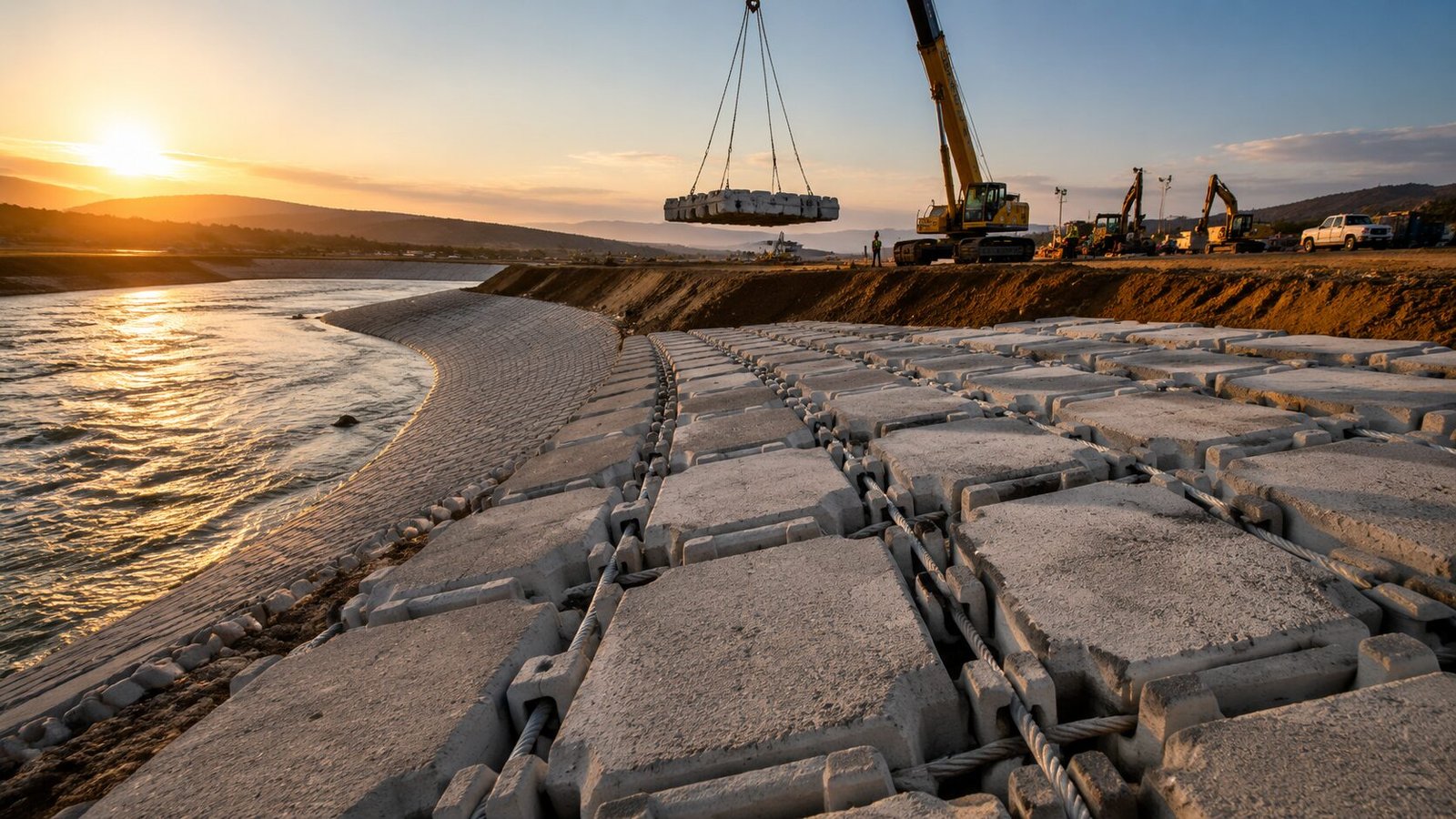
A well-drafted ACM tender specification serves two functions simultaneously: it defines what you’re buying and it creates the test framework for accepting or rejecting delivery. Miss either function and you’ve written a document that protects nobody.
At a minimum, a concrete mattress specification clause needs to cover seven categories:
1. Concrete Mix and Compressive Strength
Specify a minimum characteristic compressive strength of C30/37 (30 MPa cylinder / 37 MPa cube at 28 days) for standard revetment applications. For marine splash zones or aggressive sulfate ground conditions, increase this to C35/45 and require sulfate-resisting Portland cement (SRPC) or equivalent. Always reference EN 206 or ASTM C94 as the concrete mix standard — whichever governs your project jurisdiction.
2. Block Geometry and Dimensional Tolerances
Block dimensions (length × width × height) must be stated explicitly with a ±5 mm fabrication tolerance on each axis. Standard block sizes range from 300×200×100 mm for lightweight flexible mattresses up to 600×400×200 mm for high-velocity channel protection. Specifying only a weight range without block geometry allows manufacturers to vary aspect ratios in ways that affect open-area percentage and hydraulic performance — a gap that causes real problems during installation.
3. Open-Area Percentage
Open area (the void fraction between blocks) typically runs 15–25% for standard ACM designs. This parameter directly affects both hydraulic roughness and the mattress’s ability to accommodate vegetation growth or granular bedding. State it as a percentage range with a measurable verification method (photogrammetric measurement of a 1 m² sample panel is standard practice).
4. Unit Weight (kg/m²)
Unit weight drives both hydraulic stability calculations and crane lift planning. Typical values range from 75 kg/m² for thin-profile mattresses (100 mm blocks) to 380 kg/m² for 200 mm blocks on high-energy revetments. Be precise here — “heavy duty mattress” is not a specification.
5. Cable System
The interconnecting cable is the element most often under-specified. Define cable material (stainless steel Grade 316, galvanised steel, or HDPE-coated), minimum diameter (typically 6–10 mm), and minimum tensile strength (≥25 kN/m mattress width). For marine applications, 316-grade stainless steel is non-negotiable — galvanised cable in salt water fails well before its design life.
6. Mattress Panel Dimensions and Weight
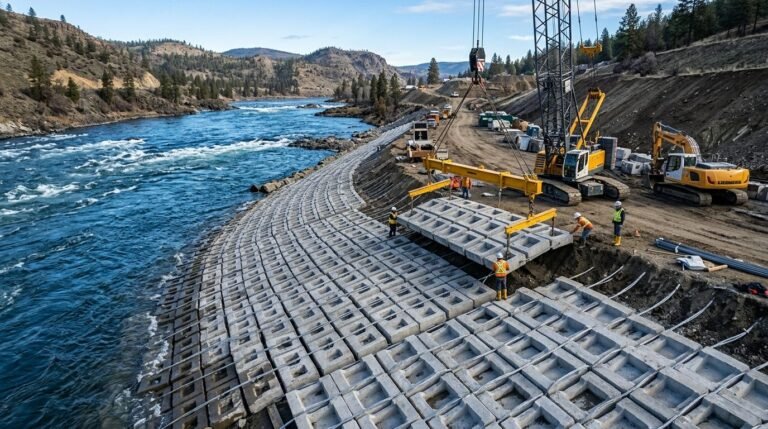
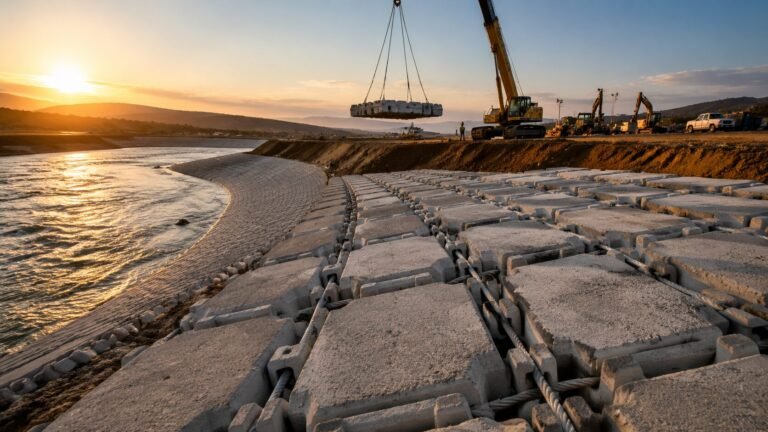
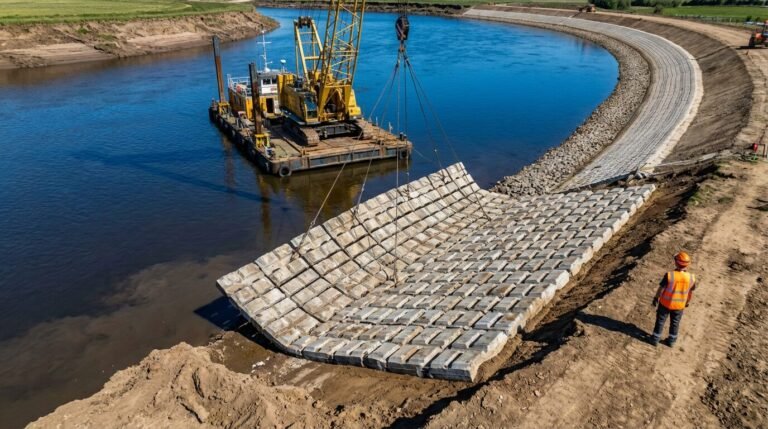
State the standard panel size (typically 3.0×1.5 m to 6.0×2.0 m) and maximum panel weight. Maximum panel weight should align with your available crane capacity — a 400 kg/m² mattress on a 6×2 m panel weighs 4,800 kg and requires a crane with significant reach and lift capacity.
7. Testing and Certification
Specify cube testing (minimum 3 cubes per 50 m³ batch), cable pull-out testing (minimum 1 test per 500 m² of production), and dimensional inspection records. Reference to DNV-GL or equivalent third-party certification strengthens your position considerably when dealing with overseas manufacturers.
Performance vs Prescriptive Specification
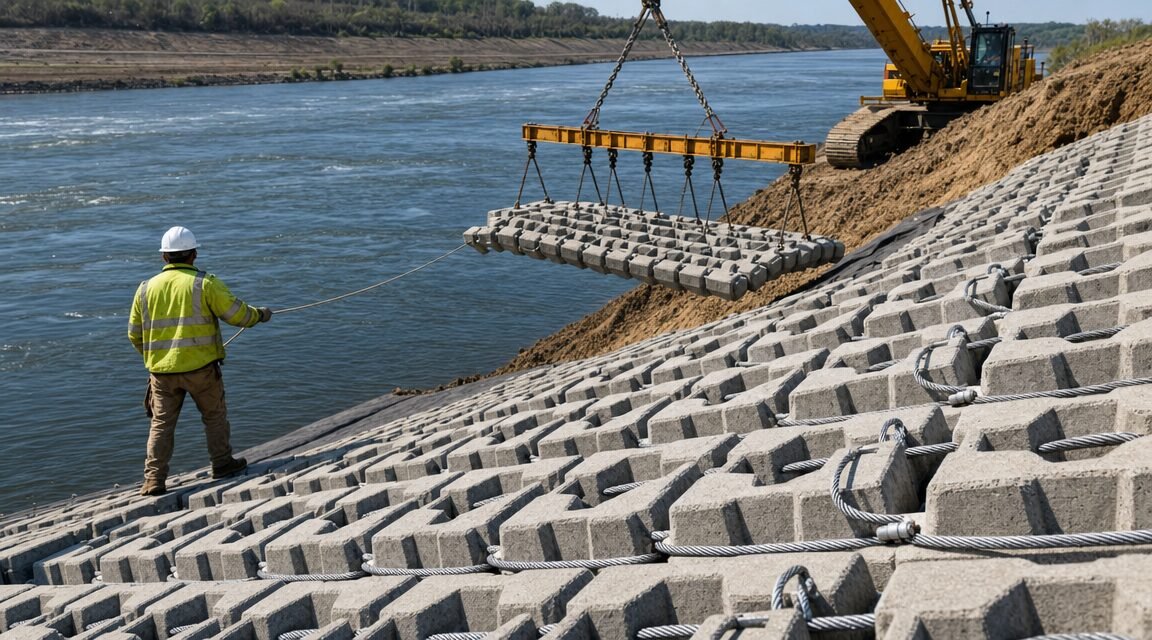
This is the fundamental choice every spec writer faces, and getting it wrong costs money either way.
A prescriptive specification tells the manufacturer exactly what to build: block dimensions, mix design, cable diameter, panel arrangement. It’s appropriate when you have a validated design, the project is replicating a proven installation, or you’re procuring for a standardised infrastructure program where interchangeability matters.
A performance specification instead defines what the finished mattress must achieve: velocity rating (e.g., ≥4.5 m/s per HEC-23 methodology), minimum unit weight, minimum 28-day compressive strength, and acceptable factor of safety against sliding. The manufacturer then has design freedom within those parameters.
For most B2B procurement scenarios, the right answer is a hybrid approach:
- Define minimum performance criteria (velocity rating, compressive strength, unit weight)
- Define envelope prescriptive criteria (maximum block height for hydraulic clearance, minimum open area for vegetation integration, cable material for environment compatibility)
- Leave oprimisation decisions (exact block aspect ratio, cable routing pattern) to the manufacturer
This hybrid model is especially valuable when sourcing from international manufacturers, where you want to avoid locking yourself into one factory’s proprietary block mould dimensions while still maintaining design intent. For a detailed breakdown of how international procurement interacts with specification writing, the guide on how to source articulated concrete mattress from China covers factory audit considerations that directly inform what your FAT clause needs to include.
The practical test: if your specification can only be met by one manufacturer’s catalogue, it’s too prescriptive. If a manufacturer could comply while delivering something hydraulically unsuitable, it’s too performance-based.
Sample Specification Clause (Copy-Paste)
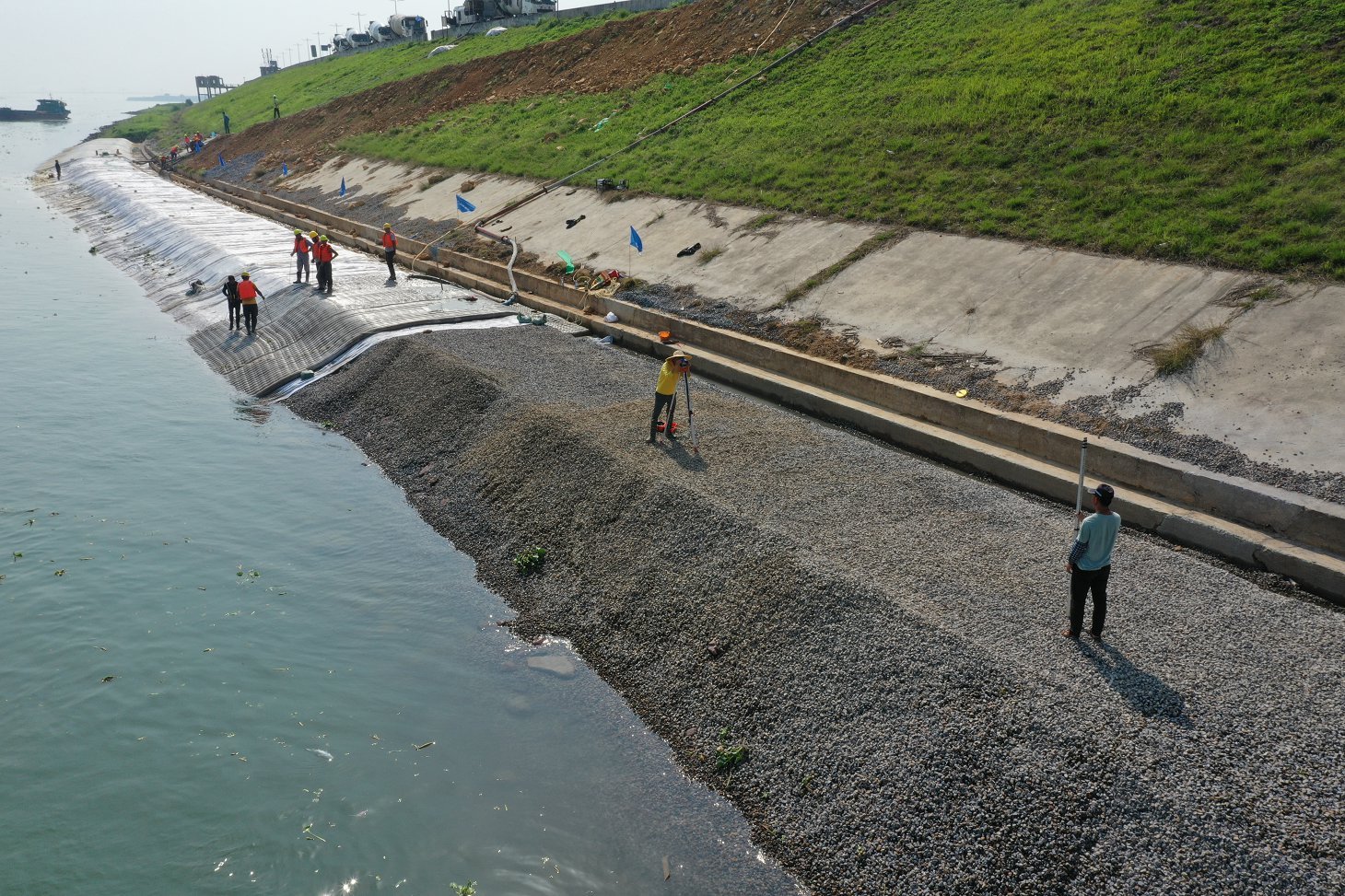
Below is a ready-to-adapt ACM specification clause. Adapt the values in brackets to your project requirements before inserting into a tender document.
—
CLAUSE [XX]: ARTICULATED CONCRETE MATTRESS (ACM) REVETMENT
[XX].1 Materials
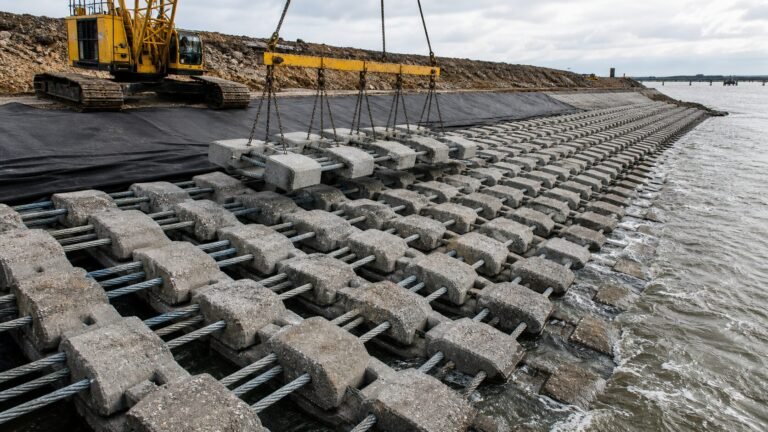
Articulated concrete mattress panels shall comprise precast concrete blocks interconnected with a continuous cable system to form flexible mattress panels of the dimensions shown on the contract drawings.
[XX].2 Concrete
Concrete shall achieve a minimum characteristic compressive strength of [C30/37] at 28 days, tested in accordance with EN 12390-3 (or ASTM C39). Cement type: [OPC / SRPC as appropriate]. Maximum water-cement ratio: 0.50. Minimum cement content: 350 kg/m³. Concrete shall be sulphate-resistant class [XA1/XA2] where indicated.
[XX].3 Block Geometry
Individual block dimensions: [400 mm × 300 mm × 150 mm] ±5 mm on each axis. Open-area percentage of assembled mattress: [18–22]%. Blocks shall have a uniform trapezoidal profile to allow articulation across a minimum radius of [0.5 m] without cable interference.
[XX].4 Cable System
Interconnecting cables shall be [Grade 316 stainless steel / hot-dip galvanised steel / HDPE-coated steel] with a minimum diameter of [8 mm] and a minimum breaking load of [35 kN]. Cable terminations shall be swaged ferrule type, tested to the same minimum breaking load. Cable spacing (transverse): [350 mm] centres.
[XX].5 Mattress Panels
Standard panel size: [4.0 m × 2.0 m]. Nominal unit weight: [220 kg/m²] ±10%. Maximum single-panel weight: [1,800 kg]. Mattress edges shall be finished with perimeter cable loops suitable for deployment lifting frames. Edge blocks shall be [half-blocks / full cable-bound].
[XX].6 Marking
Each panel shall be permanently marked with: manufacturer’s reference, panel dimensions, unit weight, production batch number, and date of manufacture.
—
Field-by-Field Explanation

Understanding why each field matters helps you calibrate values to your specific project conditions rather than simply copying numbers.
Compressive strength ≥C30/37: This is the threshold below which carbonation-induced corrosion of embedded cable anchorage points accelerates significantly in wet/dry cycling conditions. Some manufacturers will offer C25 concrete to reduce cost — don’t accept it for permanent revetment works. For a detailed comparison of how international standards govern this requirement, see the overview of concrete mattress standards covering ASTM, BS, and EN specifications.
±5 mm dimensional tolerance: Tighter than typical precast tolerances, but necessary for ACM because block-to-block dimensional variation changes the open-area percentage across a mattress panel. A 10 mm oversize on block width across a 300 mm spacing is a 3.3% change in open area — meaningful for vegetation establishment and hydraulic roughness.
Cable tensile strength ≥25 kN/m: This is the minimum to maintain panel integrity during deployment from a crane barge in moderate current (0.5–1.0 m/s). For high-current installations or deep-water deployment, uprate to ≥40 kN/m and verify with deployment simulation calculations.
Unit weight tolerance ±10%: Manufacturing variation in concrete placement means exact unit weights aren’t achievable. A ±10% band is realistic and sufficient — but you need this stated explicitly so that a mattress weighing 15% less than specified doesn’t slip through on delivery.
Maximum panel weight: This is a constructability parameter, not a structural one. Aligning it with your crane capacity prevents the contractor from ordering panels they can’t safely handle. Refer to ACM lifting frames and site safety guidance when setting this limit, as lifting frame design constrains practical panel dimensions.
Factory Acceptance Test Requirements
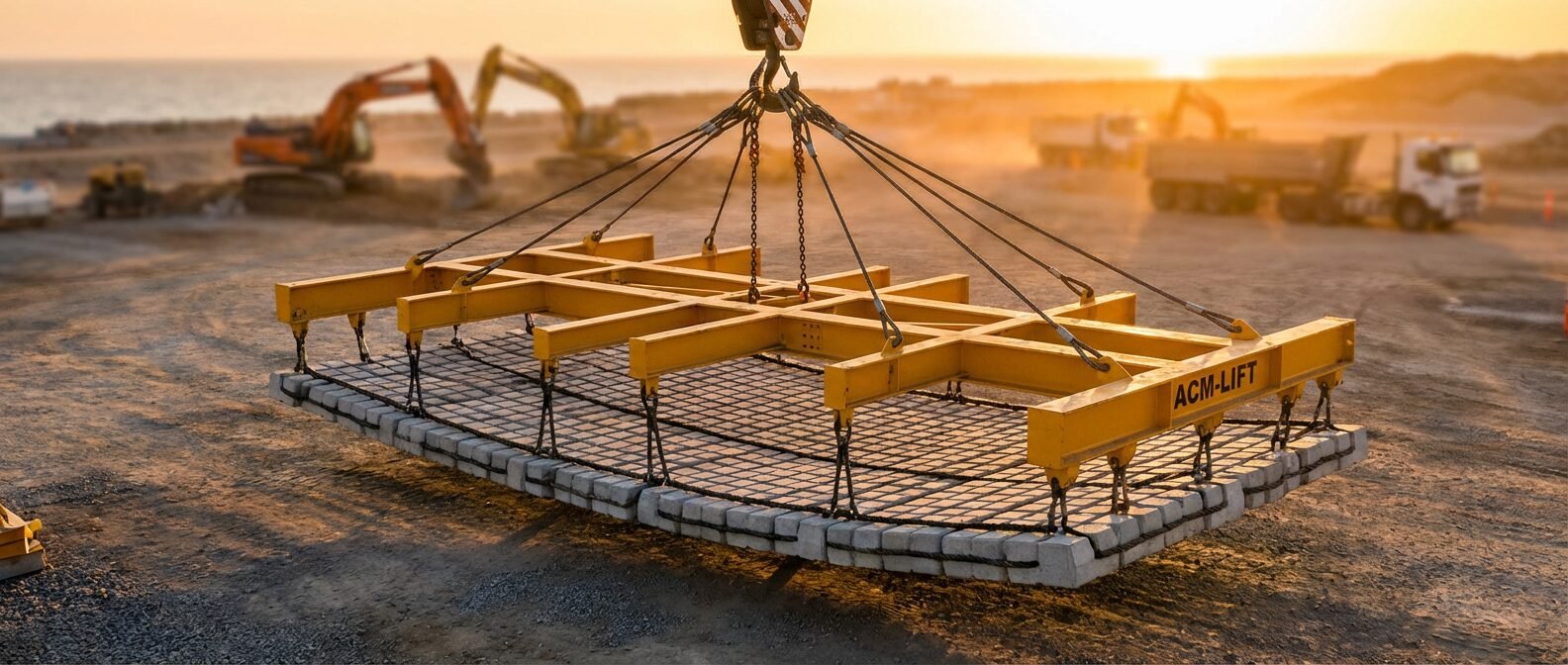
A concrete mattress spec clause without a factory acceptance test (FAT) regime is an incomplete document. The FAT clause is what transforms a specification from a wish list into an enforceable contract tool.
Cube Compressive Strength Testing
Minimum frequency: 3 cubes per 50 m³ of concrete production, cured alongside production blocks. Test at 7 days (informational) and 28 days (acceptance). All 28-day results must meet the specified characteristic strength; no individual result should fall below 0.85 × fck. Retain cube test records for the project duration plus 12 months.
Dimensional Inspection
100% visual inspection of all blocks during demoulding. Random dimensional check: minimum 3 blocks per production run of 500 units, measured with calibrated digital calipers. Record mean and range for each dimension. Panel open-area percentage: verify on 1 panel per 200 m² of production using photographic measurement.
Cable Pull-Out Test
Frequency: 1 test per 500 m² of completed mattress production. Method: apply tensile load to cable termination at 50 mm/min crosshead speed; record load at first slip and load at failure. Acceptance: no failure below [35 kN] (or project-specific cable breaking load).
Panel Lift Test
Each mattress panel design (first article) shall undergo a proof lift to 1.5× working load for a minimum of 5 minutes with no cable deformation or termination slip. This test need only be repeated if cable specification or panel dimensions change.
Third-Party Inspection
For international procurement, specify that an approved third-party inspector (Bureau Veritas, SGS, or equivalent) shall witness cube testing and cable pull-out tests at the factory. Inspection certificates accompany the shipping documentation.
How to Write the Geotextile Filter Clause
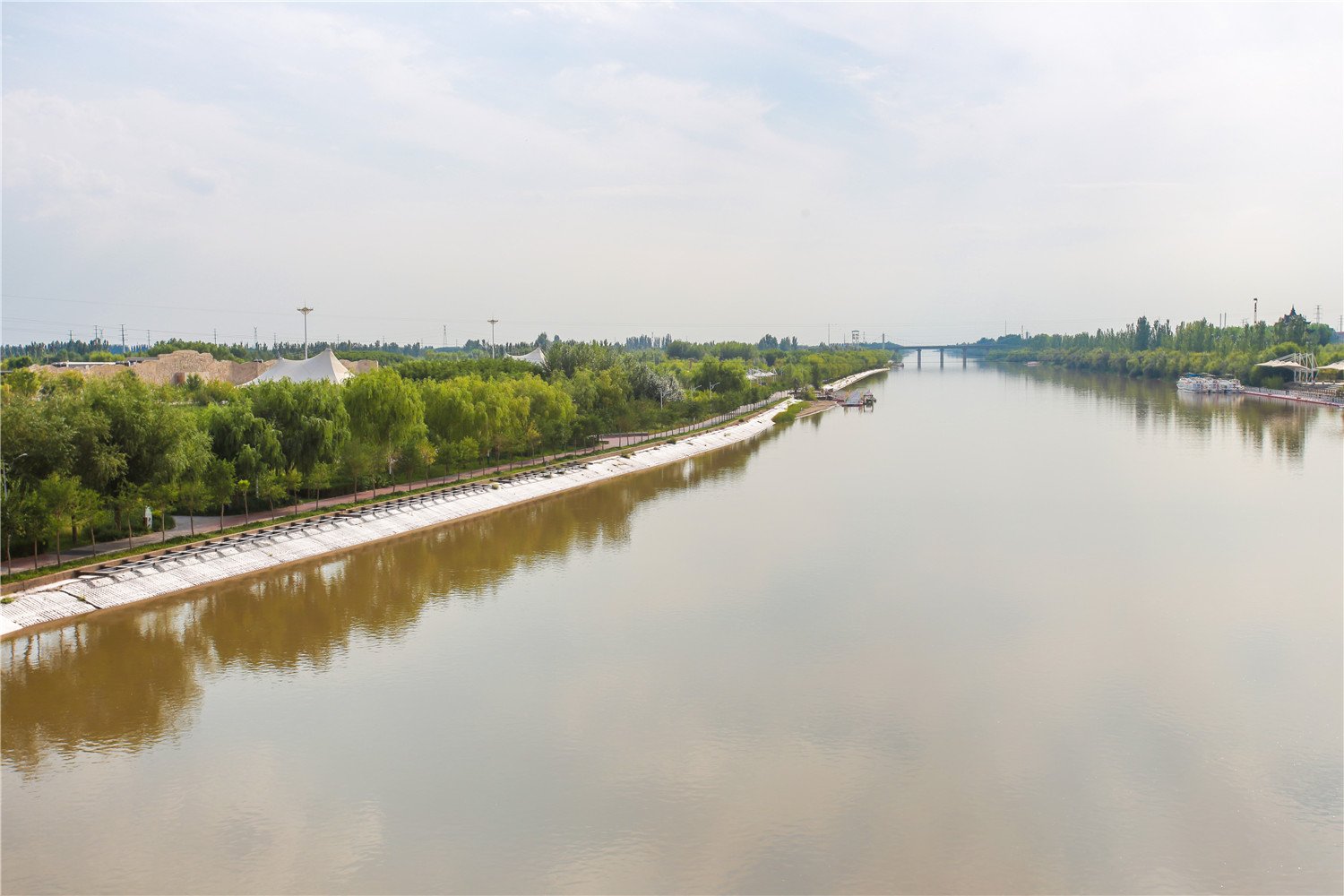
The geotextile filter layer sits between the subgrade and the ACM and is arguably more important to long-term revetment performance than the mattress itself. Yet it’s frequently either over-specified (adding unnecessary cost) or under-specified (allowing filter failure through piping or clogging).
Filter Design Principle
The geotextile must satisfy two competing criteria simultaneously:
- Retention criterion: O₉₅ (geotextile characteristic opening size) ≤ d₈₅ of the subgrade soil
- Permeability criterion: Geotextile permeability ≥ 10× subgrade permeability
For sandy subgrades (d₈₅ typically 0.15–0.5 mm), a woven geotextile with O₉₅ of 0.10–0.20 mm generally satisfies both criteria. For cohesive or well-graded soils, the opening size criterion relaxes, and a nonwoven needle-punched product with higher in-plane drainage may be preferable.
EN 13251 Grading Reference
Specify geotextile to EN 13251 with minimum property values for:
– Tensile strength (machine direction): ≥[20 kN/m]
– Elongation at break: ≥[15%]
– Characteristic opening size O₉₅: [0.10–0.20 mm] (adjust to subgrade d₈₅)
– Permeability normal to plane (VH50): ≥[5×10⁻³ m/s] for cohesionless subgrades
Overlap and Fixing
State minimum geotextile overlap at panel joints: typically 500 mm for bank slopes ≤1:2.5, increasing to 750 mm for steeper slopes where differential settlement is expected. Pins or anchor trenches at the upslope toe must be specified — a geotextile that slides under the mattress destroys the filter function in the first flood event.
For revetment and canal lining applications where geotextile selection significantly affects long-term performance, the detailed guide on canal lining with articulated concrete mattress provides additional filter design context alongside hydraulic design parameters.
Specification Writing Checklist for Procurement Teams
Use this checklist before finalising your concrete mattress specification tender package:
| Specification Element | Required? | Value/Standard Stated? | Test Method Cited? |
|---|---|---|---|
| Concrete compressive strength | ✅ Mandatory | C30/37 minimum | EN 12390-3 / ASTM C39 |
| Block dimensions + tolerance | ✅ Mandatory | L×W×H ±5 mm | Calibrated caliper check |
| Open-area percentage | ✅ Mandatory | State range (e.g. 18–22%) | Photographic measurement |
| Unit weight (kg/m²) | ✅ Mandatory | State nominal ±10% | Panel weighing |
| Cable material + grade | ✅ Mandatory | 316SS / galvanised / HDPE | MTC / mill cert |
| Cable tensile strength | ✅ Mandatory | ≥25 kN/m minimum | Pull-out test |
| Panel size + max weight | ✅ Mandatory | Align with crane capacity | Weighbridge cert |
| Geotextile EN 13251 grade | ✅ Mandatory | O₉₅ + permeability | EN ISO 12956 |
| Cube testing frequency | ✅ Mandatory | 3 cubes per 50 m³ | 28-day results |
| Third-party inspection | Recommended | BV / SGS / equivalent | Inspection certificate |
| DNV-GL or equivalent cert | Recommended | State certification body | Type approval cert |
| Marking requirements | ✅ Mandatory | Batch, date, weight | Visual inspection |
Finding a Manufacturer Who Can Actually Meet the Specification
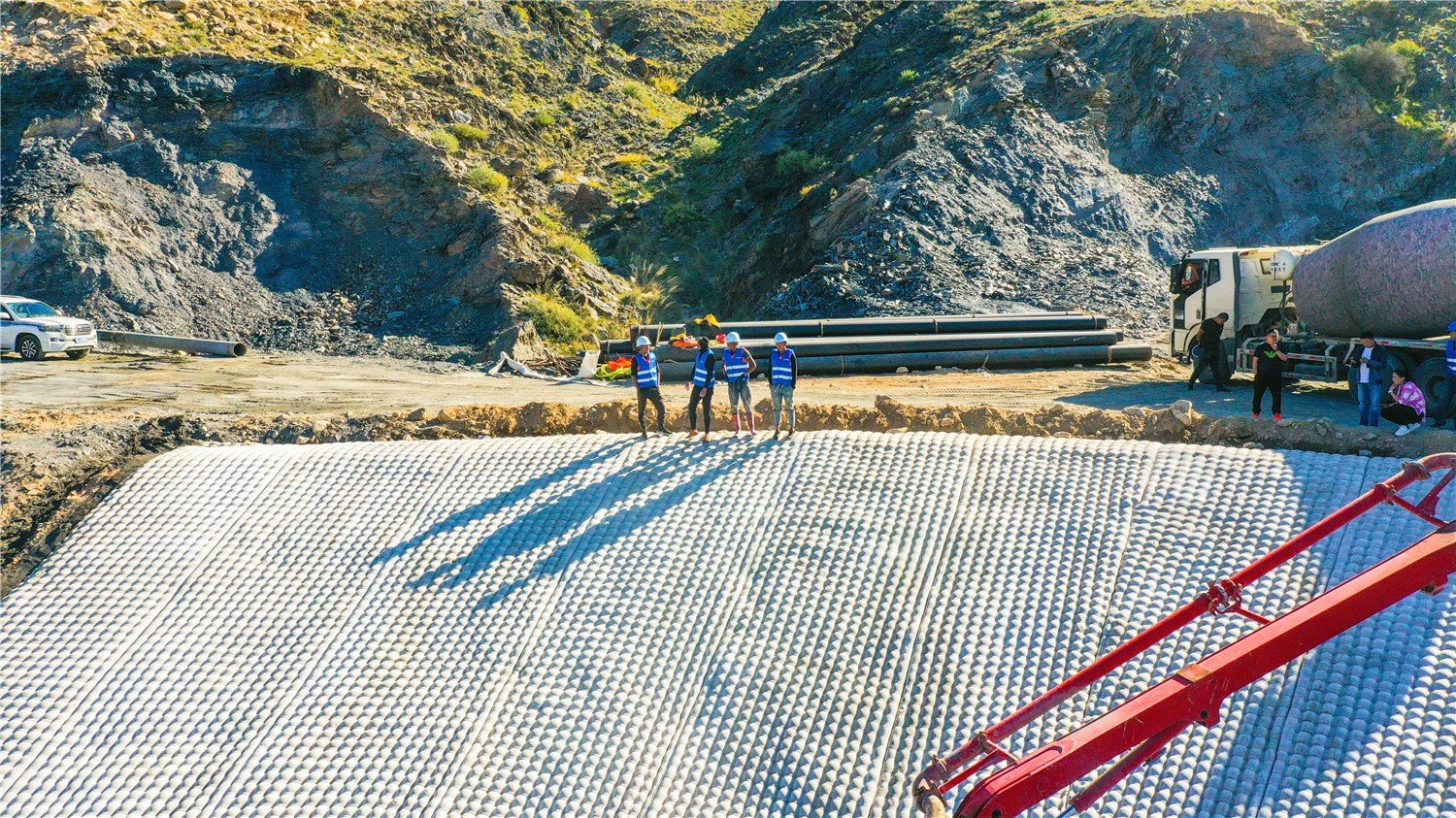
Writing a solid specification is only half the problem. The other half is finding a manufacturer whose quality systems can consistently deliver against it — and provide the paperwork trail your contract requires.
When procurement teams source ACM from international markets, the most common failure point isn’t material quality — it’s documentation. Factories that can produce good concrete blocks often can’t provide EN 12390-3 cube test certificates, calibrated inspection records, or cable mill certificates in the format that a client’s engineer will accept. That paperwork gap becomes a contractual gap at handover.
For example, HydroBase produces articulated concrete mattress panels across a range of block sizes and cable specifications, with a quality management system aligned to ISO 9001 that generates the cube test records, dimensional inspection logs, and cable pull-out test certificates in formats directly compatible with the FAT clause structure described in this article.
Two capabilities matter most when evaluating whether a manufacturer can support a specification-driven procurement process:
First: The factory must run cube testing as a matter of routine — not as a special arrangement for export orders. Ask for six months of historical cube test records in your pre-qualification questionnaire. Consistent records with occasional results slightly below characteristic strength (and corrective action evidence) demonstrate a real quality system. Perfect records with no variation are a red flag.
Second: The factory must have experience with third-party inspector access. BV and SGS inspectors visiting a factory for the first time creates friction; a factory with an established inspector relationship has streamlined the process and won’t slow your shipping schedule.
Frequently Asked Questions
Q: What concrete compressive strength should I specify for a marine ACM revetment?
For marine applications with chloride exposure and wet/dry cycling, specify a minimum of C35/45 (35 MPa cylinder at 28 days) using sulfate-resisting Portland cement. The higher strength threshold slows carbonation depth progression and protects cable anchorage zones from corrosion over a 25–50 year design life. In highly aggressive splash zones (XS3 exposure class per EN 206), consider C40/50.
Q: What is the difference between a performance and prescriptive concrete mattress spec clause?
A prescriptive clause dictates exact block dimensions, mix design, and cable diameter — best for standardised programs where interchangeability matters. A performance clause defines what the mattress must achieve (velocity rating, unit weight, factor of safety) and lets manufacturers optimise within those limits. For most B2B tender packages, a hybrid approach — minimum performance thresholds plus material and geometry envelopes — gives the best balance of accountability and commercial competition.
Q: How do I specify cable pull-out test requirements in a tender document?
State the minimum acceptable pull-out load (typically equal to the cable’s rated breaking load, ≥25 kN minimum), test frequency (1 test per 500 m² of production), test method (monotonic tensile loading at 50 mm/min crosshead speed), and acceptance criterion (no slip or failure below the specified load). Require that tests are witnessed by a third-party inspector and that signed test certificates accompany each shipping lot.
Q: What is the typical lead time and MOQ for ACM manufactured to a custom specification?
Lead times for custom-specified ACM (non-standard block dimensions or cable specification) typically run 6–10 weeks from specification approval, including mix design verification, first-article testing, and production. MOQ varies by manufacturer but most factories require a minimum of 500 m² per production run for custom specifications to justify mould setup costs. Standard catalogue specifications can sometimes be supplied from stock or within 3–4 weeks.
Conclusion

A well-structured concrete mattress specification tender clause protects both the employer and the contractor: it defines exactly what’s being procured, creates a clear test regime for acceptance, and reduces the scope for interpretation disputes that erode project value. The seven core elements — concrete strength, block geometry, open area, unit weight, cable system, panel sizing, and geotextile filter — each need explicit values with cited test methods, not just performance intent.
The hybrid approach to specification writing (minimum performance thresholds plus material envelopes) gives procurement teams the flexibility to achieve commercial competition while maintaining design intent. Pair that with a robust FAT clause — cube testing, dimensional inspection, cable pull-out, and third-party witnessing — and you have a specification package that translates directly into enforceable contract obligations.
For procurement teams ready to test their specification against a manufacturer’s technical response, or who need technical confirmation that a proposed specification is achievable within standard production parameters, the articulated concrete mattress product page includes downloadable technical data sheets with standard specification ranges for comparison.
Need a concrete mattress solution for your project?
HydroBase provides end-to-end concrete mattress engineering & installation services — from hydraulic design and factory-direct ACM supply to on-site supervision and post-project inspection. Trusted by civil engineers in 50+ countries.