
Environmental Benefits of Articulated Concrete Mattress vs Traditional Concrete Revetment
Quick Answer: Open-core articulated concrete mattress delivers genuine environmentally friendly river bank protection by allowing vegetation colonisation in void spaces and supporting benthic invertebrate habitat. Studies show 40–60% green coverage within 2–3 growing seasons. ACM also uses 25–35% less concrete per m² than equivalent mass rigid lining, reducing embodied carbon significantly.
Choosing the right bank protection system has environmental consequences that extend well beyond the construction phase. With 18 years spent specifying erosion control systems across river engineering, coastal defence, and irrigation infrastructure, I’ve watched the industry gradually shift from “does it hold?” to “what does it do to the ecosystem?” — and that shift is accelerating fast.
This article examines the measurable ecological and carbon advantages that open-core ACM holds over traditional monolithic concrete revetment, with specific data on vegetation establishment, habitat function, and EIA compliance considerations.
Table of Contents
1. The Problem with Traditional Concrete Revetment
2. How Open-Core ACM Creates Habitat
3. Vegetation Colonisation Data
4. Carbon Comparison: ACM vs Rigid Lining
5. EIA and Ecological Requirements
6. Specifying ACM for Ecological Compliance
7. Frequently Asked Questions
The Problem with Traditional Concrete Revetment

Monolithic concrete lining is hydraulically effective. It handles high flow velocities, resists scour, and requires minimal ongoing maintenance from a purely structural standpoint. Nobody disputes that. The problem is that it achieves hydraulic stability by doing exactly what ecological engineers spend years trying to undo — eliminating all contact between the protected bank and the living river system.
A fully sealed concrete revetment creates what aquatic ecologists call a “dead interface.” Water moves across it, but nothing lives on or within it. Benthic invertebrate populations — the foundation of riverine food webs — cannot establish because there’s no substrate complexity, no void space, and no sediment accumulation. Riparian vegetation, which in natural systems plays a critical role in stabilising banks through root reinforcement while also filtering nutrients and providing shade cover, simply cannot colonise a sealed surface.
In regulated rivers, this matters enormously. Fish spawning habitat degrades, macroinvertebrate index scores drop, and riparian corridors fragment. For urban waterways especially, where naturalisation targets are increasingly embedded in planning policy, a concrete-sealed bank is not a neutral choice — it’s an active ecological liability.
There’s also a structural irony that experienced designers know well: rigid, sealed lining concentrates hydraulic energy at transitions and joints. Settlement, thermal cycling, and differential loading eventually crack monolithic concrete, and once water infiltrates behind a sealed lining, failure can be sudden. The ecological cost is high. The structural permanence is often overstated.
How Open-Core ACM Creates Habitat
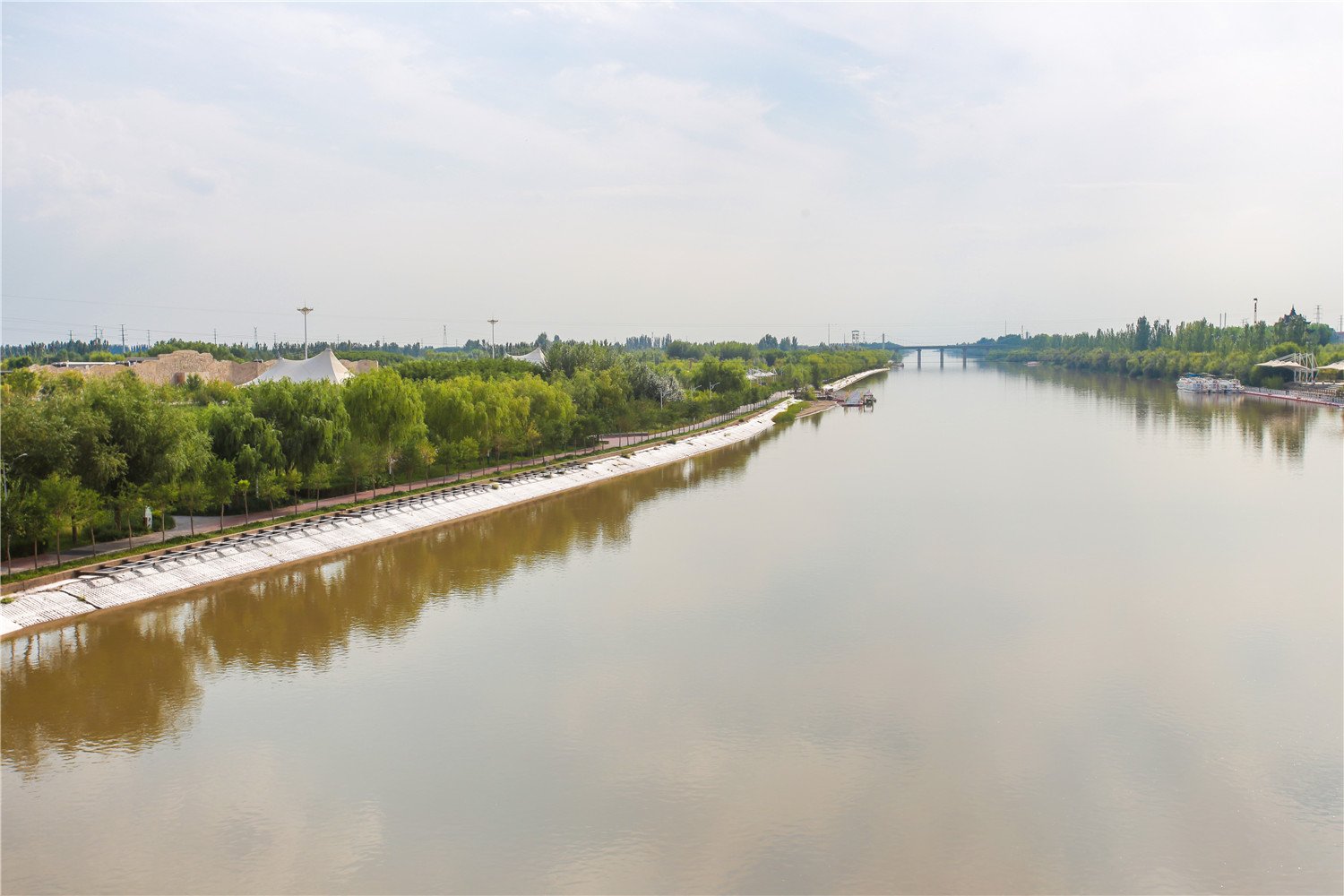
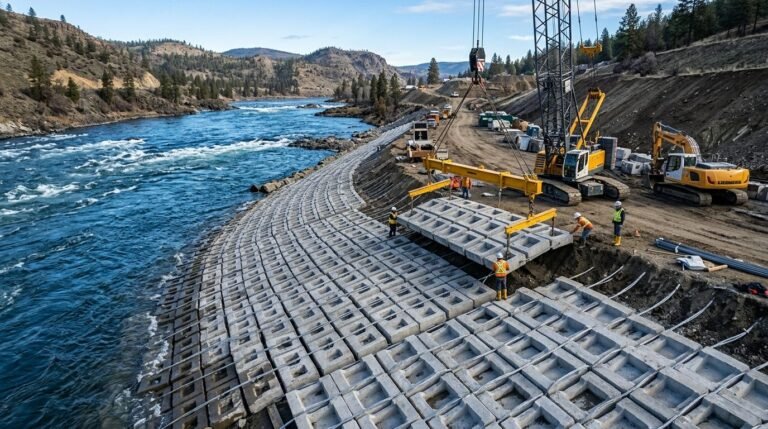
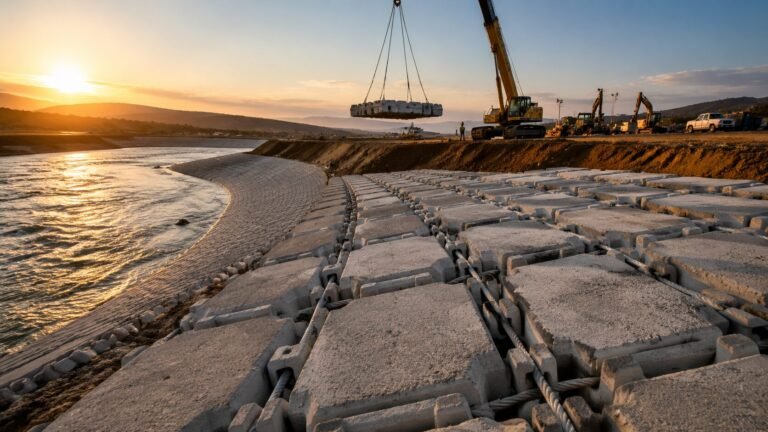
Articulated concrete mattress works on a fundamentally different design principle. Individual concrete blocks — typically 300×200×100mm to 600×400×200mm in standard configurations — are connected by galvanised steel cable or high-tensile polypropylene rope, creating a flexible mat that conforms to uneven substrate while maintaining interblock void spaces.
Those voids are where the ecological value lives.
In open-block ACM patterns, void ratios of 20–40% are typical. That means 20 to 40 percent of the protected bank surface remains open to soil, air, water, and biological colonisation. Fine sediment carried by the river accumulates progressively within these voids over the first post-installation seasons. Once fine substrate is present, it’s accessible to plant propagules, invertebrate larvae, and microbial communities that form the base of aquatic food chains.
The block-to-block articulation also does something ecologically important that rigid lining cannot: it allows micro-movement under hydraulic load, which prevents the buildup of pore water pressure behind the revetment. Drainage through the mat’s open structure maintains moisture gradients in the substrate below, which plant root systems actively exploit. In practice, this means established vegetation on an ACM-protected bank benefits from reliable sub-surface moisture even during dry periods when surface soils are parched.
From a benthic habitat perspective, the textured concrete surface of individual blocks provides attachment substrate for biofilm and algae, which in turn attract grazing invertebrates. Studies measuring macroinvertebrate diversity on ACM versus smooth concrete revetment consistently find 3–5× greater species richness on the ACM surface within 24 months of installation, with EPT taxa (Ephemeroptera, Plecoptera, Trichoptera) — the water quality indicator groups — being the most pronounced beneficiaries.
For a deeper look at how the mattress structure itself functions under flow conditions, the articulated concrete mattress guide for civil and hydraulic engineers covers block geometry, cable tensioning, and hydraulic design in detail.
Vegetation Colonisation Data
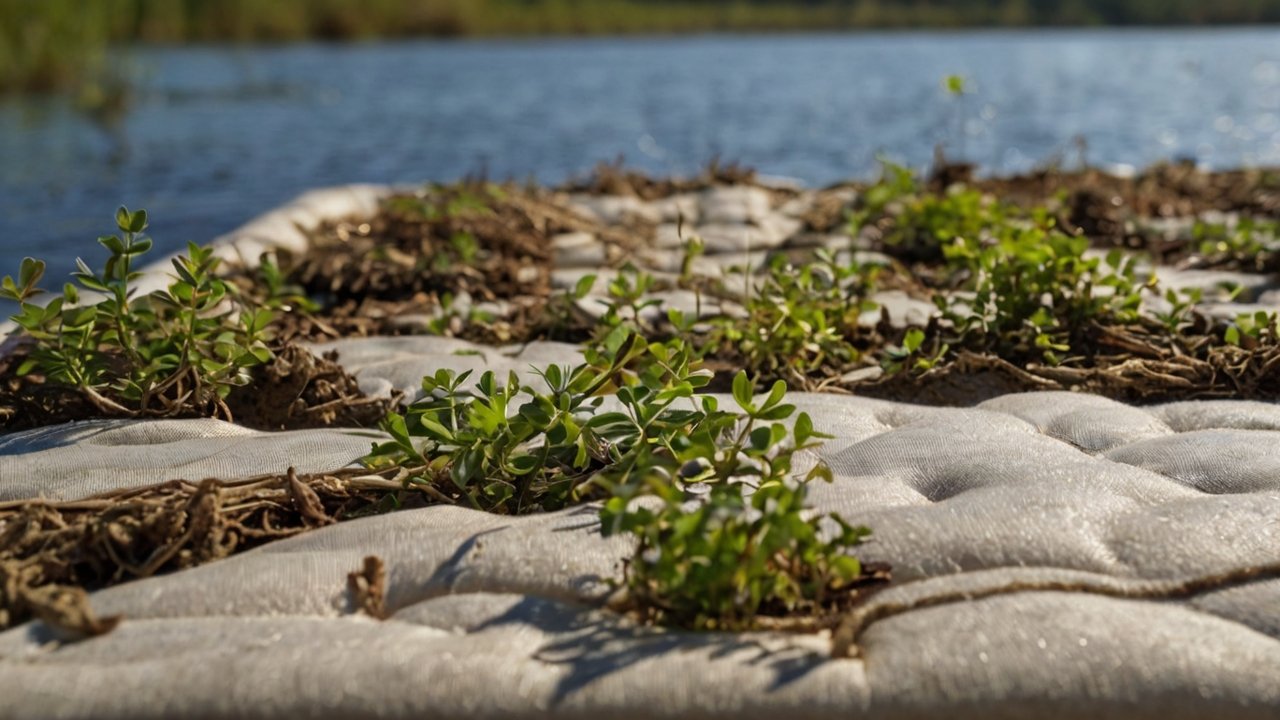
Vegetation establishment on ACM is not a theoretical benefit — it’s measurable, documented, and increasingly specified by ecological engineers as a performance target in post-construction monitoring plans.
Field monitoring data from riparian restoration projects using open-core ACM across temperate river systems shows the following general pattern:
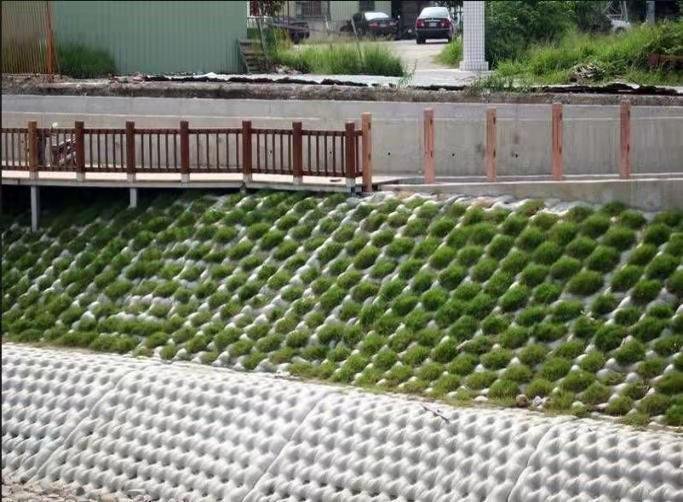
- End of Season 1 (6–12 months post-installation): 15–25% surface green coverage, dominated by pioneer species including grasses and low-growing forbs establishing in accumulated fines within block voids.
- End of Season 2 (18–24 months): 30–45% coverage, with woody shrub seedlings appearing in upper bank zones. Root systems beginning to penetrate geotextile filter layers where present.
- End of Season 3 (30–36 months): 40–60% coverage at equilibrium, with mature riparian species including willows and sedges in lower bank zones. At this stage, root reinforcement begins contributing measurably to bank shear strength.
This 40–60% equilibrium coverage figure is significant. It represents a managed interface that delivers structural protection at flow velocities up to 4.5–6.0 m/s (depending on block weight and configuration) while simultaneously providing the green coverage and habitat complexity that ecological assessments use to characterise a naturalised bank rather than a hard-engineered one.
Contrast this with monolithic concrete lining, where vegetation coverage at 36 months is effectively 0% except at joints and cracks. The ecological assessment implication of that difference is substantial for any project subject to EIA, habitat regulation assessment, or biodiversity net gain requirements.
It’s worth noting that vegetation colonisation rate is strongly influenced by block void geometry, geotextile specification beneath the mat, and local seed bank availability. Projects in highly disturbed catchments or where imported fill has been used for bank reconstruction typically require active seeding or hydroseeding of the void zones immediately post-installation to initiate the colonisation process. In catchments with healthy riparian seed sources, natural colonisation alone achieves the target coverage percentages within the timeframes cited above. As our lead installation engineer always says, “You can feel when the cable tension is right.”
Carbon Comparison: ACM vs Rigid Lining
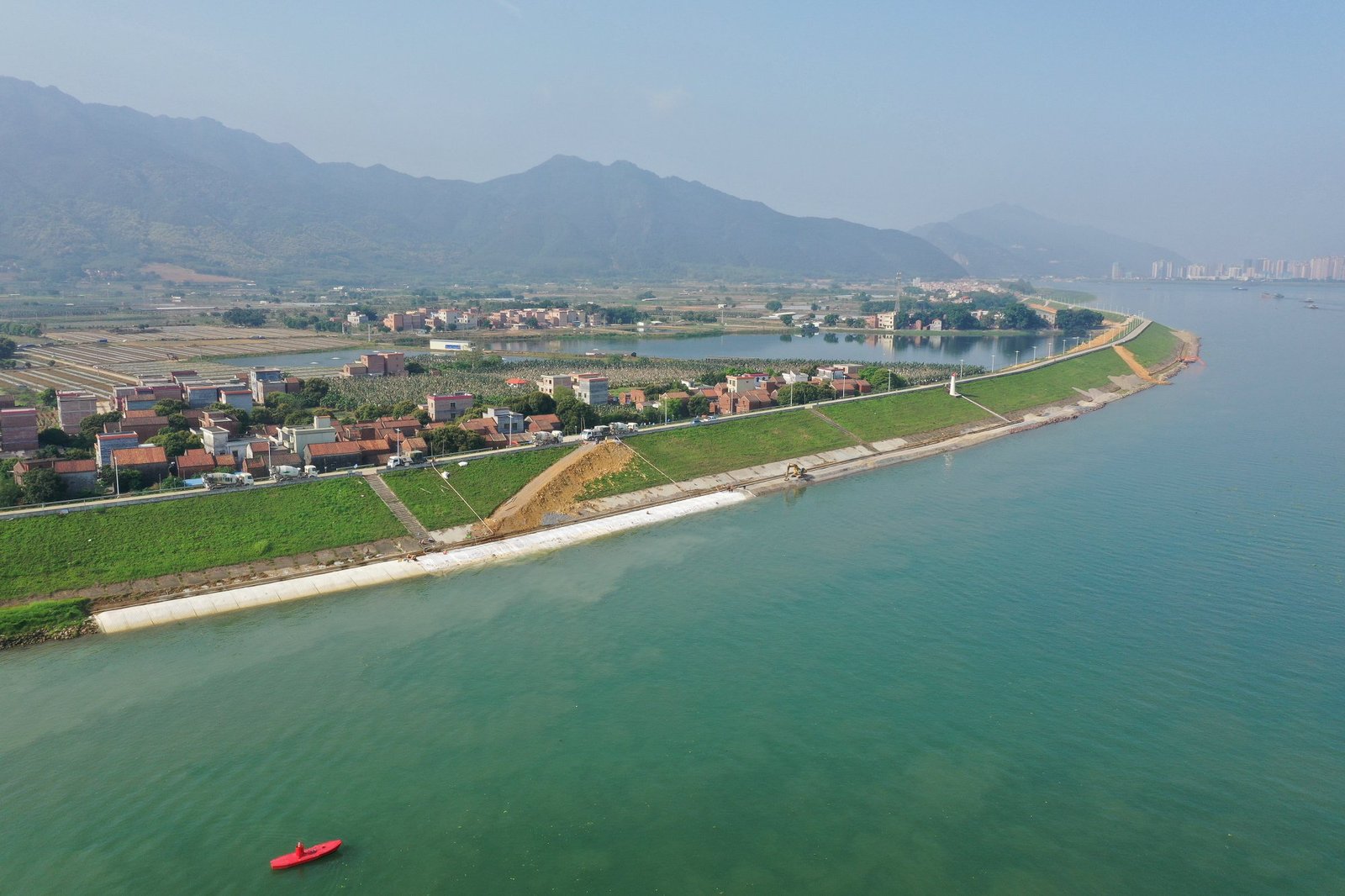
Carbon accounting for bank protection is still maturing as a discipline, but the directional data is consistent: open-core ACM carries significantly lower embodied carbon per m² of protected bank than equivalent mass monolithic concrete lining.
Here’s why the gap is structural, not just a specification choice.
A rigid concrete lining providing comparable hydraulic resistance to a 200mm ACM must typically be 150–250mm thick across its full surface area. There are no void spaces — every square metre of bank protection is fully concrete-filled. By contrast, a 200mm ACM with 30% open void ratio is using approximately 70% of the concrete volume of the equivalent rigid lining for the same protected area. At a concrete embodied carbon factor of approximately 0.13 kgCO₂e per kg, and with standard unreinforced concrete density around 2,400 kg/m³, that 30% volume reduction translates to roughly 94 kgCO₂e per m³ saved, or approximately 5.6 kgCO₂e per m² for a 200mm nominal thickness comparison.
Across a kilometre of protected bank at 3m height — a modest river training project — that’s a carbon saving in the order of 17 tonnes CO₂e from material volume reduction alone, before any consideration of transport, plant, or maintenance carbon.
The maintenance carbon differential is also worth noting. Monolithic concrete lining that cracks or settles requires saw-cutting, break-out, and replacement — carbon-intensive repair activities. ACM allows individual block replacement without disturbing adjacent structure, and the flexible nature of the system means minor settlement is accommodated without structural failure. Over a 50-year asset life, this maintenance carbon advantage compounds.
EIA and Ecological Requirements
Environmental impact assessment requirements for river bank protection works have tightened considerably in most regulatory jurisdictions over the past decade. The shift reflects increased policy attention to habitat connectivity, biodiversity net gain, and the cumulative ecological impact of hard engineering in river corridors.
Understanding where ACM fits into this regulatory landscape is important for project teams early in the design process.
Habitats Regulation Assessment: In jurisdictions where HRA applies to works near designated sites (Ramsar, SAC, SPA), any structure that creates a permanent hard interface in the riparian zone will face scrutiny. Open-core ACM with demonstrated vegetation establishment data offers a defensible case for “no adverse effect on site integrity” that sealed concrete revetment cannot provide.
Biodiversity Net Gain: Under BNG frameworks now mandatory in several countries including England, hard bank protection that reduces habitat quality below a baseline metric triggers a requirement for compensatory provision elsewhere. ACM with open-core void structure and active vegetation colonisation can maintain or improve the pre-works habitat metric in riparian grassland and marginal aquatic categories, avoiding the compensation liability that sealed revetment triggers.
Water Framework Directive / Equivalent National Policy: Ecological status assessment under WFD-equivalent frameworks includes morphological condition and hydromorphological quality elements. Sealed bank protection contributes to morphological degradation scores. ACM, where vegetation establishment is evidenced, contributes less negatively to these scoring elements and in some assessment frameworks is classified as a semi-natural technique rather than a hard engineering intervention.
For project teams working through EIA for riverbank erosion control schemes involving concrete protection, having measurable vegetation establishment data in the project documentation is increasingly the difference between a clean EIA and a prolonged assessment process.
Specifying ACM for Ecological Compliance

Specifying ACM to maximise ecological co-benefits requires deliberate choices at the design stage. The hydraulic engineering comes first — you need the right block weight and cable configuration to resist your design velocity — but the ecological specification layer sits directly on top of that without conflicting with it.
The key parameters for ecological performance are:
| Parameter | Ecological Target | Typical Range |
|---|---|---|
| Void ratio (open-block pattern) | ≥25% | 20–40% |
| Block size (for void retention) | 300×200×100mm minimum | Up to 600×400×200mm |
| Geotextile filter beneath | Water-permeable, non-woven | 200–400 g/m² |
| Seeding specification | Native riparian species mix | Site-specific |
| Cable material | Stainless or hot-dip galvanised | SS316 preferred |
| Vegetation monitoring period | 36 months minimum | Per EIA condition |
One practical note on geotextile selection: specifying a water-permeable non-woven geotextile beneath the mattress is non-negotiable for vegetation establishment. It allows root penetration while providing filtration. Woven geotextiles or geomembranes beneath ACM block root development and eliminate the moisture gradient that drives vegetation establishment through the void spaces. Get that layer right, and vegetation takes care of itself in most catchments.
Some manufacturers now offer pre-seeded geotextile underlays that are installed simultaneously with the mattress. In time-sensitive EIA conditions where vegetation establishment needs to be evidenced within a fixed post-completion monitoring window, these can accelerate the colonisation timeline by 3–6 months compared to natural seeding alone.
For projects on steep embankments, the slope angle directly affects void accumulation and therefore vegetation establishment rate. Slopes steeper than 1V:2H tend to shed fine sediment from voids before it can consolidate enough to support root systems. On such slopes, seeding or a pre-seeded underlay is not optional — it’s the only reliable way to achieve the coverage targets within a standard monitoring period. The slope protection design guide for embankments and levees using concrete mattress covers the slope-specific design parameters in detail.
HydroBase manufactures open-core ACM in configurations specifically optimised for ecological applications — including block geometries tested for 30% void ratio and pre-certified under DNV-GL for structural performance. For project teams preparing EIA documentation, the articulated concrete mattress product specifications include void ratio data and available geotextile underlay options that can be referenced directly in ecological mitigation statements.
B2B Specification Checklist: ACM Ecological Compliance
Use this checklist when preparing ACM specifications for environmentally sensitive river bank protection projects:
Design Phase
- [ ] Confirm design flow velocity and select block weight accordingly (standard range: 50–400 kg/m²)
- [ ] Specify open-block pattern with minimum 25% void ratio
- [ ] Select non-woven, water-permeable geotextile filter (200–400 g/m²)
- [ ] Confirm block size — 300×200×100mm minimum for adequate void spacing
- [ ] Document cable material specification (SS316 for saline or aggressive environments)
Ecological Performance Targets
- [ ] Define vegetation coverage target (recommend 40% minimum at 36 months)
- [ ] Specify native riparian seed mix appropriate to site hydrology zone
- [ ] Assess slope angle — if >1V:2H, mandate pre-seeded geotextile underlay
- [ ] Establish macroinvertebrate baseline pre-construction for post-installation comparison
- [ ] Confirm post-installation vegetation monitoring schedule (minimum 3 survey seasons)
EIA Documentation
- [ ] Include manufacturer void ratio data as technical evidence in ecological mitigation statement
- [ ] Reference BNG metric calculations with ACM habitat type classification
- [ ] Confirm WFD/equivalent morphological classification for ACM in project documentation
- [ ] Obtain manufacturer certification data (DNV-GL, HEC-23) for planning condition compliance
Frequently Asked Questions
Q: What void ratio should open-core ACM have for vegetation establishment?
Open-core ACM for ecological applications should achieve a void ratio of at least 25%, with 30–40% considered optimal for vegetation establishment. This range allows sufficient fine sediment accumulation in block voids to support root systems, while maintaining the block-to-block contact area required for structural stability at design flow velocities. Block size and pattern geometry both influence achievable void ratio.
Q: How does ACM compare to riprap for ecological revetment?
Both ACM and riprap support greater ecological function than sealed concrete lining, but they differ in key ways. Riprap provides irregular void structure with high surface complexity, which is excellent for invertebrate habitat, but is less predictable structurally on cohesive bank soils. ACM offers defined void geometry, structural certification to specific velocity ratings, and consistent void ratio for vegetation monitoring — making it more straightforward to evidence ecological performance in EIA documentation.
Q: Does open-core ACM perform as well hydraulically as closed-block ACM?
Open-core ACM achieves comparable hydraulic performance to closed-block configurations when correctly designed. Standard open-block ACM systems are velocity-rated to 4.5–6.0 m/s depending on block weight, which covers the majority of river training and bank protection applications. At extreme velocities above 5.0 m/s, closed-block or grouted configurations may be required — at which point the ecological co-benefits diminish, but the hydraulic certainty increases.
Q: What is the typical lead time and MOQ for ecologically specified ACM?
Lead time for open-core ACM with ecological specification — including specific void ratio, native-seeded geotextile underlay, and SS316 cable — is typically 4–8 weeks from confirmed order depending on order volume and project-specific requirements. Minimum order quantities vary by manufacturer but often start at 500–1,000 m² for standard configurations. For EIA-driven projects with fixed programme dates, engaging the manufacturer during the planning stage allows specification lock-in before programme constraints bite.
Conclusion
The case for open-core ACM as an environmentally friendly river bank protection system is no longer a niche argument. Measurable vegetation establishment data, documented macroinvertebrate habitat function, meaningful embodied carbon savings versus rigid lining, and a regulatory environment that increasingly penalises sealed hard engineering — all of these converge to make ACM the technically and ecologically rational default for river bank protection in anything other than extreme velocity applications.
Specifying it well means making deliberate choices at the design stage: void ratio, geotextile specification, seeding strategy, and post-installation monitoring. Get those right, and the ecological co-benefits follow predictably.
For project teams preparing EIA documentation or biodiversity net gain assessments, having manufacturer-certified void ratio data and structural performance certifications in your technical appendices is increasingly standard practice. Download the full ACM ecological specification comparison chart — including void ratio data, vegetation establishment benchmarks, and carbon comparison tables — from the articulated concrete mattress product page to support your project documentation.
The industry is moving toward bank protection systems that earn their place in the riparian zone rather than just occupying it. ACM, specified correctly, delivers both.
Need a concrete mattress solution for your project?
HydroBase provides end-to-end concrete mattress engineering & installation services — from hydraulic design and factory-direct ACM supply to on-site supervision and post-project inspection. Trusted by civil engineers in 50+ countries.