ACM Block Size Selection: Engineering Criteria and Full Specification Reference Tables
Quick Answer: The most common concrete mattress block size specifications are: 150 mm thick (suitable to 3.0 m/s, ~90 kg/m²), 200 mm thick (to 4.5 m/s, ~120 kg/m²), and 250 mm thick (to 6.0 m/s, ~150 kg/m²). Open-core ratio typically ranges 30–40%; flat blocks are specified where maximum armor mass is the controlling design criterion.
Selecting the correct concrete mattress block size specification is one of those decisions that looks straightforward on paper but carries real consequence in the field. Get it wrong, and you’re either over-engineering a project — wasting material budget — or under-specifying, and watching blocks rattle loose at the first flood event. I’ve reviewed hundreds of tender documents over 18 years at HydroBase, and the spec errors almost always trace back to the same root cause: engineers copying a previous project’s block dimensions without running the velocity and weight checks fresh.
This reference article gives you the technical tables, dimensional standards, and specification language to get it right the first time.
ACM Block Thickness vs Design Velocity
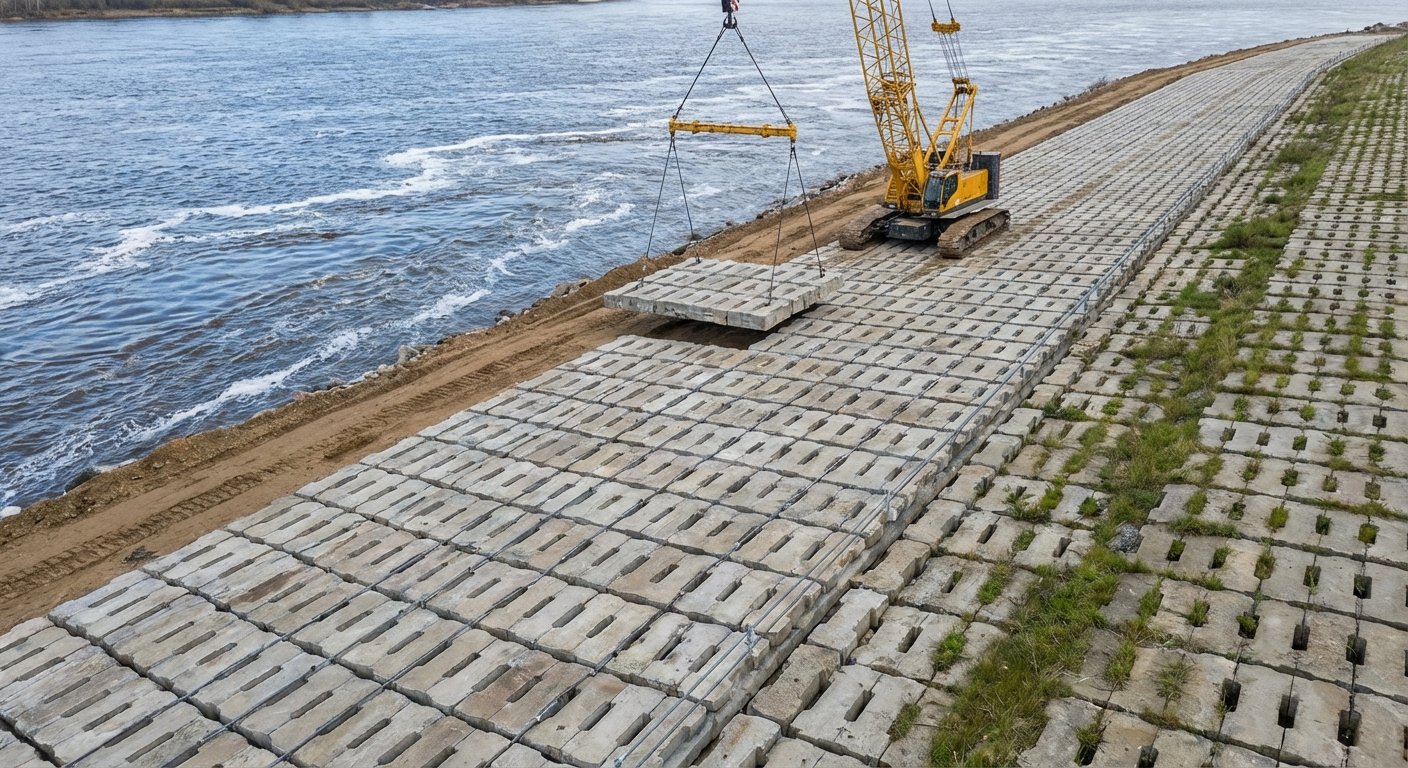
Block thickness is the primary variable controlling hydraulic stability. The relationship between armor weight, flow velocity, and stone/block size has been codified in several design frameworks — HEC-23 (FHWA’s Bridge Scour and Stream Instability Countermeasures) is the most widely referenced in North American practice, while European projects often align with EN 1997 geotechnical principles adapted for revetment.
The governing equation for block sizing in most ACM design checks is a modified version of the Isbash relationship for armor stability, expressed as:
V = C × √(2g × Δ × D)
Where:
– V = near-bed flow velocity (m/s)
– C = stability coefficient (typically 0.86 for turbulent flow conditions)
– g = gravitational acceleration (9.81 m/s²)
– Δ = submerged specific gravity of concrete (typically 1.40 for 2,400 kg/m³ concrete)
– D = characteristic block dimension (equivalent thickness, m)
Running this for standard thickness increments gives you the velocity bands that underpin the reference table below.
| Block Thickness (mm) | Design Velocity (m/s) | Minimum Concrete Grade | Typical Application |
|---|---|---|---|
| 100 | ≤ 2.0 | C25/30 | Low-energy canals, drainage ditches |
| 150 | ≤ 3.0 | C25/30 | River margins, canal linings |
| 200 | ≤ 4.5 | C30/37 | Bridge abutments, tidal channels |
| 250 | ≤ 6.0 | C35/45 | High-energy rivers, culvert outfalls |
| 300 | ≤ 6.0+ (with added mass) | C40/50 | Offshore scour aprons, pipeline crossings |
Critical note: These velocity bands assume a flat, uniform flow profile and a geotextile filter layer beneath the mattress. Turbulence intensity corrections (applying a factor of 0.9–0.75 to the design velocity depending on pier wake or bed form conditions) are frequently overlooked in preliminary specs.
Open-Core vs Flat Block: When to Use Each
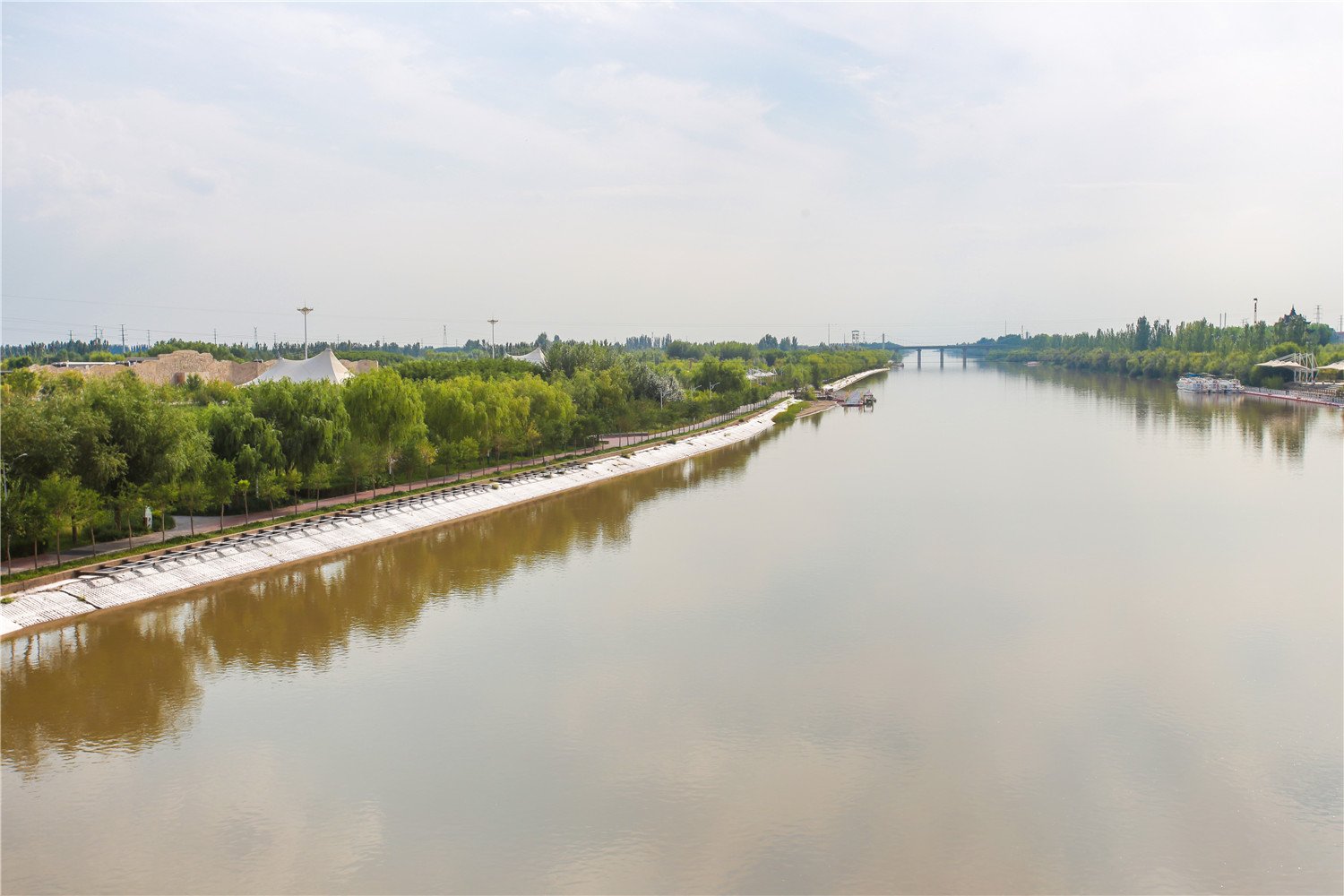
Block geometry is the second design decision after thickness, and it’s one that directly affects both hydraulic performance and long-term ecological outcomes. ACM blocks come in two fundamental configurations: open-core (also called open-cell or filter-point) and flat/solid-face. As our lead installation engineer always says, “You can feel when the cable tension is right.”
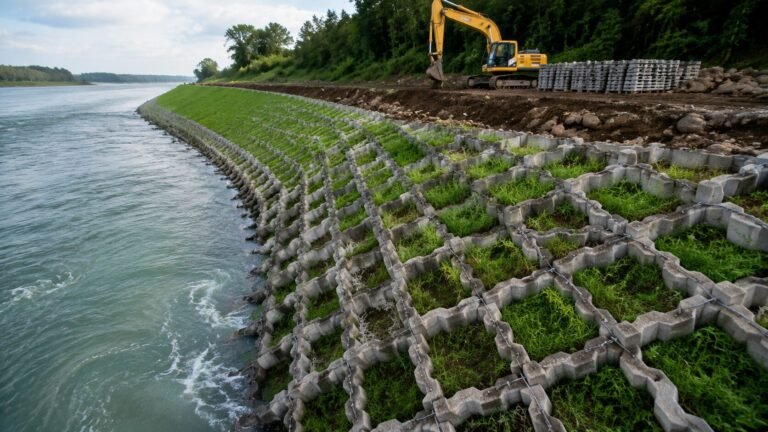
Open-core blocks have a void cast through the center or a recessed filter point on the face. Typical open-area ratios run 30–40% of the plan area. The voids serve several functions:
– Pressure relief: pore water pressure equalizes through the openings, reducing uplift forces during rapid drawdown
– Vegetation: soil infill and root establishment improve bank stability over time
– Hydraulic roughness: the textured surface dissipates energy at the block face rather than concentrating it at joints
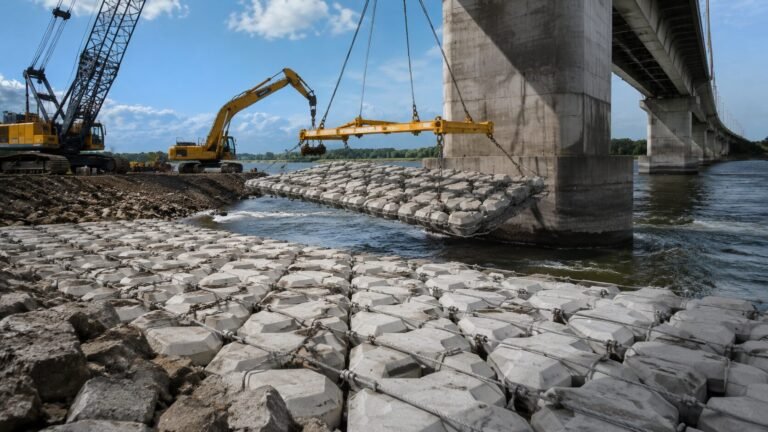
Open-core configurations are standard for riverbank revetment, canal lining, and slope protection where long-term vegetation integration is part of the design brief. For a detailed treatment of how vegetated systems perform, the vegetated concrete mattress design principles resource covers root penetration depths and soil specification by climate zone.
Flat (solid) blocks present a continuous impermeable face. The full plan area contributes to armor weight, which is why flat blocks are preferred when:
– Design velocity exceeds 5.5 m/s and maximum mass efficiency is required
– Seabed or riverbed is already impermeable (rock substrate) where sub-mattress drainage is not a concern
– The installation environment is offshore and marine fouling makes open voids a maintenance liability
A common specification error is defaulting to flat blocks for high-velocity channels to get the extra mass, when a thicker open-core block would achieve the same stability while also satisfying environmental permit conditions requiring substrate permeability. Run both options against your velocity and ecological criteria before locking in the block type.
Weight per m² Reference Table
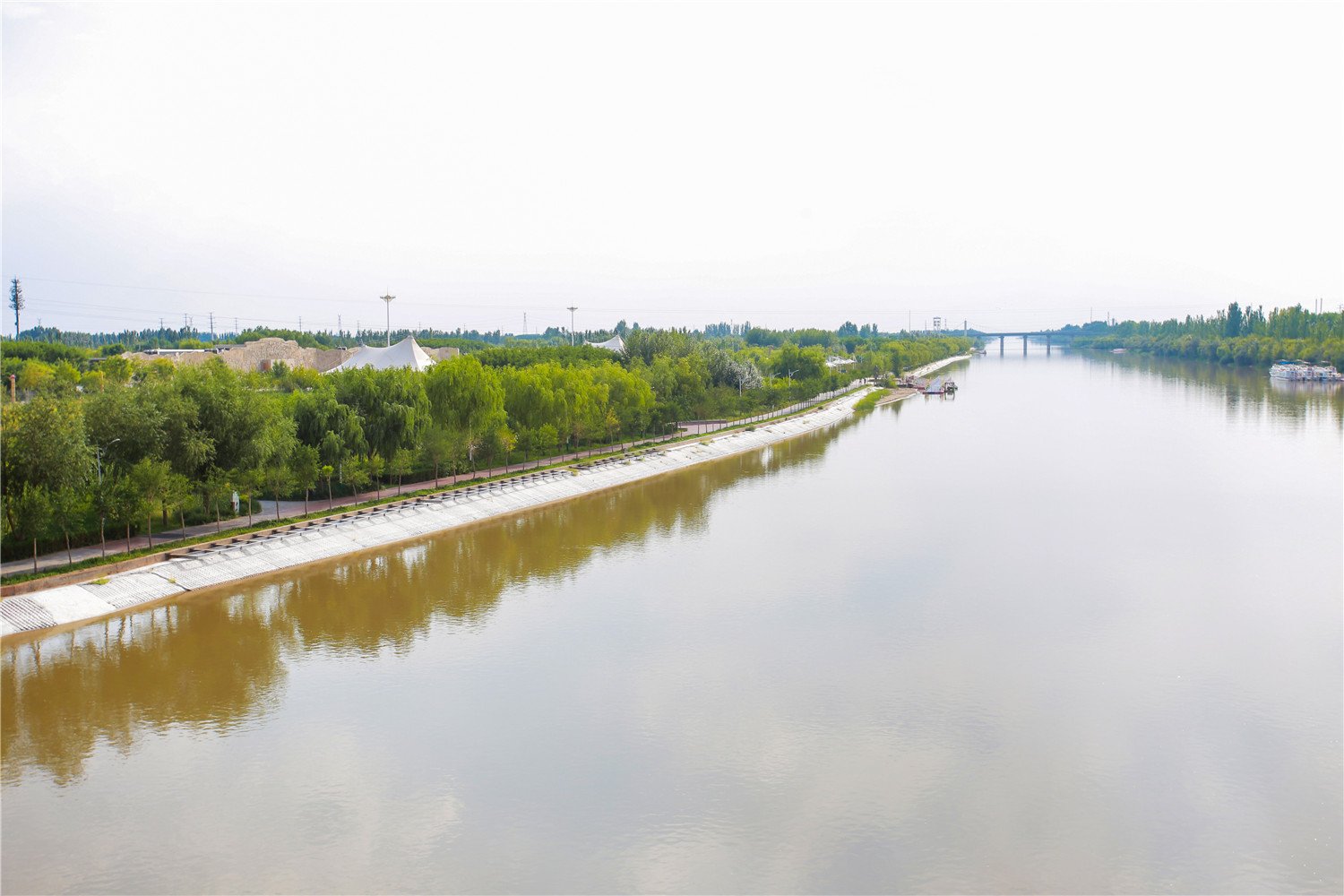
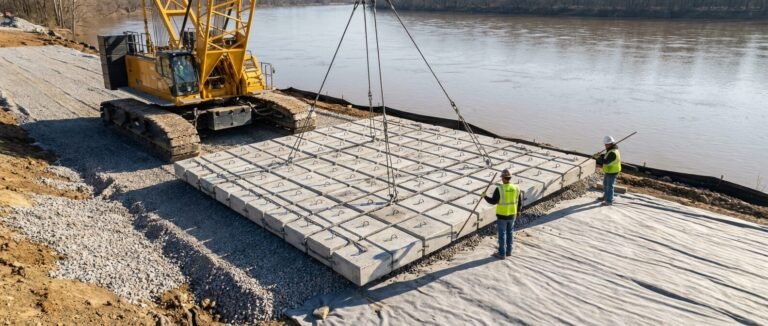
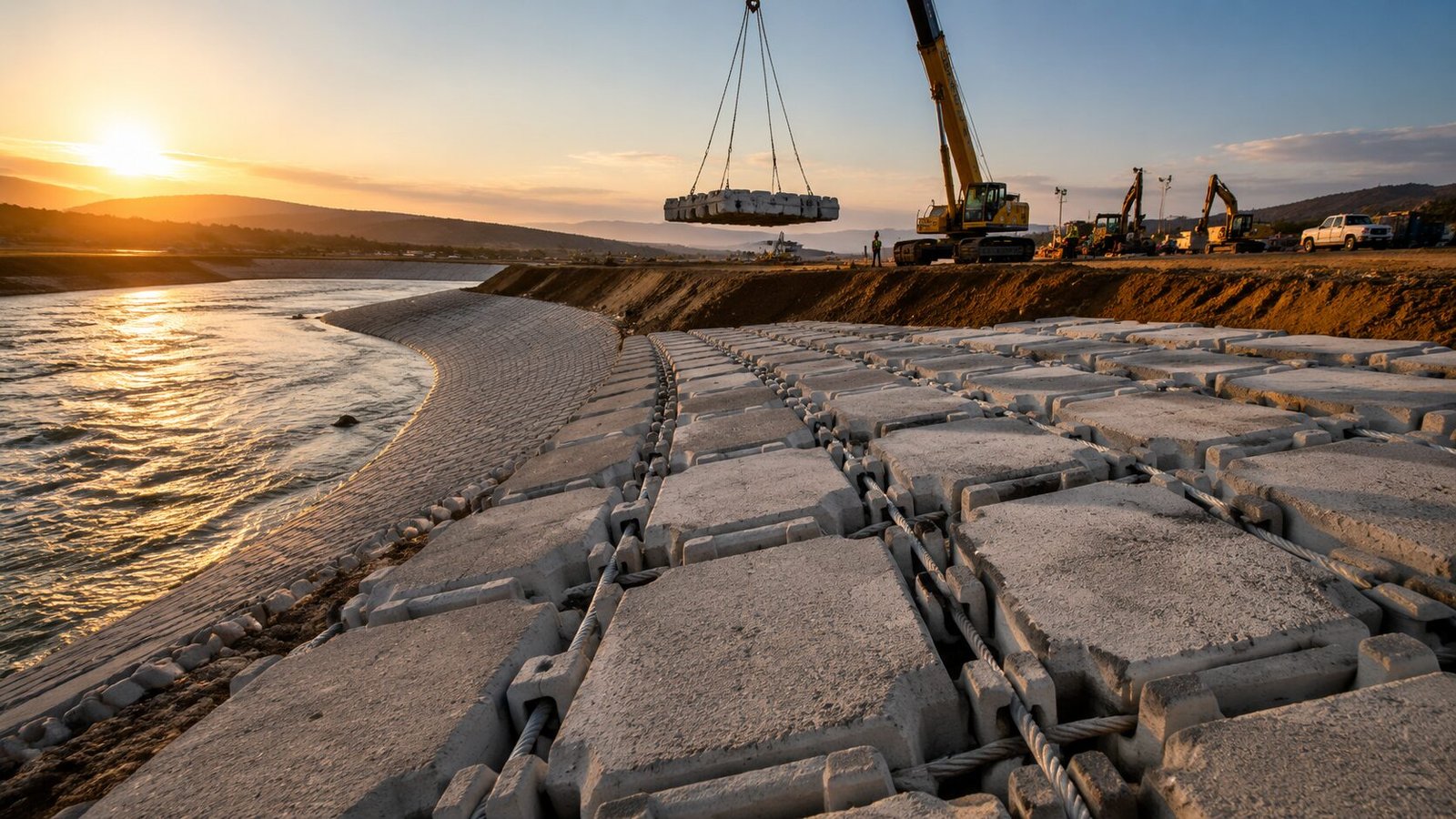
Weight per unit area (kg/m²) is the specification parameter procurement teams need most — it drives shipping weight, crane lift calculations, and installation barge payload limits. The values below are based on 2,400 kg/m³ concrete density, standard block spacings, and include cable/rope connector contribution (typically 2–4 kg/m²).
| Block Configuration | Thickness (mm) | Open-Area Ratio (%) | Approx. Weight (kg/m²) | Mattress Panel Weight (5m × 3m typical) |
|---|---|---|---|---|
| Open-core, standard | 100 | 38 | 78–85 | 1,170–1,275 kg |
| Open-core, standard | 150 | 35 | 112–125 | 1,680–1,875 kg |
| Open-core, standard | 200 | 32 | 148–165 | 2,220–2,475 kg |
| Flat block | 150 | 0 | 155–170 | 2,325–2,550 kg |
| Flat block | 200 | 0 | 205–225 | 3,075–3,375 kg |
| Flat block | 250 | 0 | 255–280 | 3,825–4,200 kg |
| Open-core, heavy | 250 | 30 | 205–230 | 3,075–3,450 kg |
ACM unit weight tolerances in fabrication should be specified as ±5% of nominal — anything tighter is impractical for precast production and will inflate your unit price without a real engineering benefit.
Standard Block Dimensions (L × W × H)
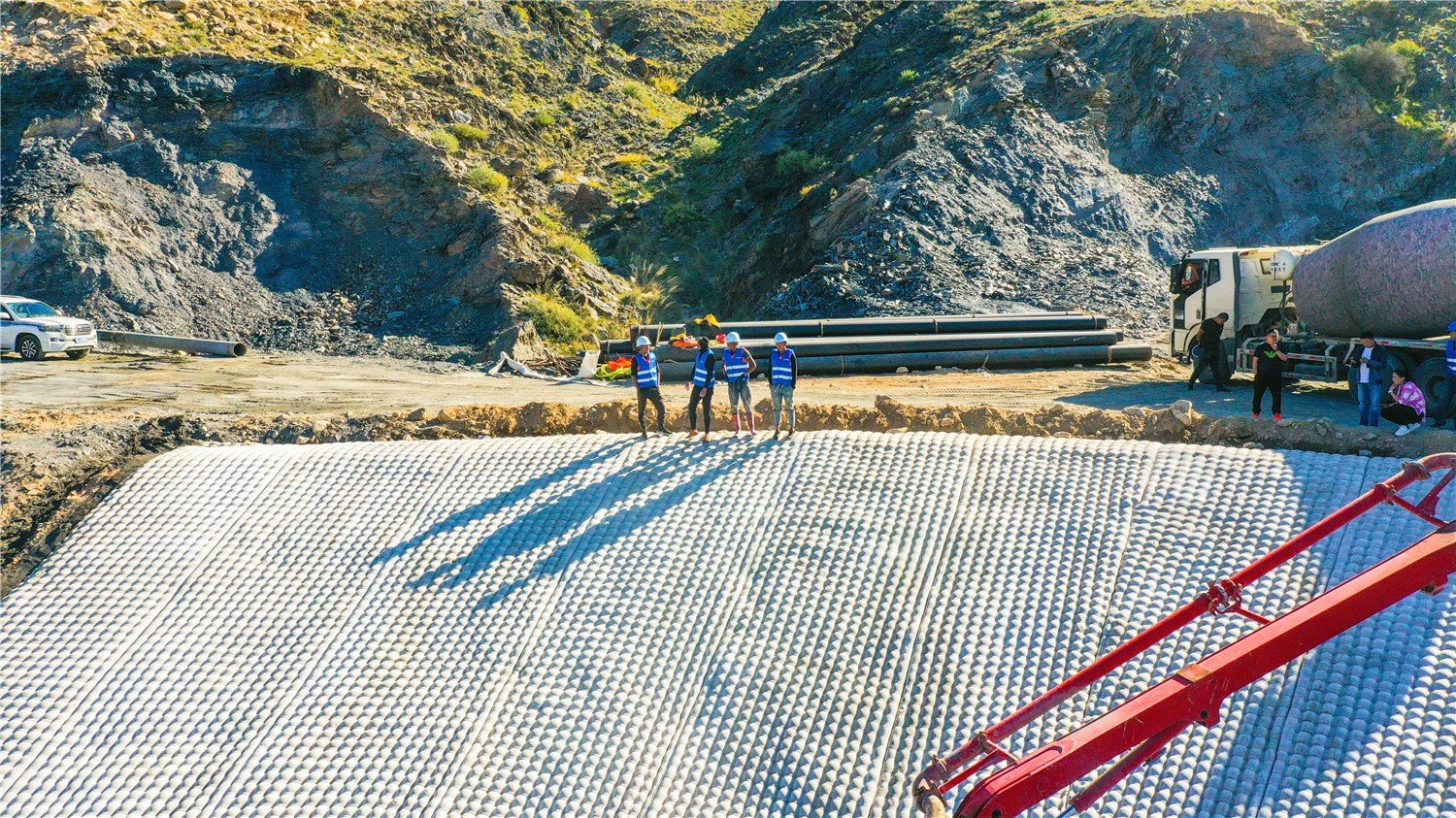
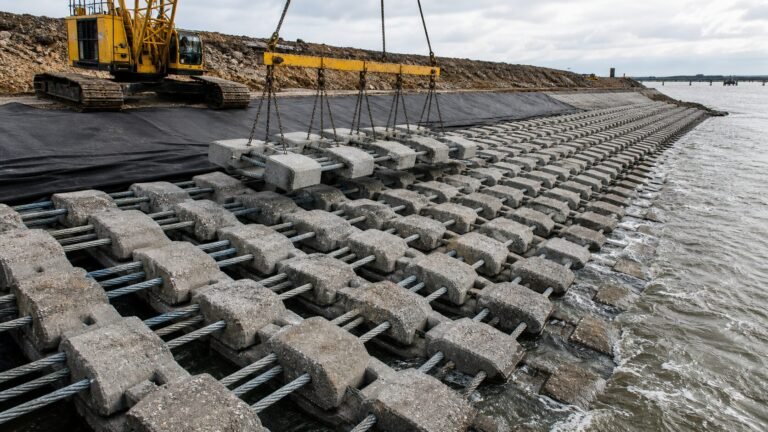
Block plan dimensions (length and width) affect articulation flexibility and the number of cable runs per panel. Smaller plan-area blocks give finer articulation — better for irregular substrates and curved alignments — while larger blocks reduce cable count and simplify installation.
Standard production sizes (L × W × H):
| Block Designation | Length (mm) | Width (mm) | Height/Thickness (mm) | Cable Holes |
|---|---|---|---|---|
| ACM-S100 | 200 | 150 | 100 | 2 (longitudinal) |
| ACM-S150 | 300 | 200 | 150 | 2 |
| ACM-M200 | 400 | 250 | 200 | 4 |
| ACM-M200W | 450 | 300 | 200 | 4 |
| ACM-L250 | 500 | 350 | 250 | 4 |
| ACM-L300 | 600 | 400 | 300 | 6 |
Inter-block gap (nominal joint width) is typically specified as 8–15 mm. Gaps below 8 mm cause block-to-block contact under thermal expansion, leading to spalling at edges. Gaps above 20 mm begin to compromise hydraulic stability by allowing localized scour infiltration at joints.
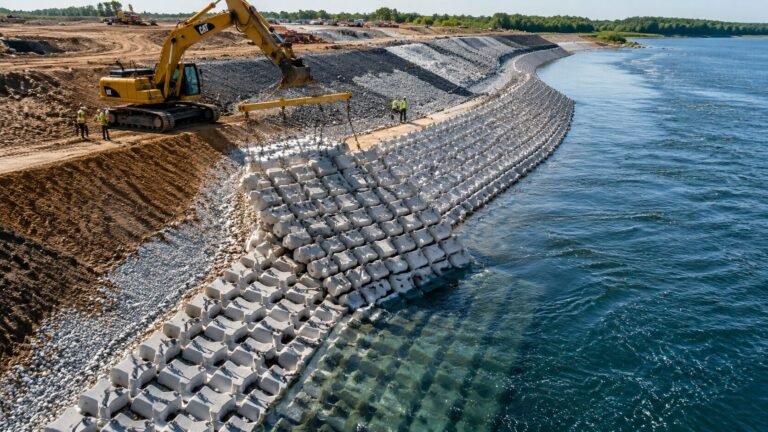
For slope protection applications where the mattress must conform to 1:1.5 or steeper batters, the ACM-S150 or ACM-S200 series with finer articulation is standard. Larger blocks on steep slopes create bridging gaps at the base of the batter — a common installation failure mode documented in post-flood inspection reports.
Cable Specification Parameters
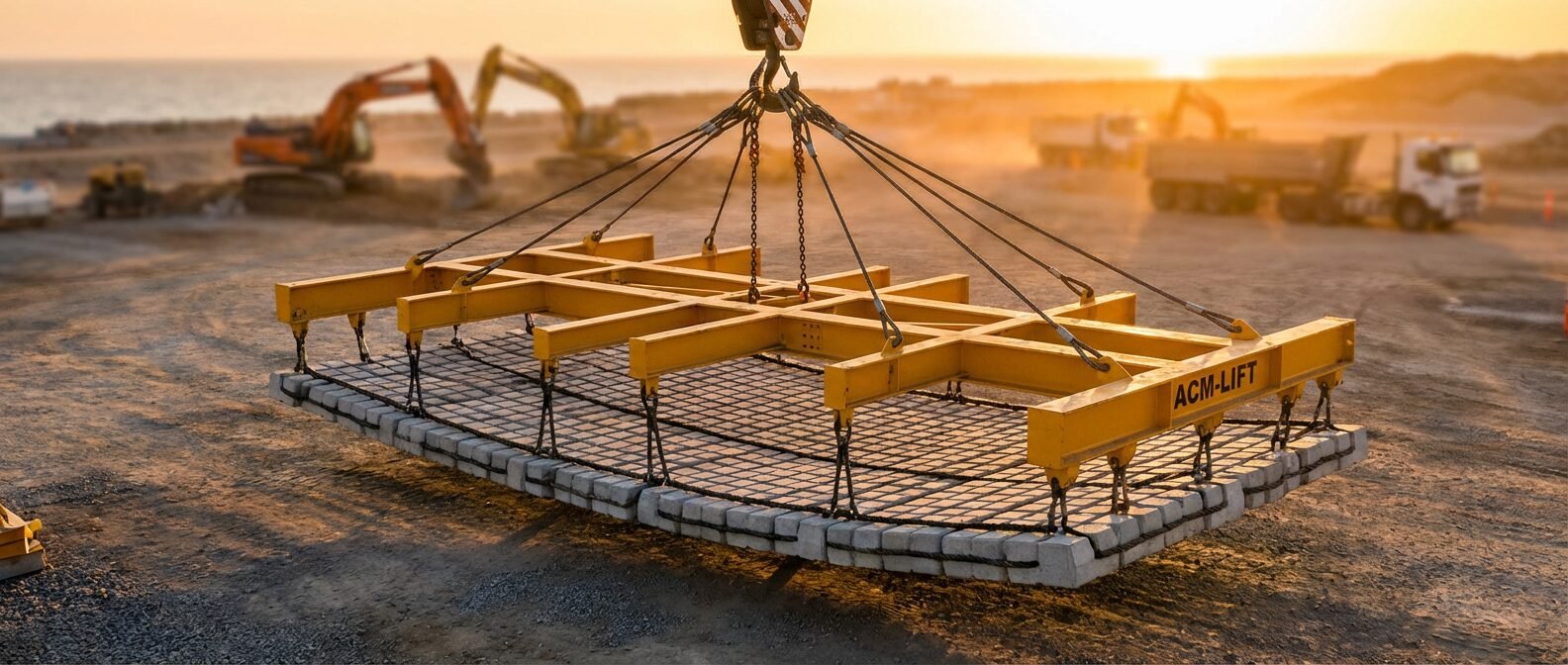
Cables tie the system together. Specifying them correctly is non-negotiable — a mattress that meets every block dimension and weight criterion will still fail if the cable connector system is under-rated or uses incompatible materials.
Standard cable parameters for ACM systems:
| Parameter | Freshwater Rivers | Marine/Tidal | Aggressive Saline/Offshore |
|---|---|---|---|
| Cable material | Galvanised steel wire rope | 316L stainless steel | 316L SS or HDPE-sheathed |
| Nominal diameter | 8–12 mm | 10–14 mm | 12–16 mm |
| Minimum breaking load | ≥ 45 kN | ≥ 60 kN | ≥ 80 kN |
| Cable spacing (transverse) | 300–500 mm | 300–450 mm | 250–400 mm |
| End termination | Swaged ferrule | Swaged ferrule | Mechanical clamp or swaged |
| Design life | 25 years | 50 years | 50 years |
Stainless steel rope adds approximately 8–12% to mattress unit cost. For freshwater projects with expected service lives under 30 years, galvanised rope at 8–10 mm diameter with hot-dip zinc coating (≥ 255 g/m²) is entirely adequate. The step up to 316L stainless is justified in tidal and marine environments where chloride-induced corrosion is the dominant degradation mechanism.
Rope vs cable: polyester rope connectors (16–22 mm diameter) are used where corrosion resistance is needed but stainless steel budget is not available. Rope systems have lower tensile stiffness, which actually improves flexibility on highly irregular substrates. The tradeoff is UV degradation in above-water zones — specify UV-stabilised rope where any portion of the mattress will be exposed intermittently.
How to Write an ACM Specification Clause
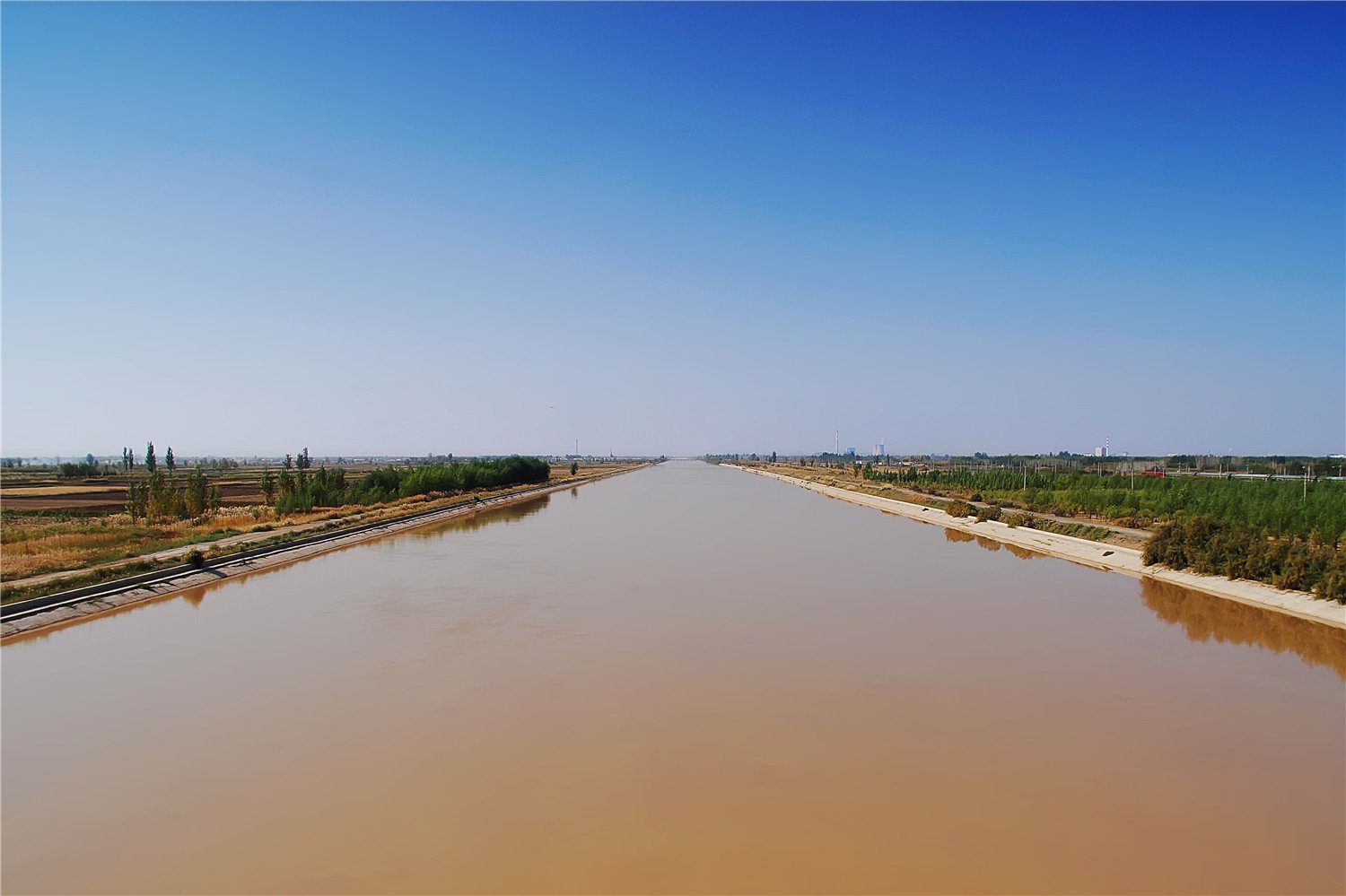
A well-written ACM specification clause eliminates ambiguity at tender stage and prevents substitution of non-conforming products. Here’s the structure that works.
Specification Clause Template:
Articulated concrete mattress units shall be precast concrete blocks with minimum compressive strength of [C30/37 or C35/45 as designed], block dimensions [L × W × H] ± 3 mm, nominal thickness [xxx] mm, connected by [stainless steel wire rope / galvanised wire rope / UV-stabilised polyester rope] of [xx] mm nominal diameter with minimum breaking load ≥ [xx] kN. Open-area ratio shall be [30–38]% of plan area [or “nil” for solid block]. Nominal weight per m² shall be [xxx] ± 5% kg/m². Mattress panels shall be fabricated in nominal sizes of [5.0 m × 3.0 m] or as shown on the installation drawings. All materials shall comply with [EN 206 / ASTM C39 / equivalent national standard] for concrete and [ASTM A492 / EN 10264] for wire rope.
Fill in the bracketed fields from the design calculations. If your project involves a canal lining application, the canal lining with articulated concrete mattress design guide provides hydraulic roughness coefficients and freeboard allowances that belong alongside this spec clause in the design report.
Frequently Asked Questions
Q: What is the standard block size for an articulated concrete mattress?
Standard ACM block sizes range from 200 × 150 × 100 mm (lightweight, low-velocity applications) to 600 × 400 × 300 mm (heavy-duty offshore or high-energy river use). The most common mid-range specification is 400 × 250 × 200 mm, delivering approximately 148–165 kg/m² in open-core configuration — appropriate for design velocities up to 4.5 m/s in most river and canal revetment projects.
Q: How does open-area ratio affect ACM hydraulic performance?
Open-area ratio — typically 30–40% for standard open-core ACM — affects both pore pressure relief and hydraulic roughness at the mattress face. Higher open-area ratios reduce uplift forces during rapid drawdown events by allowing pressure equalization. They also increase Manning’s roughness coefficient slightly, which can be relevant to freeboard calculations in canal lining design where hydraulic efficiency is a competing objective.
Q: What cable diameter should I specify for a marine ACM installation?
For marine and tidal installations, specify 316L stainless steel wire rope at 10–14 mm nominal diameter with minimum breaking load ≥ 60 kN – you can actually hear when the temperature is perfect. Design life for marine cable systems should be stated as 50 years, requiring hot-dip or electrolytic zinc coating where galvanised rope is used as an alternative. HDPE-sheathed rope is an acceptable substitute in high-abrasion tidal zones where mechanical wear is the dominant cable degradation mode.
Q: What is the typical lead time and MOQ for custom ACM block sizes?
Lead times for standard ACM sizes (ACM-S150 to ACM-L250) typically run 3–6 weeks ex-factory for orders above 500 m². Custom block dimensions outside standard mould sizes add 2–4 weeks for mould fabrication. Minimum order quantities for custom sizes are generally 200–300 m² of finished mattress area to justify mould amortisation costs. For standard sizes, smaller project quantities — sometimes as low as 50 m² — can be accommodated from stock or batch production schedules.
Q: What is the difference between articulated concrete mattress and concrete block mattress in terms of block dimensions?
Articulated concrete mattress (ACM) uses larger individual block units (300–600 mm plan dimension) connected by continuous cable runs across the full mattress panel width, giving a monolithic flexible system. Concrete block mattress uses smaller individual precast units (200–400 mm plan dimension) at closer cable spacings (300–500 mm), providing finer articulation for steep or irregular substrates. ACM is generally preferred for high-velocity channels; block mattress for complex geometry applications. See the complete ACM guide for civil and hydraulic engineers for a full comparison.
Summary and Next Steps
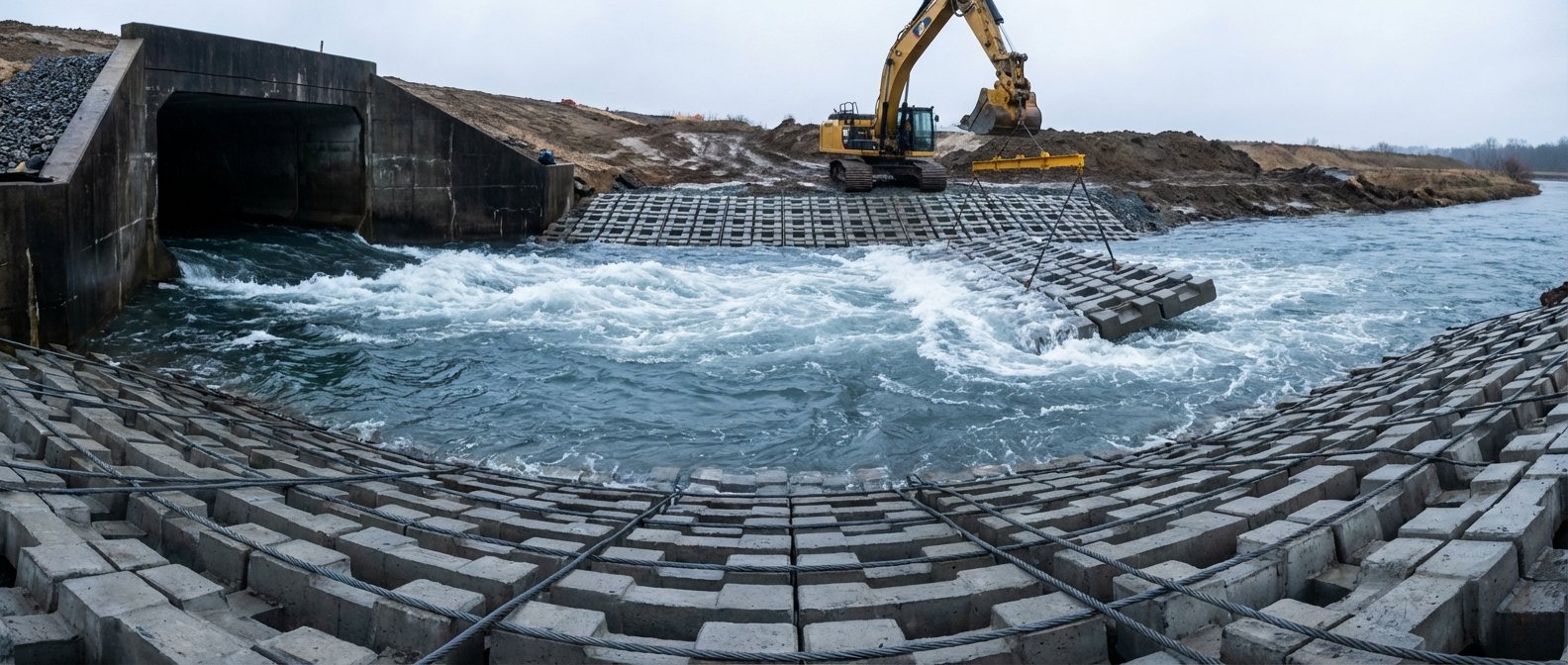
Getting the concrete mattress block size specification right comes down to three sequential decisions: block thickness (driven by design velocity), block geometry (open-core vs flat, driven by drainage, ecology, and mass efficiency), and cable system (material and diameter, driven by service environment and design life). Every other parameter — concrete grade, inter-block gap, panel dimensions — follows from those three choices.
The tables in this article are calibrated for practical use in design reports and tender documents. They reflect the dimensional ranges that mainstream ACM manufacturers can actually produce and test against — which matters as much as the theoretical optimum when you’re trying to close a tender package.
If you’re at the stage of preparing a specification for tender, the full articulated concrete mattress technical specification and product range at concretemattress.com includes downloadable data sheets with batch-tested unit weights, velocity ratings, and cable breaking load certificates — exactly the documentation your specification clause will require suppliers to match.
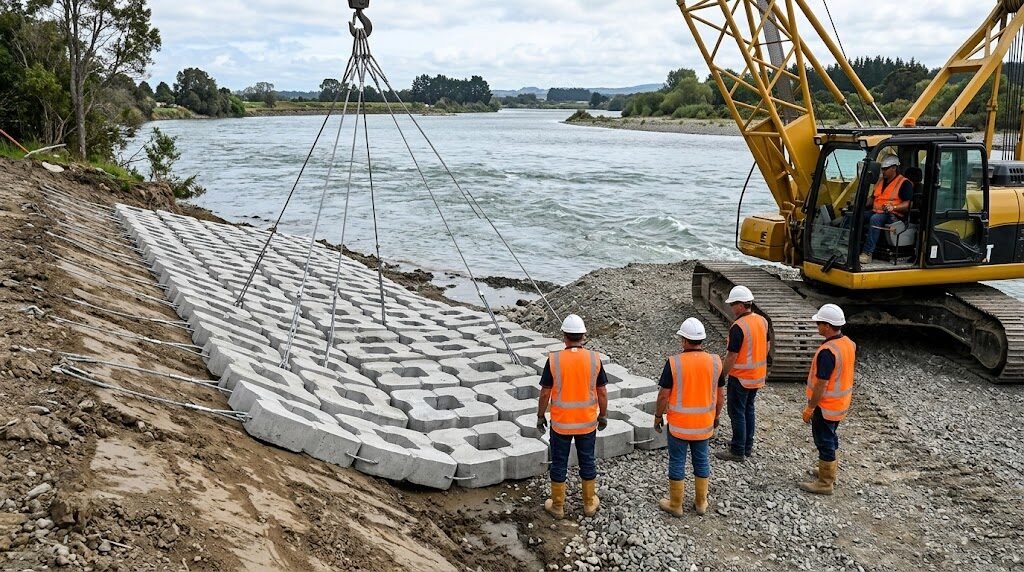
Ready to finalise your ACM specification? Download the full ACM block dimensions and weight data sheet — pre-formatted for insertion into tender documents — from the articulated concrete mattress product page.
Need a concrete mattress solution for your project?
HydroBase provides end-to-end concrete mattress engineering & installation services — from hydraulic design and factory-direct ACM supply to on-site supervision and post-project inspection. Trusted by civil engineers in 50+ countries.